
What Is Kitting in a Warehouse? Process & Benefits
Kitting is the step that turns a bill of materials into one sellable unit. Someone pulls the components, builds them into a fixed set, checks the set against a specification, and books the result as a single SKU. From then on the warehouse picks one item instead of five.
That moves work, inventory and risk. A kit built wrong is wrong for every order in the batch, not just one. A component committed to a kit is unavailable to the orders that sell it loose.
Three things sink most kitting projects, and none of them is bench speed: a bill of materials with no version number, no agreed rule for what happens when a component runs short, and a kit bench forty feet from the stock it consumes.
What kitting actually is
A kit is a set of components sold and shipped as one unit — a starter pack, a gift box, a device with its charger and case. Kitting is the physical and transactional work of building that set inside the warehouse. Three things happen at once:
- The component SKUs are consumed.
- A new kit SKU appears with its own quantity on hand.
- Labour and packaging are recorded against a work order.
Do the first two without the third and you have kits nobody can cost. Do the third without the first two and the system keeps selling components that are already sealed inside finished kits — the phantom stock that surfaces as a short pick three weeks later.
Kitting is not pick-and-pack. Pick-and-pack ships what the order asked for; kitting builds something that did not exist in inventory, then stores it. It behaves like light manufacturing, which is why it needs a station and a check rather than a packing table.
Kitting, bundling and assembly are different jobs
The three words get used interchangeably in meetings, and then someone prices the wrong one.
Bundling is a sales decision — two products sold together at one price. Nothing physical changes.
Assembly is the physical join: pressing a handle into a housing, seating a connector. It needs a tool and a fit check.
Kitting is putting finished items into one container with one label. The hard part is keeping the component count and the kit count in agreement, not the hand movement.
A kit that contains an assembled sub-part is both, and someone has to price it that way.
The three records that make a kit real
You cannot build kits reliably from a part-number spreadsheet. Three records have to exist first, and each fails differently.
The bill of materials. Not a list of what is in the box — a versioned specification: component SKU, quantity per kit, and any condition (insert language, regional plug, expiry-sensitive lot). Version control matters more than completeness. When marketing changes the welcome card, you need to know which kits on the shelf were built to which version.
The work order. How many kits, which BOM version, which station, which components are reserved. Without one, stock is pulled against nothing and the count drifts.
The kit SKU. A kit built from existing items is a new trade item. GS1's identification rules treat it that way: if the combination is priced, ordered and invoiced as one thing, it gets its own identifier instead of borrowing a component's. Carton labels, barcodes and case packs are checked against that identifier.
The common shortcut is to reuse the main product's SKU with a suffix. It holds until the same product ships both loose and kitted and the suffix stops matching what the marketplace expects.
Pre-kit or kit-to-order: size a buffer, don't guess
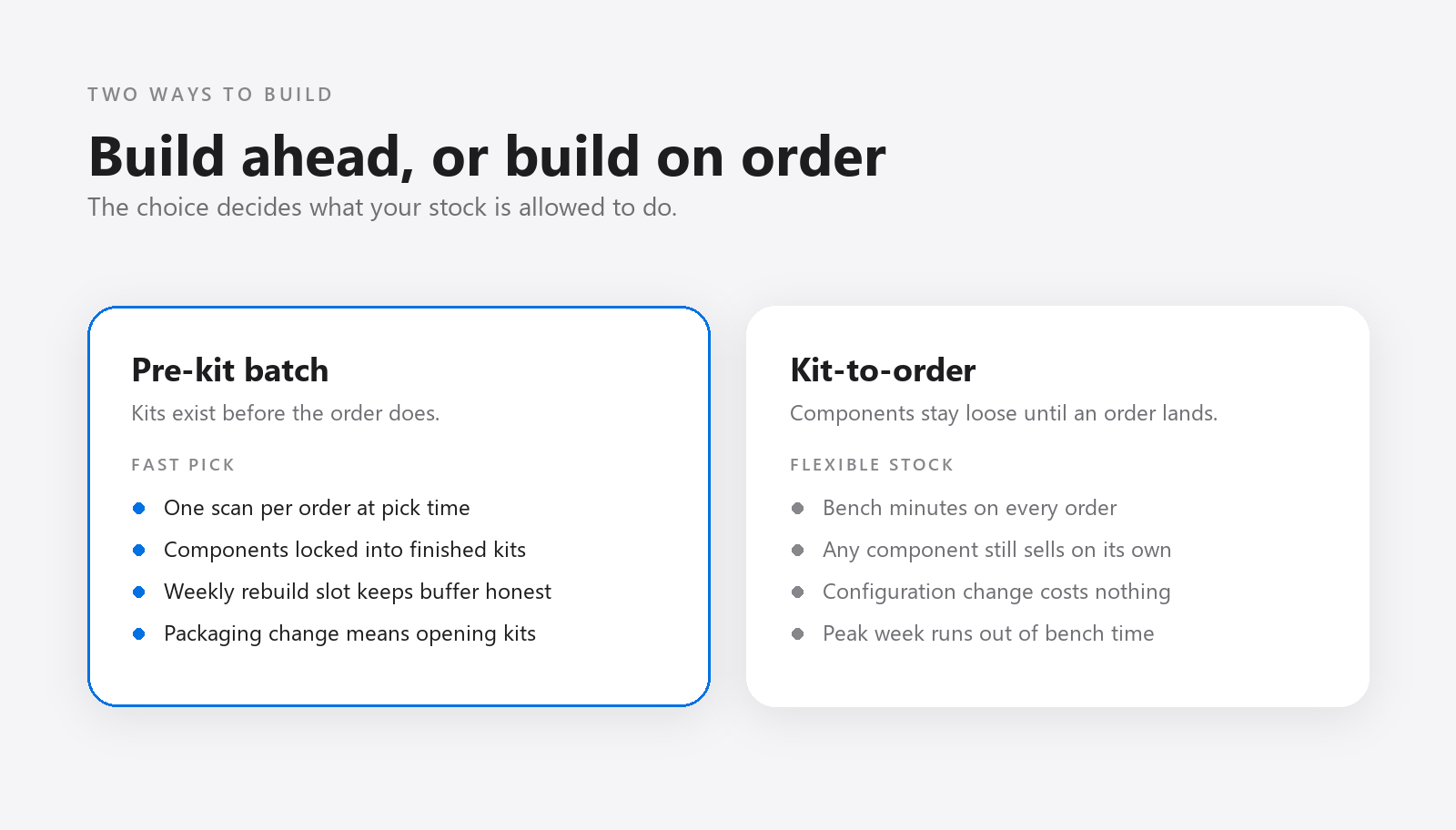
Pre-kitting builds a batch ahead of demand and stores finished kits. Picking becomes one scan. The cost is committed inventory: every component inside a finished kit is unavailable to any other order until the kit sells or is taken apart.
Kit-to-order keeps components loose and assembles on demand. Nothing is committed, but every order pays the assembly minutes — and peak week is exactly when those minutes are gone.
| Method | Works when | Ties up | Change cost |
|---|---|---|---|
| Pre-kit batch | Demand predictable, volume steady | Components, converted into kits | High — changes mean opening kits |
| Kit-to-order | Many configurations, uncertain demand | Bench time in the order window | Low — swap a part and carry on |
| Hybrid: buffer plus build-to-order | Top sellers plus a long tail | A small finished-goods buffer | Medium — two processes to run |
The hybrid is where most established operations end up. A practical starting buffer is two to three weeks of forecast for the fastest-moving kits, rebuilt on a fixed weekly slot, with everything else built to order. Long enough to absorb a normal spike, short enough that a packaging change does not leave you with a pallet of obsolete boxes.
The classic failure: a brand pre-kits its whole holiday range in September to lock a packaging price, then changes the insert copy in October. The saving on boxes is smaller than the cost of opening and rebuilding — and rebuilt units cannot be sold as new.
Put the bench where the walking is
The kitting station is a small warehouse with one operator in it. Pick-module rules apply, only the distances shrink and the mistakes get more expensive.
Golden zone first. Components used in every kit sit between hip and shoulder height, directly in front. Slow movers go high or low.
Separate look-alike parts. Two variants differing by a colour band or a two-millimetre connector should never sit side by side. Physical distance is the cheapest error-proofing available.
Replenish from behind or above. Restocking should never make the builder step out of the work envelope or reach across a half-built kit. A bench replenished from the front stops every twenty minutes.
Give empty containers a home. Marked positions for empty totes in and full totes out. Without them, finished kits pile on the floor and get knocked over, which is how forty becomes thirty-eight with two unexplained units.
Shortage is the bottleneck, not speed
Ask what limits kitting output and the honest answer is component availability, not bench speed. One missing insert stops a batch, not a kit.
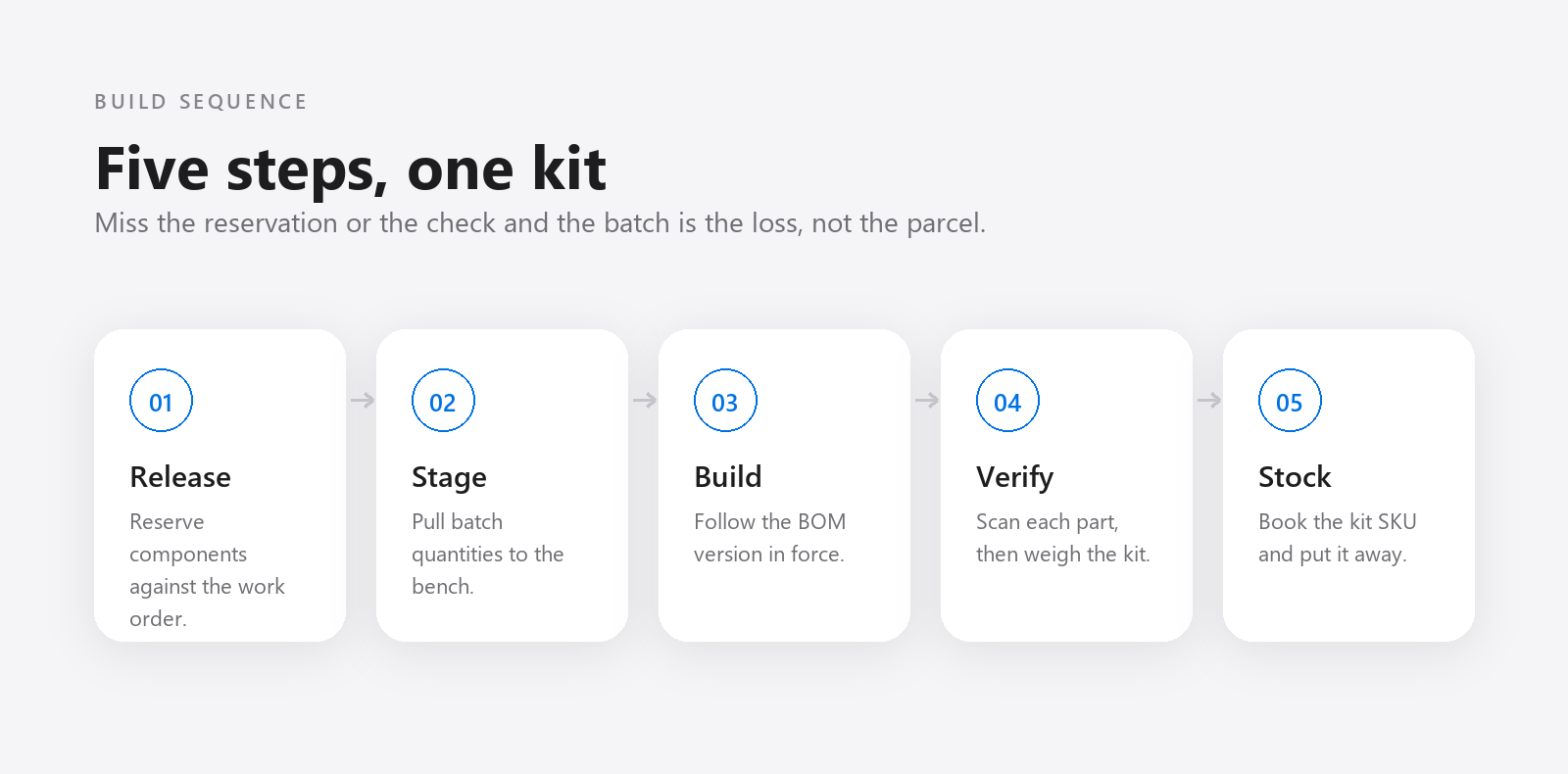
Reserve on release, not on pick. When a work order releases, components should be allocated in the system. Otherwise two orders released the same morning chase the same last carton, and the second one finds out halfway through the build.
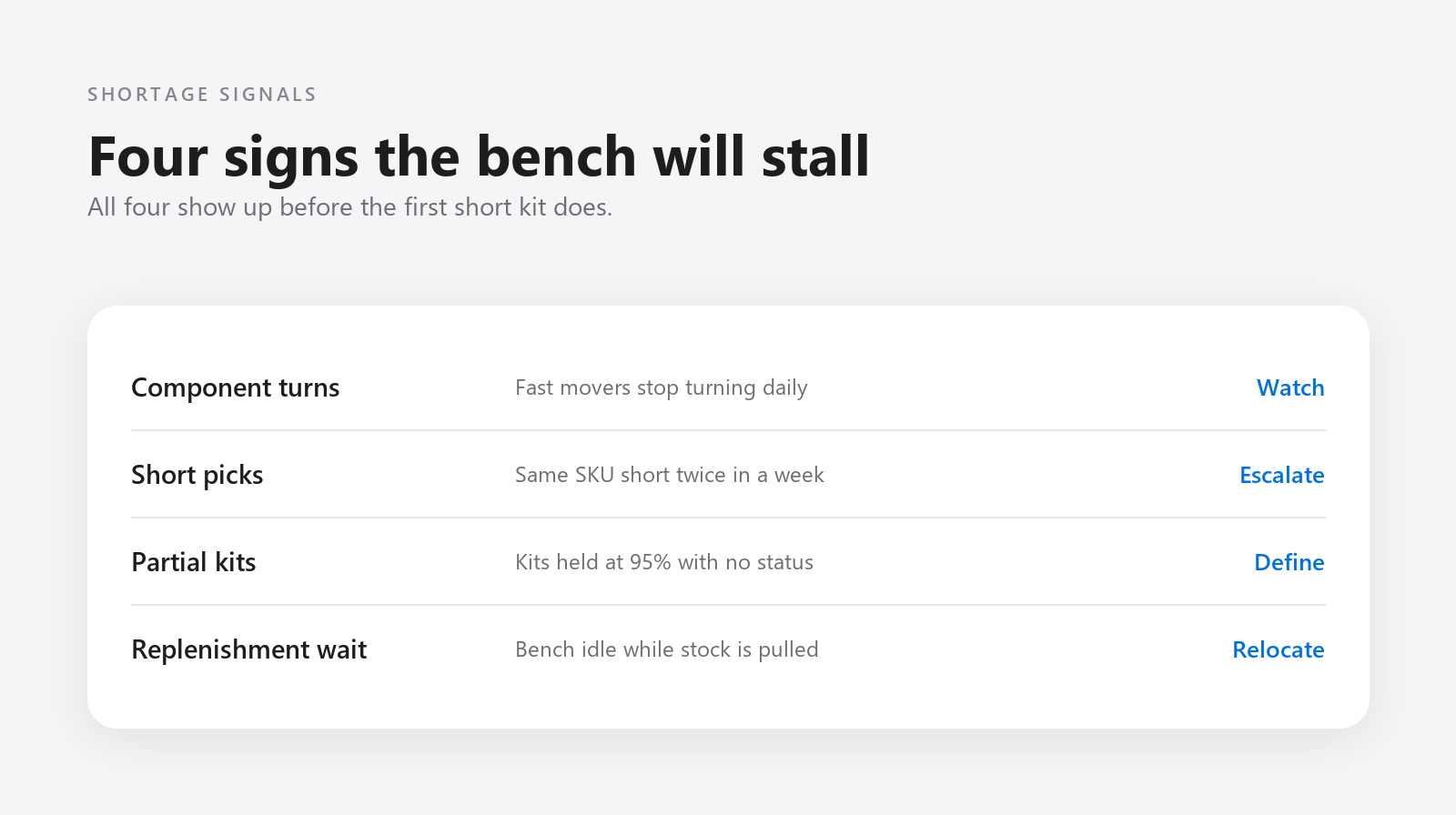
Write the short-kit rule down. When a component runs out mid-batch the choices are: hold partial kits, build complete kits and set the remainder aside, or substitute. Pick one, put it in the work instruction, and give the system a Each Order Status for a partially built kit. The worst outcome is a bench of kits that are 95% complete and a system that calls them finished.
Watch component turns, not kit turns. Fast-moving stock near the bench should turn several times a day. Anything that has not moved in a week is occupying space a live component needs, and treating that as housekeeping rather than capacity is how a bench loses a third of its reachable stock to dead inventory.
Verify at the end of the bench
A kit error is not one bad parcel. It is every parcel in the batch, plus the returns, plus the review.
Scan every component. The scan is not there to prove the builder was careful. It is there so the system refuses to advance an incomplete kit, which makes the error impossible rather than unlikely.
Weigh the finished kit. Load the target weight for each configuration and weigh every unit off the bench. A tolerance of a few grams catches a missing insert card or a double-packed accessory. It does not catch two parts of identical weight, which is why the scan comes first.
Count the batch, not the unit. At the end of a run, kit count times BOM quantity must equal components consumed. A variance means something left the bench unrecorded, usually a damaged kit that was quietly rebuilt.
Operations that publish numbers describe kit accuracy in the high nineties, with the best in the 99.9% range. Treat those as targets to verify, not specifications to assume.
What a kit costs
Build the number from four lines, then compare quotes on the total.
| Cost line | What drives it | How it is quoted |
|---|---|---|
| Component handling | Component count, not kit count | Per component pulled, or per kit |
| Assembly labour | Steps, dexterity, packaging complexity | Per kit, per hour, or per placement |
| Materials | Box, insert, tissue, seal, label | At cost, or cost plus margin |
| Setup and version change | New BOM, changeover, photo approval | One-time fee per configuration |
Do the labour arithmetic yourself. A builder producing 90 three-component kits an hour at a fully loaded $18 an hour is producing labour at $0.20 a kit. If the quote is $1.40 for the same kit, then $1.20 is materials, setup amortisation, quality time and margin — which may be fair, but you should see which bucket it sits in.
Volume moves this more than anything else. Piece-rate packing in high-throughput Asian warehouses is routinely described at around RMB 0.10 a parcel, roughly a cent and a half, but that is a single-item pack with no BOM, no verification and no kit SKU. It is a useful floor for pure hand motion and a useless benchmark for a kitted build.
Where kitting stops paying
It pays when the same combination sells repeatedly, components are stable, and the pick saving exceeds the build cost. Four conditions reverse that.
Low volume per configuration. At forty units a month, setup, version control and shelf space cost more than the picks saved.
Components that change often. Every change is a rebuild decision. A promotional kit that changes monthly is usually better built to order, even at a higher unit cost.
Loose sales of the same component, with volatile demand. Pre-kitting takes stock hostage. When the loose item is what sells, you open kits to get it back — and opened kits are used goods.
Shelf life. Batteries, cosmetics, food. A pre-built kit inherits the shortest expiry inside it, so the buffer is measured in weeks, not months.
The short version
Kitting converts components into one SKU so fulfilment does one pick instead of five. The build is the easy part. The BOM version, the reservation rule, the shortage policy and the verification step decide whether it works — four documents nobody enjoys writing.
Start with one kit family, build to order for a month, and record actual minutes per kit and component variance before committing to a pre-kit batch. If the minutes come in above the quote, the quote was for a simpler kit than the one you have.
Moving assembly out of house? Send the component count per kit, monthly kit volume and number of configurations, and we will come back with a build plan and a per-kit cost before pricing.
References (Neutral Third-Party Sources)
- GS1 — Global Trade Item Number (GTIN): how a trade item priced, ordered and invoiced as one unit is identified, including combinations built from existing items. https://www.gs1.org/standards/id-keys/gtin
- CSCMP — Supply Chain Management Definitions and Glossary: the professional definition of logistics management, which includes packaging and assembly. https://cscmp.org/CSCMP/Educate/SCM_Definitions_and_Glossary_of_Terms.aspx
- WERC — DC Measures: the metric set used to benchmark pick accuracy, dock-to-stock cycle time and backorders. https://www.werc.org/page/ASSESS-DC_Measures
- OSHA — Warehousing: recognised hazards in warehouse work, including ergonomics and manual handling at workstations. https://www.osha.gov/warehousing
- ISO — ISO 9001:2015 Quality management systems — Requirements: the requirement for documented information and controlled work instructions behind a repeatable build. https://www.iso.org/standard/62085.html