
Influencer Gifting at Scale: How to Send PR Boxes That Get Featured
A seeding programme is an address table with a shipping label attached. The box is the visible part and the cheapest part. What decides whether 200 parcels turn into 12 posts or 60 is how addresses were collected, what the customs form says, and whether anyone knows the parcel arrived.
Two numbers frame the work. A well-run warehouse holds its mis-ship rate under 0.3%, and a tightly systematised one can publish 0.05%. A creator list assembled from DMs and screenshots rarely gets near that, because nobody validated the rows. The gap is not effort. It is structure.
Start with the row, not the box
One creator, one row. That row has to answer six questions before anything is printed: who signs for it, where it goes, which phone the carrier can call, which variant is sent, which card goes inside, and who put this person on the list.
The address field is where most of the money is lost, and the loss is small and repetitive. Apt 4B and #4B are not the same string to a scanner. A building number without a unit number often lands in a lobby cupboard, because the front desk will only accept parcels with a unit on the label. A management company is different again: it will take a pallet, and it will not appreciate forty separate couriers arriving on a Tuesday.
Good warehouse software catches this before a label exists. The order enters, the system checks inventory and the address, and a row without a street number or with a state that does not match the ZIP stops there and goes to a human. That is the behaviour you want. Let the system stop you before the label prints, not the courier at the door. The first costs nothing. The second costs the product, the freight and the relationship.
Collect addresses through a form, not a DM thread
A form does three jobs at once: it captures the fields you need, it records consent, and it keeps the data in one place instead of eleven inboxes.
| Field | Why it matters | What breaks without it |
|---|---|---|
| Full legal name | Building desks and agencies release parcels against a list | Parcel refused at reception |
| Street and unit number | Scanners and couriers route by unit, not by building | Delivery scan never generated |
| Phone number | Customs and last-mile calls for international parcels | Parcel held while nobody answers |
| Size or shade | Sent to match the creator's content, not your leftover stock | Wrong variant, no post |
| Address type | Decides signature, appointment and handling fees | Second attempt, billed again |
| Consent record and date | Proves opt-in rather than an unsolicited parcel | Complaint you cannot answer |
Put one plain sentence above the submit button: this is a gift, there is no obligation to post. It lowers the recipient's guard and it lowers your legal exposure, because the FTC treats a free product as a material connection whether or not you asked for coverage. If a creator does post, "gifted" on its own is too vague; the disclosure has to name the brand.
Offer an alternative address too. A PO box, a management office, a workplace. Fewer creators than you think want their home address in a brand's spreadsheet, particularly the ones with enough reach to attract attention.
One parcel each, or one delivery per agency
Direct despatch is the default and usually the right answer. Every parcel has its own label, its own scan and its own failure mode, so a bad address costs one unit rather than a consignment.
Consolidation is cheaper per unit and harder to run. You ship a carton to a management company or a local hub, and someone there breaks it down and hands the boxes out. That only works if there is a named person on the other side who has agreed to do it.
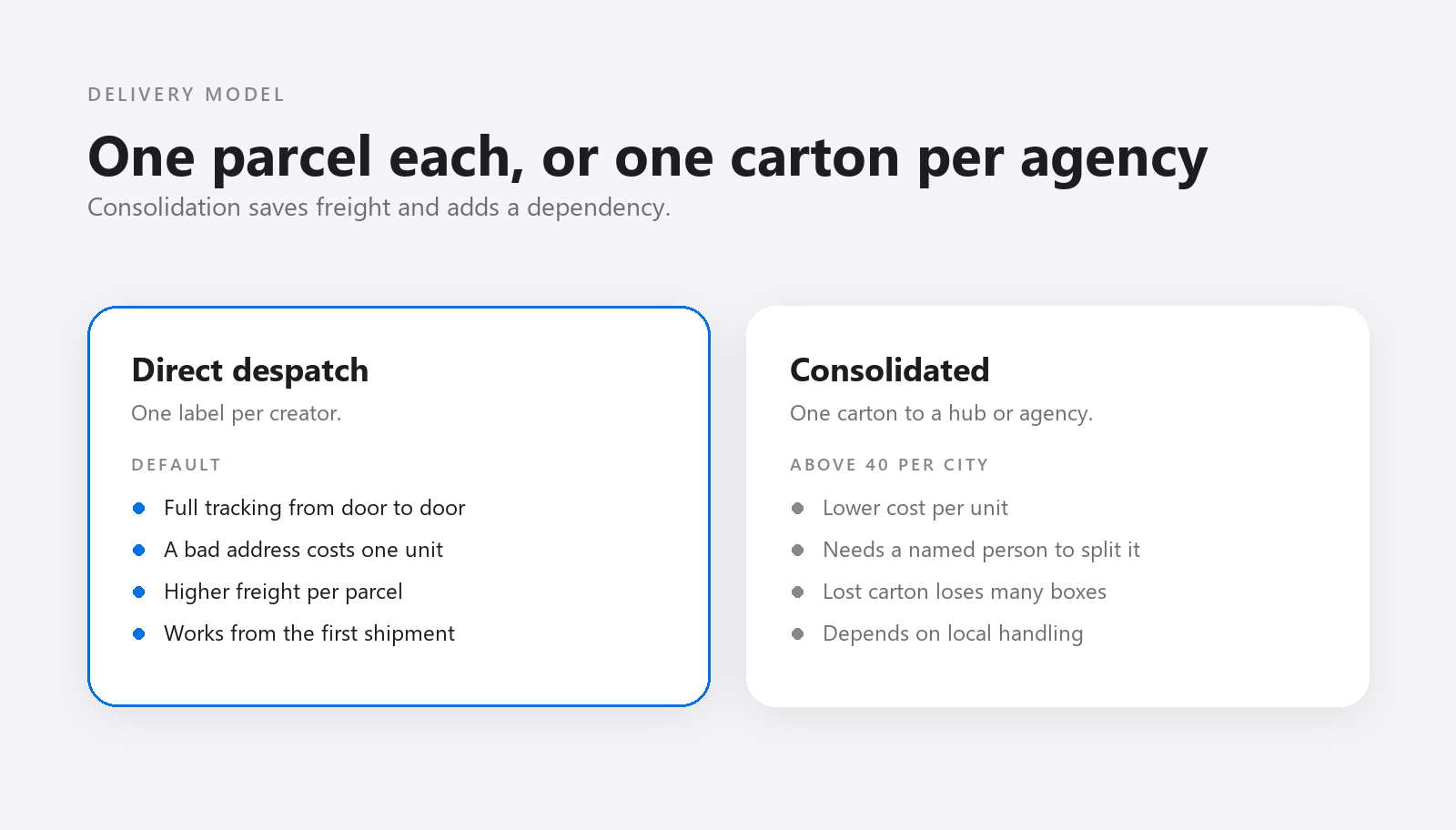
A workable threshold: below roughly forty parcels into one metro area, direct wins on traceability, and traceability is what you are buying. Above that, the freight saving justifies the phone calls. This is not an industry standard, and the real number depends on the country, the carton size and whether the agency wants the work.
Ask three timing questions before you promise a send date: the daily cut-off, inbound to shelf, and pick to carrier handover. A 22:00 cut-off with same-day despatch, 48 hours inbound and 24 hours outbound is typical. Those numbers, not the courier's advertised transit time, decide whether boxes leave on the day you promised.
Declare the sample as a sample
Customs does not read your intent. It reads one line on the form.
"Gifts" is not an acceptable description. USPS asks for a specific description of every item, with enough detail to identify what it is, what it is made of and what it is for: one scented candle, a cotton tote bag, a stainless steel bottle. A vague line gets the parcel rejected, returned or destroyed, and the return leg is billed to you.
Declare at cost, not at retail. Inflate it and the recipient may face a duty bill on a present. Deflate it and an insurance claim pays out at the number you wrote.
Then check what is inside. Lithium batteries are hazardous material and some configurations can only travel by ground. Perfume contains alcohol and cannot fly. A check on the bill of materials is cheaper than a parcel held at a border while an officer asks what is in the box.
If a freight forwarder moves the bulk stock, put liability in writing before the container leaves. Port storage accrues daily, and when a forwarder's cash runs out the cargo owner is the one asked to pay to get the container released.
Follow four links, not one number
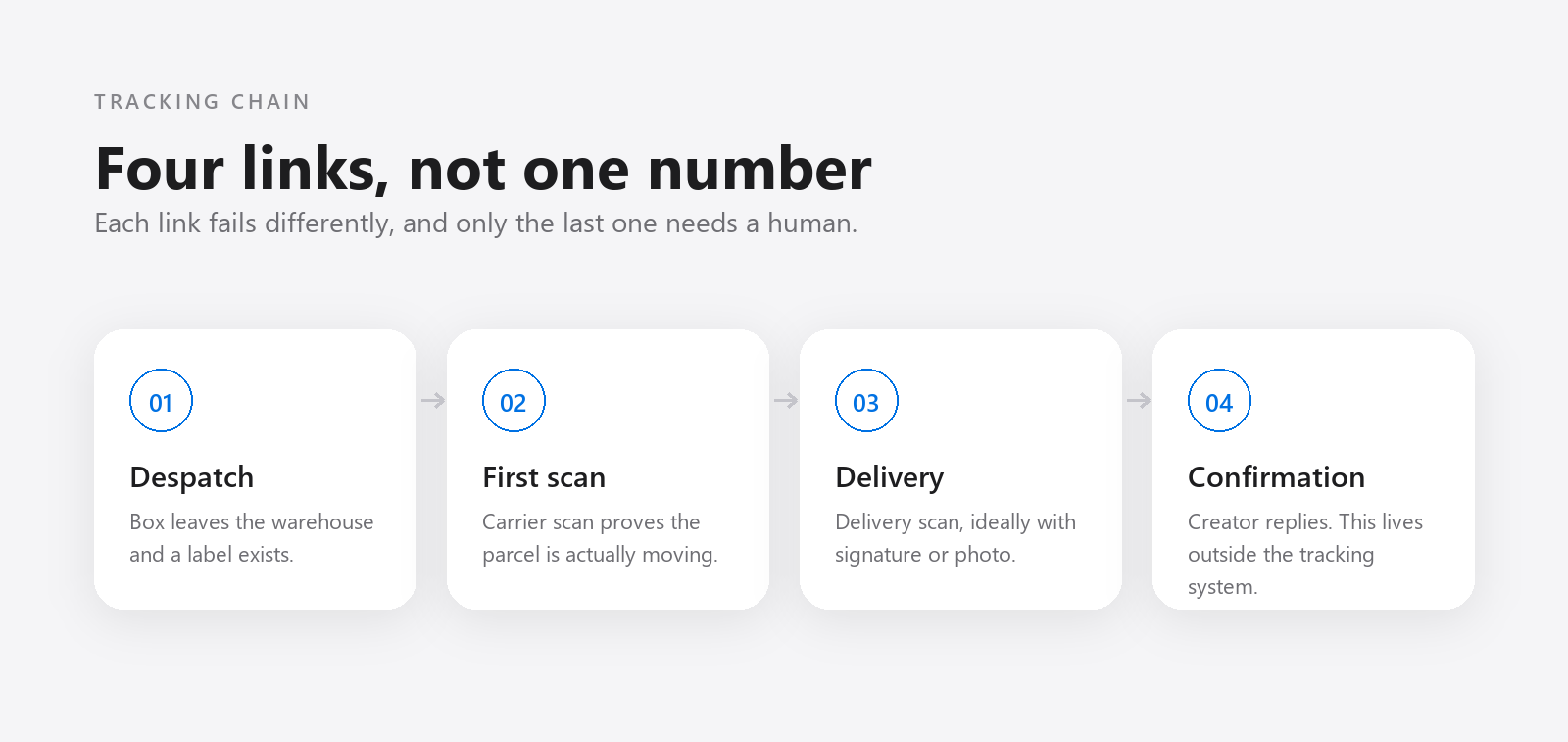
A tracking number is not a tracking chain. There are four points, and each one fails differently.
- Despatch. The parcel leaves and gets a number. This proves it left, nothing more.
- First scan. The carrier's initial scan, sometimes called an A-scan. A parcel with no first scan usually has a label problem or was never collected, and that is the moment a replacement is still cheap.
- Delivery. A delivery scan, ideally with a signature or a photo. Residential deliveries are often left at the door and marked delivered anyway.
- Confirmation. The creator says they have it. This one does not exist in any logistics system, so a person has to ask.
Time the follow-up from the delivery scan, not from the send date. Forty-eight hours after delivery is early enough to be useful and late enough that the box has been opened. Ask whether it arrived and whether anything was missing. Do not ask whether they are posting.
Set a return rule in advance: two failed attempts and the parcel is written off, with the Without Breaking Budget moved to the next name.
What 200 boxes actually buy
Break the funnel into stages and the arithmetic gets uncomfortable.
| Stage | Parcels | What it tells you |
|---|---|---|
| Despatched | 200 | List confirmed, addresses validated |
| Delivered | 188 | 12 returned or lost, a 6% failure rate |
| Receipt confirmed | 64 | Creator replied or posted an unboxing |
| Content published | 12 | At least one public post |
At a landed cost of $38 per box (product, packaging, freight), the run costs $7,600 and each piece of content costs $633. Push published posts to 30 and the same run costs $253 per post.
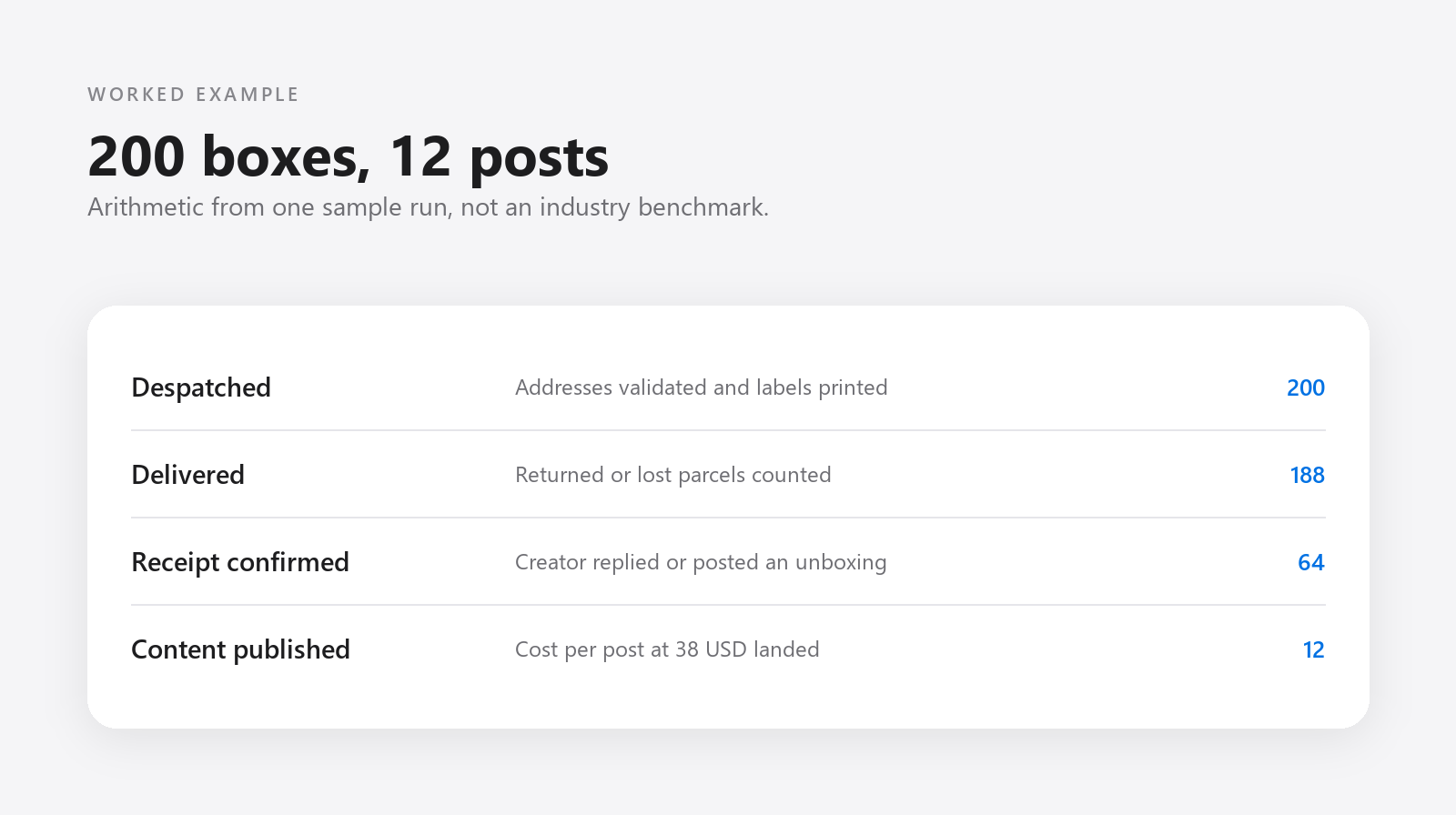
Those figures are worked arithmetic, not a benchmark. The structure is the point: the cost per post is decided at stage two and stage four, not by how good the box looks. A high return rate means the list was dirty. Delivered parcels with no content mean the box had nothing to say.
Run the numbers before the second batch, not after. The first batch is the only honest estimate you will ever have of your own list.
Segment before you print anything
Three tiers, three different boxes. Contracted creators get the custom card and the exact variant, because there is a date attached. Category-fit creators with no contract get the standard box and a handwritten note, because they are the ones most likely to post unprompted. The long tail gets the cheapest acceptable version, priced so that a silent recipient is not a loss.
Sending to the biggest accounts first is the common mistake. The larger the audience, the fuller the calendar. Twenty to fifty mid-sized accounts produce data you can act on; five hundred parcels produce a graph you cannot explain.
Four failures visible in the data
- Return rate above 5%. The list is the problem. Either the addresses were never validated or the file is six months old.
- Delivered, low confirmation, no posts. The box is the problem. The card did not explain what this is or why it went to this person.
- Posts without disclosure. A compliance problem you inherit. "Gifted" alone is not enough, and a platform label does not replace a plain-language line.
- Damage clustered in the same corner. An assembly problem. Kits need an insert that holds the product still, and every sealed box should be weighed: a variance of a few grams is how you catch a missing card before it ships.
The sheet you hand to the warehouse
One row per creator, and the columns are the failure points: recipient and unit, phone, variant, kit version, battery or liquid flag, declared description and value, send date, tracking, delivery date, confirmation date, post URL. That is the difference between a programme and 200 individual favours.
The short version
Seeding fails in the table before it fails in the box. Validate the address, declare the contents properly, watch the first scan, and follow up once, two days after delivery. Then count what came back and price the next batch from that number.
If you already have a list ready to send, send it over with the country split. We will check the address fields before anyone talks about boxes or rates.
References (Neutral Third-Party Sources)
- Federal Trade Commission — Disclosures 101 for Social Media Influencers: free or discounted products create a material connection that must be disclosed clearly and conspicuously. https://www.ftc.gov/business-guidance/resources/disclosures-101-social-media-influencers
- Federal Trade Commission — FTC's Endorsement Guides: What People Are Asking: why "gifted" alone is too vague and why a platform disclosure tool is not sufficient on its own. https://www.ftc.gov/business-guidance/resources/ftcs-endorsement-guides-what-people-are-asking
- USPS — Priority Mail: dimensional weight divisor of 139 for parcels over one cubic foot, nonstandard size surcharges, and included tracking. https://www.usps.com/ship/priority-mail.htm
- USPS — Domestic Shipping Prohibitions, Restrictions, & HAZMAT: lithium batteries and alcohol-based products are restricted, and some are ground-only. https://www.usps.com/ship/shipping-restrictions.htm
- USPS — Customs Forms: every item needs a specific description, and "gifts" is explicitly listed as unacceptable. https://www.usps.com/international/customs-forms.htm
- USPS — How to Prepare & Send a Package: address layout, return address placement and drop-off rules. https://www.usps.com/ship/packages.htm
- GS1 — GS1 Digital Link: how one QR code can carry a GTIN and resolve to information you can update without reprinting. https://www.gs1.org/standards/gs1-digital-link