
Custom Kitting & Product Bundling: How to Launch Multi-SKU Bundles
A multi-SKU bundle is a new trade item, not a discount on four existing ones. That distinction decides what follows: whether the bundle needs its own barcode, whether you hold component stock, how revenue is split when it sells, and what happens to the components when it stops selling.
Most launches go wrong in the same order: four products picked, price set by adding up individual margins, photography booked — and only then a call to the warehouse.
Decide virtual or physical before anything else
A virtual bundle is a listing that groups existing SKUs. Nothing is physically combined, and it can be re-cut next week without touching inventory.
A physical bundle is a kit: assembled into one unit, sealed, labelled with its own barcode, stored as a single item. It behaves like any other SKU in a warehouse — which is exactly the point, and exactly the cost.
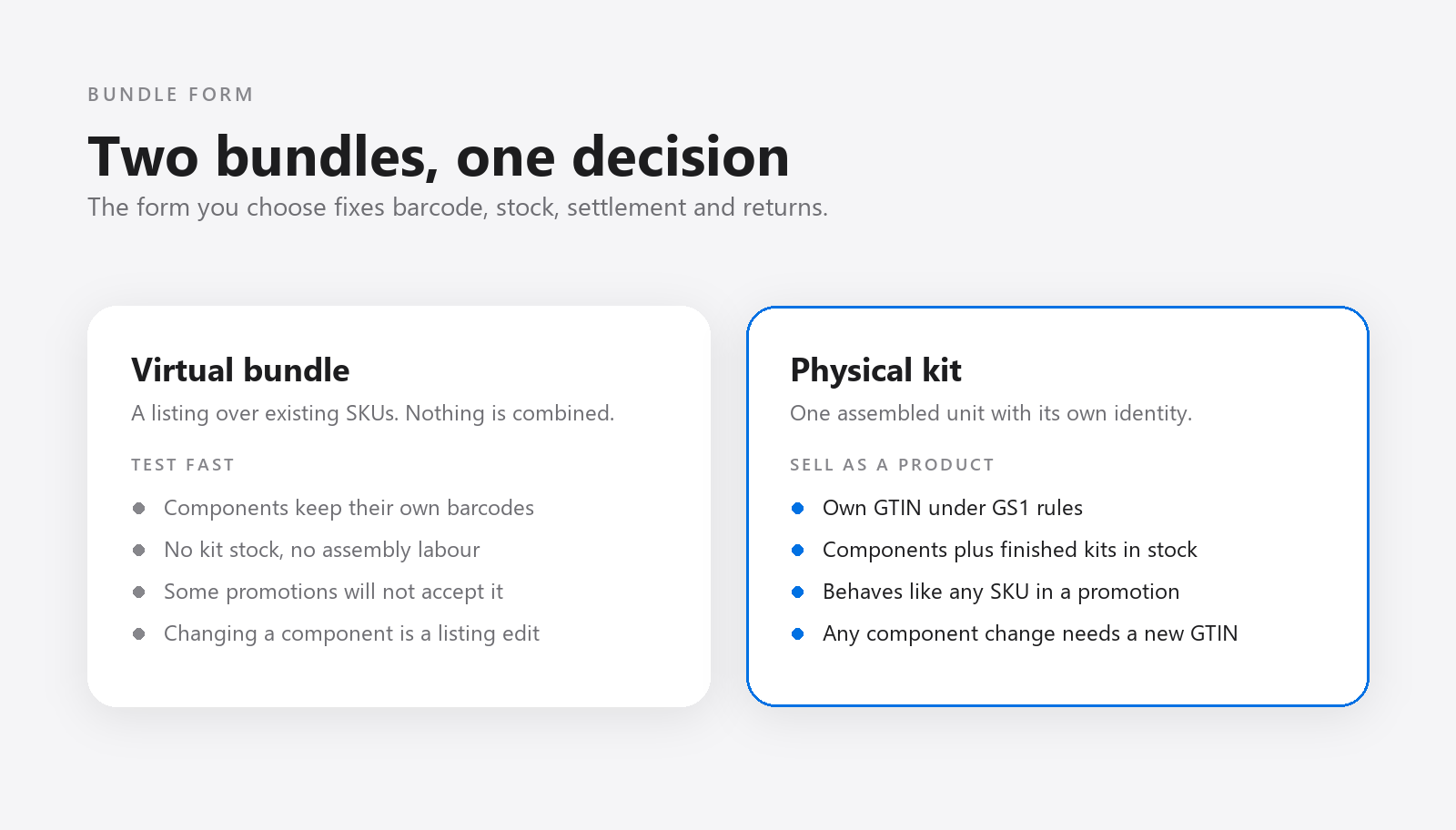
A physical kit enters every promotion a normal SKU can enter, collects its own reviews, and ships to wholesale. A virtual bundle often cannot, because promotion tools expect a single SKU with stock behind it.
The reverse is also true. A physical bundle sold across suppliers means splitting revenue back to each supplier, then splitting it again on returns. Platforms running cross-brand sets have built exactly that — de-kitting, return to supplier, settlement rebuilt underneath. The supplier ships as usual; the platform absorbs the complexity.
| Question | Virtual bundle | Physical kit |
|---|---|---|
| Own barcode required | No — components keep theirs | Yes, via GS1's assortment rule |
| Inventory held | Component stock only | Components plus finished kits |
| Can join any promotion | Often limited by the platform | Yes, behaves as a normal SKU |
| Changing a component | Edit the listing | New barcode, new listing |
| Revenue split across suppliers | Handled at order level | Must be rebuilt for the kit and returns |
Build physical when the bundle must behave like a product: own packaging, reviews, wholesale, gifting. Build virtual when you are testing whether the combination sells.
Price the bundle from the component stack
Adding up margins is the wrong arithmetic. A bundle does not carry four sets of fulfilment cost; it carries one pick, one pack, one box, one last-mile charge, plus an assembly step the individual items never had.
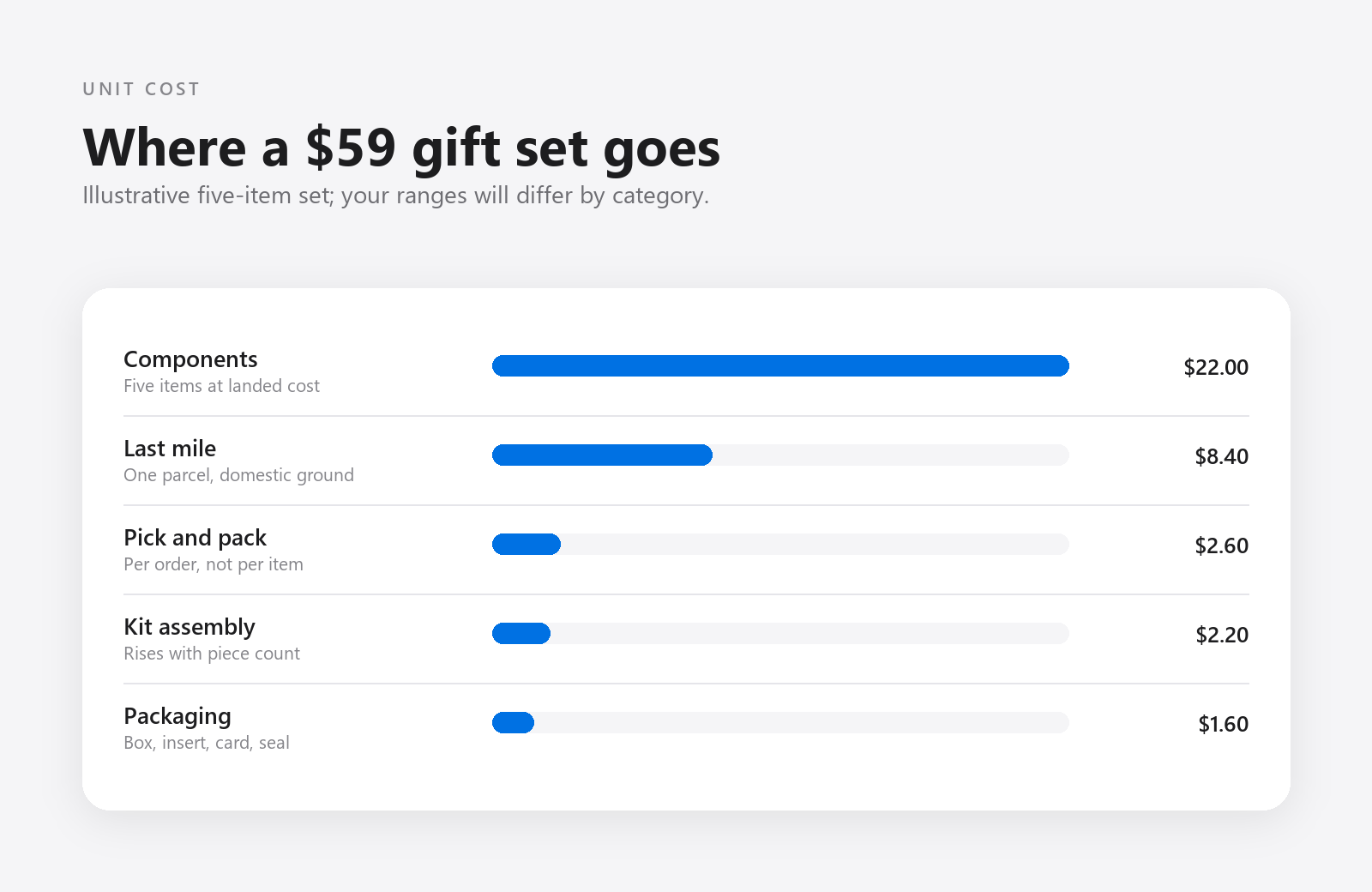
Build unit cost from the bottom: components at landed cost, assembly labour, packaging, pick and pack, last mile. Divide by units, not orders, then compare against bundle price minus platform fee.
Packaging is where the money hides. A carton moving from $0.22 to $0.17 is five cents; at 100,000 units a day it is $5,000. Warehouse controllers in China run the same arithmetic in yuan — 1.5 to 1.2 is 30,000 yuan a day at 100,000 orders. Bundles need a box size up from the single item, so that line deserves a sample, not a percentage.
| Cost line | Typical range (third-party industry data, not a quote) |
|---|---|
| Component cost | At landed cost, plus 2–4% for damage and shrink |
| Kit assembly labour | $0.50–$2.50 per kit, driven by piece count |
| Packaging and inserts | $0.60–$3.00 per kit |
| Pick, pack and label | $1.50–$3.50 per order |
| Last mile, domestic | $6–$12 per parcel |
| Setup, first article, training | $50–$250 one time |
Piece count is the lever nobody prices. A four-piece and an eight-piece set often ship in the same box at the same weight band, so last mile barely moves while assembly, error-proofing and packaging climb linearly. Most categories land at four to six pieces; past eight, added order value tends to be eaten by labour and by a mis-ship rate that creeps up with each component. Gift sets and boxed collections are the exception, because completeness is the product.
Give the bundle its own identity
A physical kit sold as a distinct item needs its own GTIN. GS1 treats a fixed combination of two or more trade items as a new trade item: components keep their own GTINs, the assortment gets a separate one, and any change, addition or replacement of a component requires a new GTIN.
Swapping an insert or replacing a discontinued colour is a new barcode, not a listing edit. The old barcode keeps its reviews and ad history; the new one starts at zero.
A pricing rule comes with bundles too, aimed at page copy. A "was $89, now $59" claim needs an $89 genuinely offered, openly and actively, for a reasonably substantial period. Summing four component prices and calling that the former price is a comparison that never existed. Clearance bundles are where this goes wrong, because the urge to invent an anchor price peaks when the stock is dead.
Write a bill of materials a picker can build from
A bill of materials is a work instruction. If it describes contents but not sequence, the bench improvises, and the improvisation stays invisible until complaints arrive.
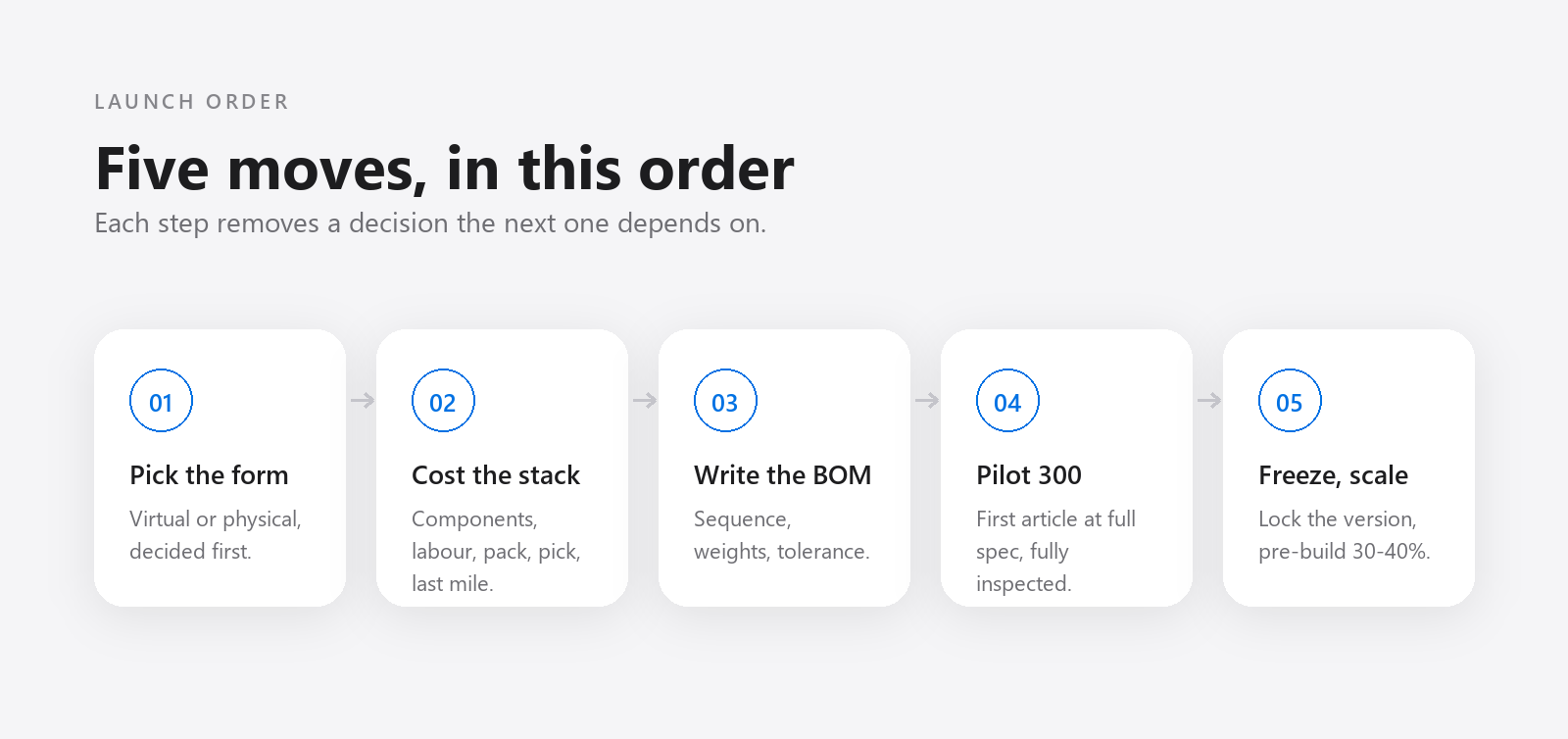
The fields that matter: component SKU and quantity; the barcode each component is scanned by; assembly order with a photo of the finished arrangement; packaging spec — box type, insert, card position, seal method; label position; quality checkpoints with pass/fail criteria; version number and effective date; substitution rules, including who signs off.
The last two prevent most disputes. Without version control the warehouse builds to last month's sheet; without a substitution rule, a missing component either stops the line or is quietly swapped for something close.
Put the kit's net weight and tolerance in the document too. A warehouse that takes kitting seriously loads kit and insert weights into its system and weighs every finished unit, flagging anything outside tolerance — five grams is the number one operator publishes. That catches the missing sachet and the double-packed one with the same check.
Where minimums change the answer
Sampling, tooling and station training are fixed costs. They do not shrink because you only want 30 kits.
That is why quotes cluster. A standard run starts around 500 units; a 30-unit run is often possible at roughly 50% more per unit. Lead times split the same way — a large run is scheduled in weeks, commonly 30 days and up, while a small batch comes back in 7 to 15 days.
So run it two-stage: 30 to 100 units at the premium to validate kit and packaging, then 500-plus at standard pricing once the numbers hold. Ask for sampling and setup to be credited against the repeat order — usually available, almost never offered.
Build a pilot batch of 100 to 300
A pilot is not a small production run. It is a first article: full BOM, real packaging, production station, 100 to 300 consecutive units, inspected completely rather than sampled.
Three things get tested. Cycle time — how many kits one person builds in a minute sets the assembly price, and day one will be worse than the spreadsheet. Packaging fidelity — mock-up versus real kit usually diverges at card position and insert height. The error loop — at dispatch, label and order should be scanned against each other, and a mismatch should stop the label printing. "A's goods with B's address" is not a training problem; it is a missing check.
Ask what error rate they report, and make them define the denominator. One operator advertises pick error below 0.3%; a warehouse manager writing about the same problem aims for five per hundred thousand. Two orders of magnitude apart — pick errors, dispatch errors and complaints are three metrics.
Freeze the spec, then scale in waves
After the pilot, freeze three things together: BOM version, packaging version, barcode. Put an effective date on the freeze and route later changes through a change note. A warehouse building to two versions at once is how a small tweak becomes 400 wrong kits.
Scaling is a scheduling decision. A store shipping 100,000 orders in a day does not assemble 100,000 kits that morning — roughly 40,000 were already built and staged. For a bundle, pre-building 30–40% of the first week's forecast is a reasonable start, the rest built to order. Pre-build too much and a slow seller becomes de-kitting work; too little and the first spike arrives as a backlog.
The ship date on the page is a promise, not a label. In the U.S., an order with no stated handling time is expected to ship within 30 days, and a delay obliges you to offer a wait-or-refund choice. Ask what cut-off time still makes that date.
Returns are a kitting problem too
The most valuable capability in a bundle programme is taking a kit apart. When a set stops moving, de-kitting turns finished inventory back into sellable components; without it, the same stock is a pallet of Send PR Boxes nobody can list.
Cross-supplier sets need one more layer: components go back to the supplier they came from, with settlement reversed. Platforms running these programmes describe the reverse flow — sorting, de-kitting, return to supplier — as the harder half of the project.
Ask three questions before signing. How is de-kitting charged, per kit or per component? Do components return to sellable stock with original barcodes intact? Who pays for packaging that cannot be reused? A partner who cannot answer will hand you the pallet the first time a promotion misses.
The short version
Decide virtual or physical first, because it fixes barcode, inventory, settlement and returns at once. Price from the component stack and treat piece count as a cost. Write a BOM a picker can verify, with a weight tolerance. Validate with 30 to 100 units, lock price at 500, pilot 100 to 300, pre-build 30–40%, and keep a de-kitting path open.
If the piece count on your bundle plan keeps growing, send us the SKU list, units per kit and expected first order — we will come back on structure before we talk about price. For the cost side, see what kitting services cost and the kitting and assembly overview.
References (Neutral Third-Party Sources)
Facts and concepts in this article were verified against standards bodies, U.S. federal regulations, and carrier and industry reference material. No fulfillment provider pages are cited.
- GS1 — Global Trade Item Number (GTIN): how trade items are uniquely identified across the supply chain. https://www.gs1.org/standards/id-keys/gtin
- GS1 — Predefined assortment: a fixed physical combination of trade items is a new trade item, and any component change requires a new GTIN. https://www.gs1.org/1/gtinrules/en/rule/271/predefined-assortment
- eCFR — 16 CFR Part 233, Guides Against Deceptive Pricing: the requirement that a former price be genuinely offered before it is used as a comparison. https://www.ecfr.gov/current/title-16/chapter-I/subchapter-B/part-233
- eCFR — 16 CFR Part 435, Mail, Internet, or Telephone Order Merchandise: the default 30-day shipment rule, the duty to offer delay or refund, and the refund window. https://www.ecfr.gov/current/title-16/chapter-I/subchapter-D/part-435
- DHL — Logistics of Things glossary: Kitting: the definition of kitting and the split between logistics kitting and warehouse kitting. https://lot.dhl.com/glossary/kitting/