
Luxury Corporate Gifts That Impress (Without Breaking Budget)
The gift people remember is rarely the most expensive one in the room. It is the one that arrived on the right day, in one piece, with a card that mentioned something real. A $400 object that turns up three days after the dinner, carrying a $30 duty bill, lands worse than a $90 object handed across a table with two sentences spoken over it.
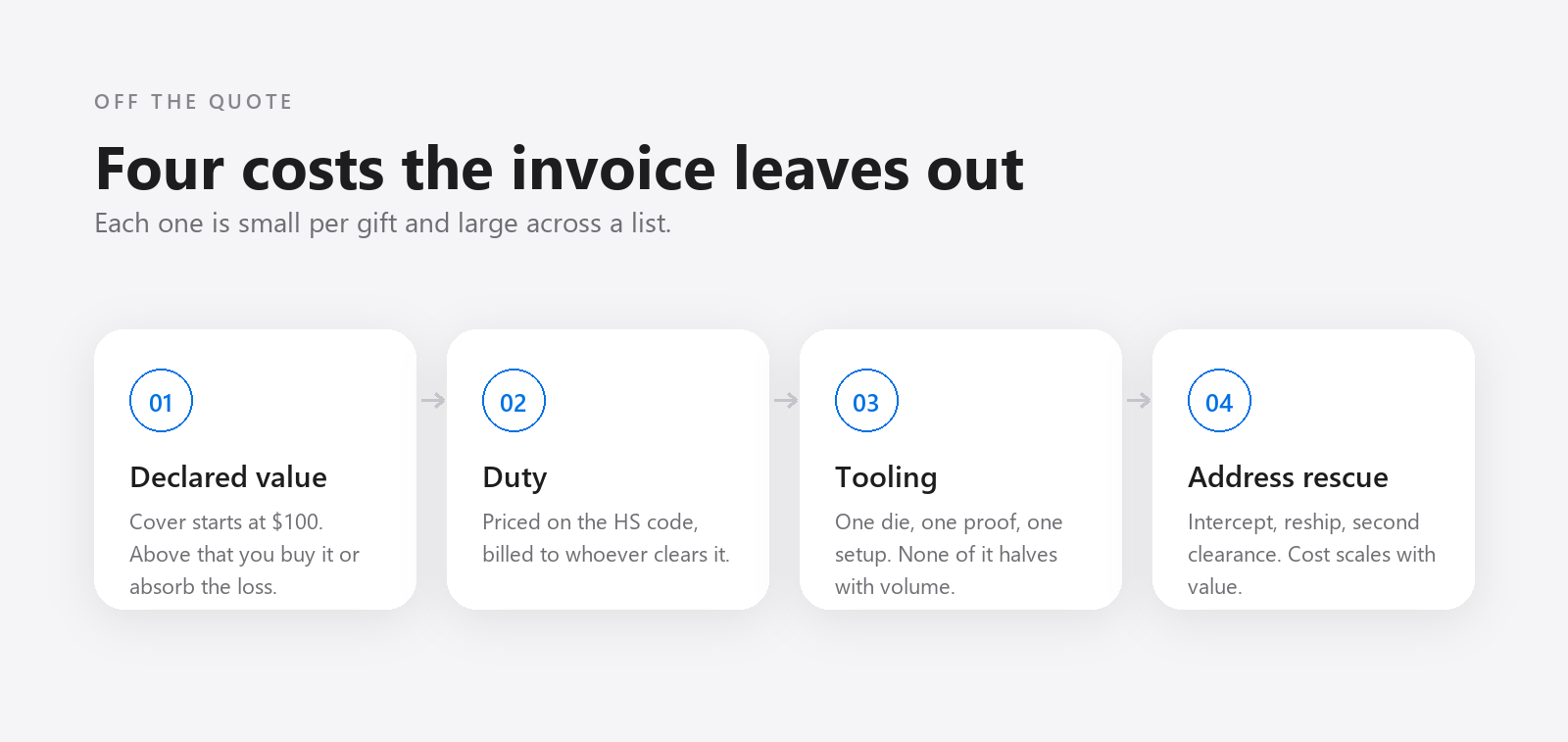
Procurement compares unit prices, because unit prices are the only numbers on the quote. But the quote covers roughly six of every ten dollars the gift actually costs. The rest sits in four places: declared value, duty, decoration lead time, and what happens after the address turns out to be wrong.
The invoice is not the price
Money leaves in five places: the object, packaging, decoration, freight, and recovery after something goes wrong. The first four can be quoted; the fifth can only be budgeted, and it doubles.
Packaging is a freight decision disguised as a design decision. A small change to the outer dimensions can raise units per pallet by around 20% — real money over a multi-year programme. Drop a carton's unit price by a third of a yuan and at 100,000 orders a day you save 30,000 yuan a day. Gift volumes are far smaller, but the logic holds. A few cents per unit only matters once you multiply it by the number of units.
Declared value decides what you get back
USPS includes $100 of cover on Priority Mail and Priority Mail Express. Above that you buy indemnity, up to $5,000, priced from $2.80 on the declared value you write on the customs form. Lose a $400 gift without extra cover and you recover $100, minus the claim paperwork.
Three habits separate a claim that pays from one that stalls: photograph the item, the packed interior and the sealed carton before dispatch; expect an ID check at the door above $500; file within 60 days, with the postmarked receipt and the proof of value attached.
The other exposure sits upstream. In 2021 a freight forwarder collapsed with 56 containers held at port and more than 300 sellers behind them; the settlement asked cargo owners to advance 22 yuan per kilogram or be treated as having abandoned their goods. The lesson is not that forwarders are unreliable. It is that on high-value shipments, your provider's balance sheet is part of your risk position.
Duty is charged to a person, and it should be you
Customs does not read intent. A gift is not a tariff category; it is a commodity with a six-digit HS code, and the duty rate follows the code. Vague paperwork fails at the border — every item needs its own value and a specific description, and a line reading "gifts" will be rejected, returned or destroyed.
Mixed sets add a wrinkle. Composite goods are classified as a set by the item that gives the set its essential character, so whisky packed with two glasses may clear as spirits or as glassware depending on where the value sits.
Then comes who pays. Delivered duty paid and recipient-pays are two lines in a spreadsheet and two different experiences: a client asked for $30 at the door has received a bill with your name on it. Price duty into the landed cost and ship DDP. Check the destination's prohibited-items list — leather, alcohol, food, lithium batteries — before the design is locked.
Engraving, foil and the 30 days nobody quotes
Decoration costs behave in the opposite way to most buyers' intuition. They do not fall in proportion to quantity; they are held up by fixed costs. Chinese suppliers quote two ways, and both describe the same structure: a 500-unit minimum, or 30 units at roughly 50% more per unit. One mould, one proof, one labour setup — none of it halves because you want 30 pieces. Cutting the order does not save money. It spreads the same fixed cost across fewer units.
Lead time has the same shape. Bulk runs 30 days from scheduling through inspection and freight; a small batch often ships in 7 to 15 days. When the event date is fixed, lead time is the first constraint on process choice, not price.
- Laser engraving. No tooling, priced per unit of machine time, the default under a few hundred.
- Foil stamping. One die per colour, per position. Two colours, two dies, never amortised at low volume.
- Screen printing. A setup and a colour match per pass; more colours, higher minimum.
Schedules slip at proof approval, not production. A proof left in an inbox for three days moves every downstream step by three days. Freeze the artwork four weeks out, then allow quantity changes only.
The wrong address costs more at $400 than at $40
A misdirected $40 item is a replacement. A misdirected $400 item is a sequence: an intercept fee, a delay, possibly a second clearance on the return leg, and a recipient who now knows the gift did not arrive.
Three failures cover most of it: a recipient who is travelling, a mailroom that will not sign for an unlabelled box, an address from three months ago.
The fix is unglamorous: confirm every address five business days before dispatch, one named person per list, not a mass email. Put a phone number on every international shipment, because a carrier that cannot reach the recipient parks the parcel in a depot and eventually sends it back. And follow the label conventions of the receiving side — retail distribution in North America runs on 48 × 40 inch pallets with labels in fixed positions, and "label legible, tracking live" is not optional anywhere.
Buy fewer, better
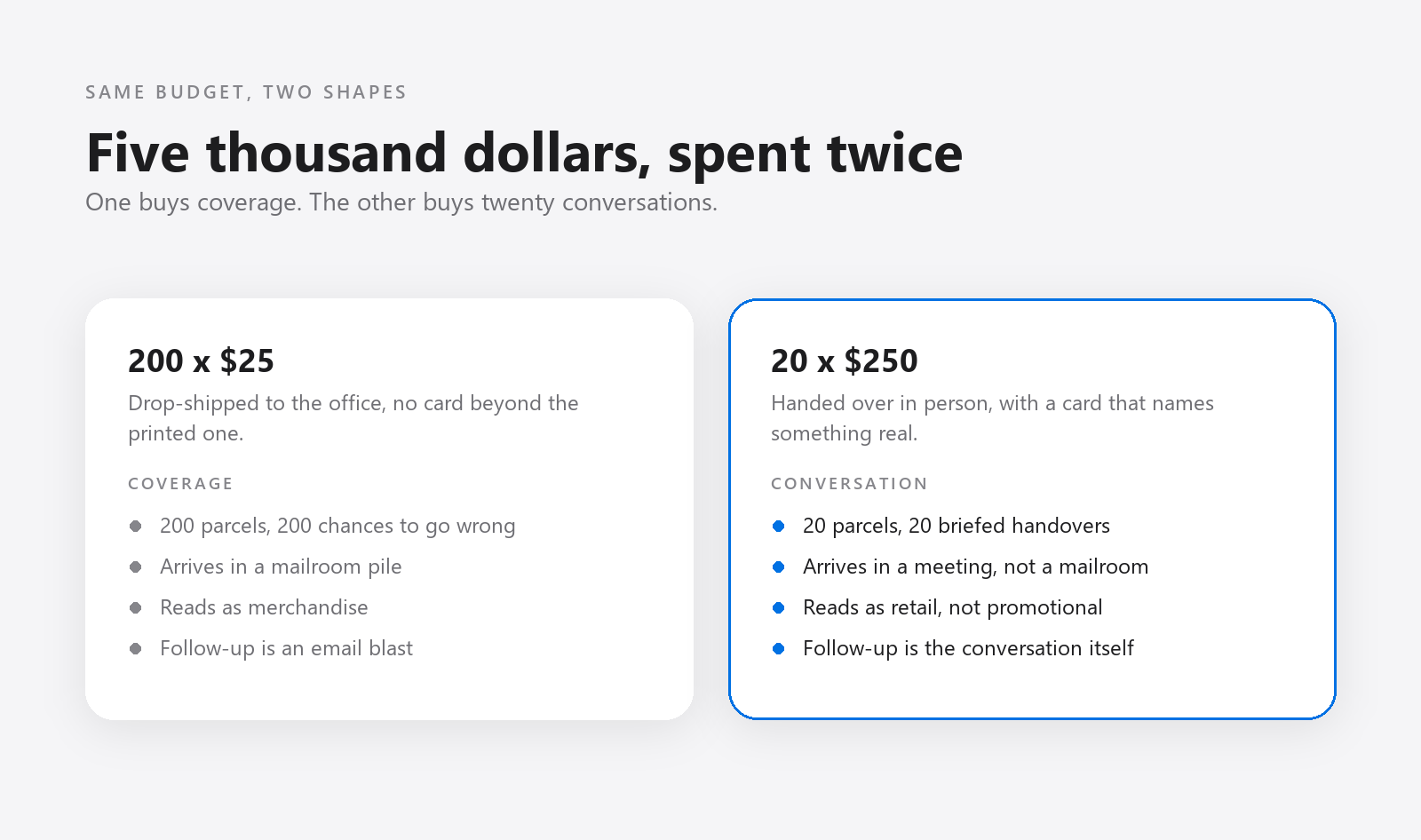
Take the same $5,000 and spend it two ways. Two hundred people get a $25 item, drop-shipped. Or twenty get a $250 item, delivered by hand with a handwritten card. The second creates twenty conversations rather than two hundred acknowledgements, and shrinks the failure surface from 200 parcels to 20.
Four moves make an object read as expensive:
- Weight. The first judgement is physical. Plated zinc feels different from brass.
- One material. Full-grain leather or solid walnut beats three materials assembled together.
- Fewer marks. A large logo turns an object into merchandise; one position, tone-on-tone, reads like retail.
- A slow open. A damped lid, a fitted insert, a card kept separate — the unwrapping speaks before the object does.
The third has a condition: blind deboss needs its own die, and below about 50 units it does not amortise. At small volumes, restraint means fewer marks, not more processes.
Four ways to deliver, four different risks
| Method | Cost per gift | What you control | How it usually fails |
|---|---|---|---|
| Hand delivery by your own staff | Highest, includes travel and hours | Timing, setting, the person speaking, the first sentence | The courier was never briefed, so the gift changes hands with no words |
| Courier to the office | Medium, plus cover | Signatory, delivery date, outer carton | Reception signs, the box sits in a mailroom, the recipient finds it a week later |
| Direct to home | Medium to low, highest address risk | Surprise, privacy | Stale address, family member signs, parcel taken from a doorstep |
| Local partner on the ground | Depends on city | Local timing, language, etiquette | The partner does not know your brand and the delivery feels outsourced |
The rule is blunt. Under 30 recipients, where each relationship is worth a conversation: hand delivery. Over 100, where coverage is the point: office or home. A local partner only works if they have delivered before. Past a few hundred, the packing becomes kitting work and the delivery becomes pick and pack.
A per-gift budget that survives finance
Build the budget per gift, not as a lump sum, then multiply. The ranges below are planning figures, not a quote:
| Cost line | $80 gift | $250 gift | $600 gift |
|---|---|---|---|
| Object | 45–55 | 150–175 | 380–430 |
| Packaging and insert | 6–10 | 12–20 | 25–45 |
| Decoration | 3–5 | 6–12 | 12–30 |
| Domestic freight | 8–12 | 12–20 | 20–35 |
| Duty and clearance, cross-border | 0–12 | 15–40 | 40–110 |
| Insurance | 1–2 | 3–6 | 8–15 |
| Delivery labour, allocated | 0–5 | 10–25 | 30–60 |
| Contingency, 8–12% | On the subtotal above | On the subtotal above | On the subtotal above |
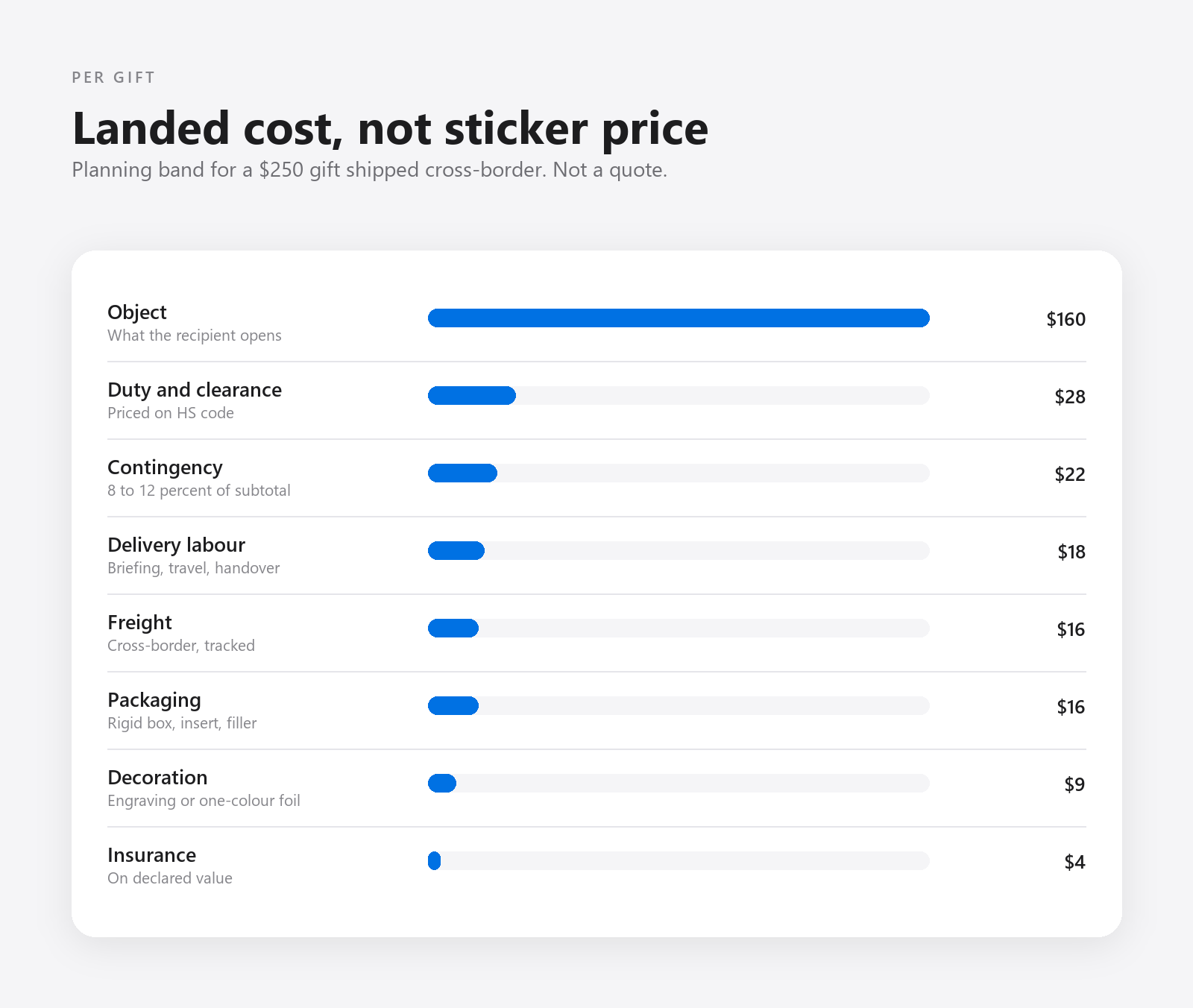
Keep decoration plus delivery under 35% of the object price; past that, you are buying logistics and the gift is a passenger.
The card, the signature, and the first sixty seconds
The first minute after the lid comes off decides whether the gift reads as "something the company sent" or "someone thought about me". Three things in that minute can be designed: what the recipient sees first, what the card says, and whose name is at the bottom.
What they see first should be the object, not a printed sheet. The card should not open with "Dear Valued Client". It should contain one specific thing — a question they raised in a meeting, the years you have worked together, the milestone being marked. The signature should be a person, not a department.
Thirty handwritten cards is realistic. Two hundred is not. Past that number, print the body, sign by hand, and do not pretend every card is personal. Recipients can tell.
The short version
High-value gifting rarely fails because the object was not good enough. It fails on the duty bill at the door, the engraving that missed the event, the three-month-old address, or the card that reached the wrong person.
When the budget is tight, the move is not a cheaper object. It is fewer objects, a delivery you can stand behind, and one card with a real sentence in it.
With a list and a fixed date, send the headcount, the country split and the per-head budget. We will come back with a plan before we talk pricing.
References (Neutral Third-Party Sources)
- USPS — Insurance & Extra Services: included cover on Priority Mail and Priority Mail Express, purchased indemnity up to $5,000, pricing from $2.80 on declared value, ID requirements above $500, and the 60-day claim window. https://www.usps.com/ship/insurance-extra-services.htm
- USPS — Customs Forms: per-item value and specific description requirements for international parcels, and the consequence of vague declarations. https://www.usps.com/international/customs-forms.htm
- International Trade Administration — Harmonized System (HS) Codes: how six-digit classification drives duty rates, and how composite goods sold as a set are classified. https://www.trade.gov/harmonized-system-hs-codes
- USPS Postal Explorer — Index of Countries and Localities: country-by-country prohibitions and restrictions that apply before a gift is designed. https://pe.usps.com/text/imm/immctry.htm