
Pick and Pack Services: How It Works & What It Costs
Pick and pack is priced per order plus per additional item. Someone walks to a bin, takes the unit, checks it against the order, packs it into a box, applies the label, and hands it to a carrier. That's the whole service. What varies is how the work is organised and how the invoice is built.
Which is why two quotes that both say "about $2.50 an order" can land 40% apart on your actual bill. Before comparing providers, convert every quote into the same shape: fixed cost per order, cost per additional item, packaging included or billed, peak surcharge, and which picking method the rate assumes.
Five ways to be quoted, one order
| Quoting model | Looks like | Fits | Watch for |
|---|---|---|---|
| Flat per order + per item | $2.00 + $0.50 per unit | Orders with a stable item count | Grows fast once orders carry 3+ items |
| First item included | $2.50 including the first unit, $0.50 after | Mostly single-item orders | Barely differs from the model above at low item counts |
| Flat up to X items | $3.00 up to 5 units, then $0.50 each | Kits, bundles, multi-item orders | Confirm the cap and what happens above it |
| "Free" pick and pack | $0.00 per order fee | Nobody, to What Really | The cost reappears in shipping or surcharges |
| All-in-one | One rate covering pick, pack and postage | Teams that want simple accounting | The exclusion list is usually long |
Run the same order mix through all five and the ranking changes. That's the point: the model, not the headline number, tells you what you'll pay at your volume.
The picking method sets the rate
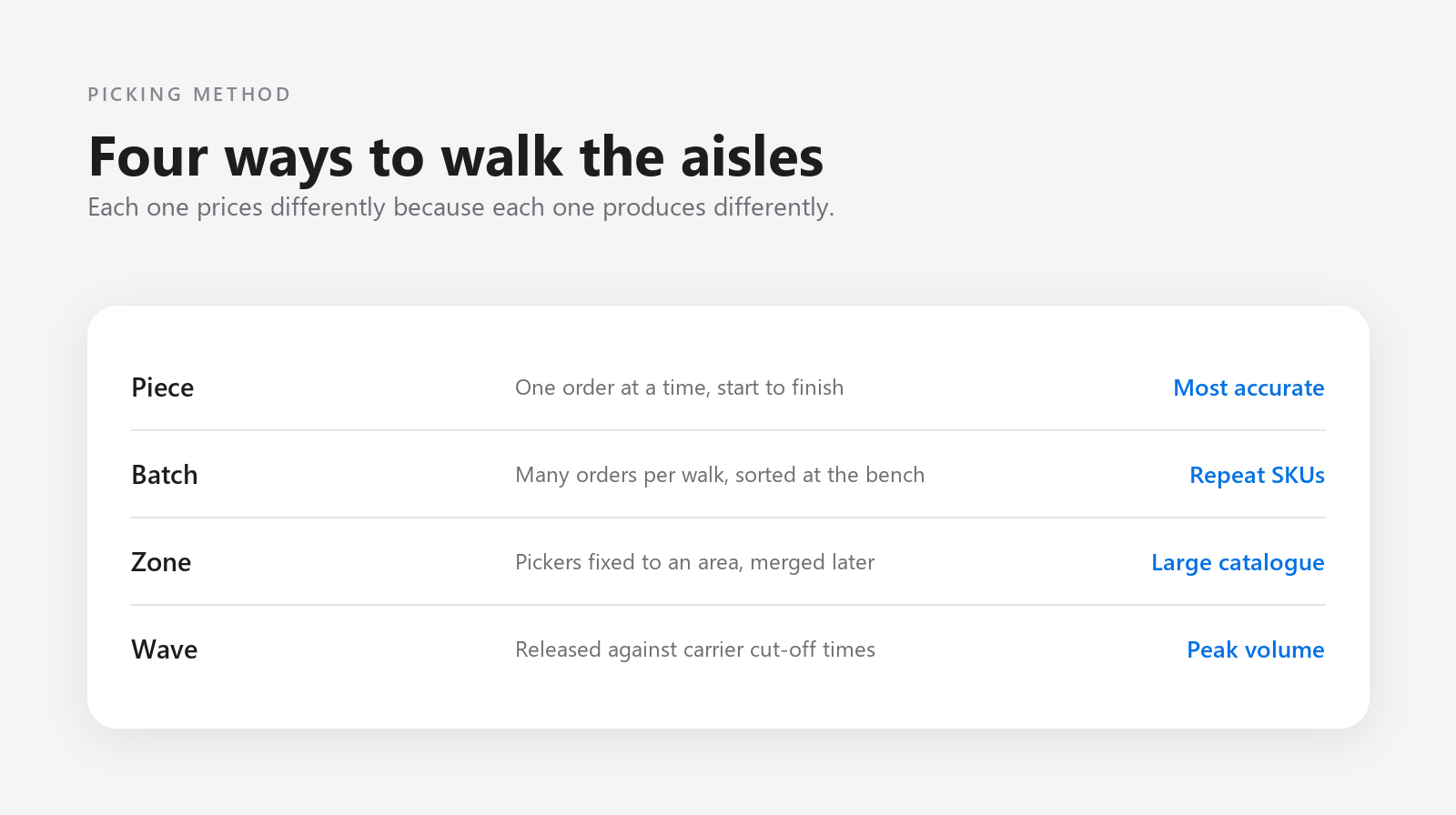
- Piece picking — one order at a time, start to finish. Highest accuracy per order, lowest output per person. Right when volume is low and orders look nothing alike.
- Batch picking — collect for many orders in one pass, then sort at the packing bench. The win comes from repetition: the same SKU pulled dozens of times in one walk.
- Zone picking — split the warehouse, assign pickers per zone, merge at a consolidation point. Suits large catalogues in large buildings, and adds a merge step where errors can enter.
- Wave picking — release work in waves tied to carrier cut-off times, combining zone and batch logic. This is what carries a promotion spike without overtime.
The deciding variable is your order profile, not your provider's preference. If 70% of orders are single-item, batch picking saves little. If the average order carries three or four units and the same SKUs repeat, piece picking is paid-for inefficiency.
Two levers still in your hands
Box choice. Carriers bill dimensional weight — length × width × height divided by a divisor, compared against actual weight, whichever is greater. A provider that grabs whatever carton is closest makes you pay for air. Put box selection by order content into the service standard, and ask for a monthly box-size distribution report. On small parcels this is routinely worth $1–2 an order.
Item count per order. The per-additional-item fee is small and it multiplies by items, not orders. Restructuring "buy two get one" into a single bundle SKU turns three item fees into one.
Where 99.5% accuracy actually comes from
Accuracy is a process output, not a promise. Three actions produce it:
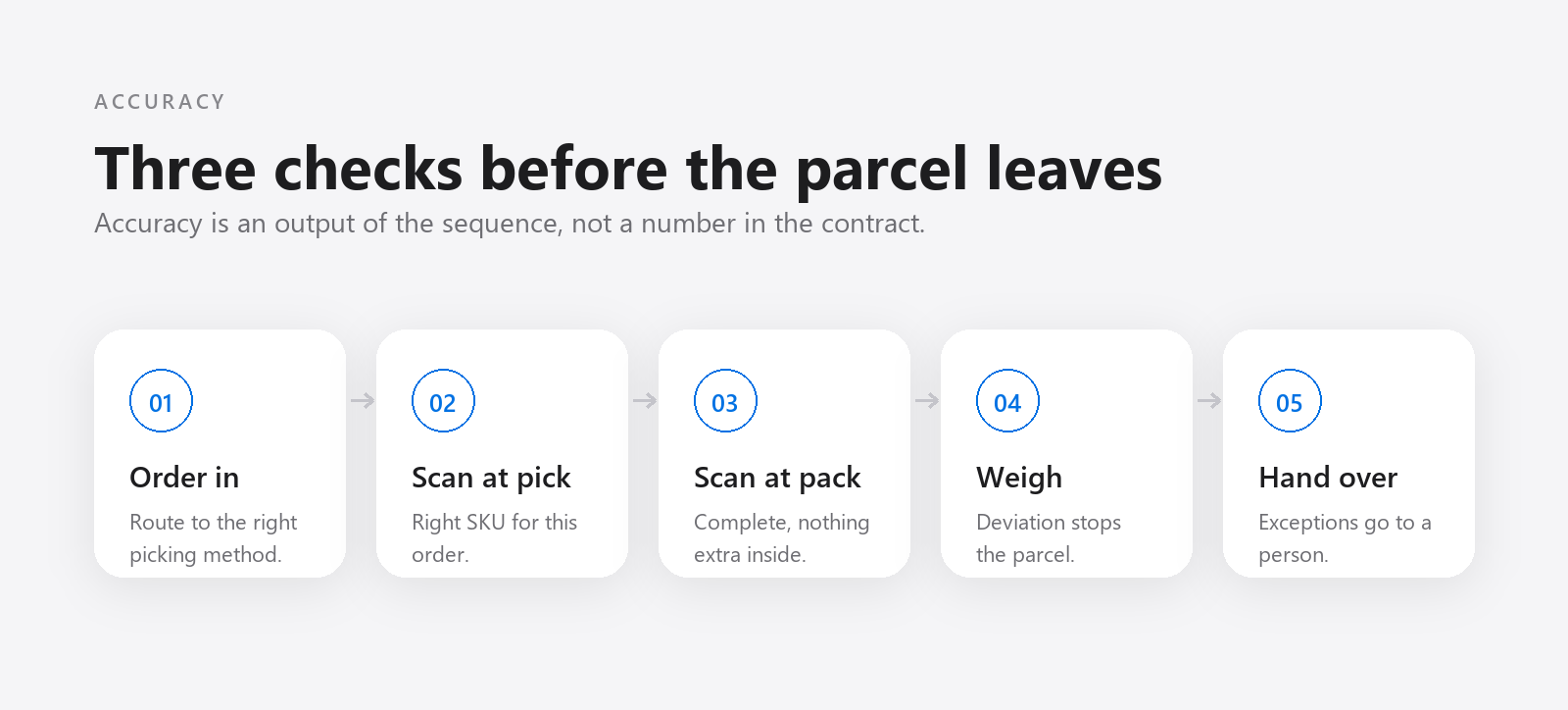
- Scan at pick — is this the SKU this order needs.
- Scan at pack — is the order complete, and is anything in the box that shouldn't be.
- Weigh at dispatch — a deviation past the threshold stops the parcel before it leaves.
Then a fourth thing that most operations skip: an exception station. Wrong item, short shipment, damage, suspicious address — those orders leave the main flow and go somewhere with a person attached. Without that station, exceptions travel inside normal orders and surface as customer complaints three days later.
One diagnostic worth keeping: if the same handful of SKUs keeps producing errors, the problem is the slot, the packaging, or visual similarity — not the picker. Re-slot before you retrain.
Using FBA rates as a ruler
Most brands already know one public price list, which makes it a useful yardstick. In the 2022 US fee schedule, Fulfillment by Amazon charged about $3.09 for a standard-size unit up to 1 lb, plus $0.43 for each additional pound; storage ran about $0.87 per cubic foot per month for most of the year and $2.40 in October–December; labelling was about $0.30 a unit; and a holiday surcharge of roughly $0.35 a unit applied in peak.
| Line | FBA reference (2022, US) |
|---|---|
| Standard unit up to 1 lb | ~$3.09 per unit |
| Each additional pound | ~$0.43 |
| Monthly storage | ~$0.87 / cu ft (peak ~$2.40) |
| Labelling | ~$0.30 per unit |
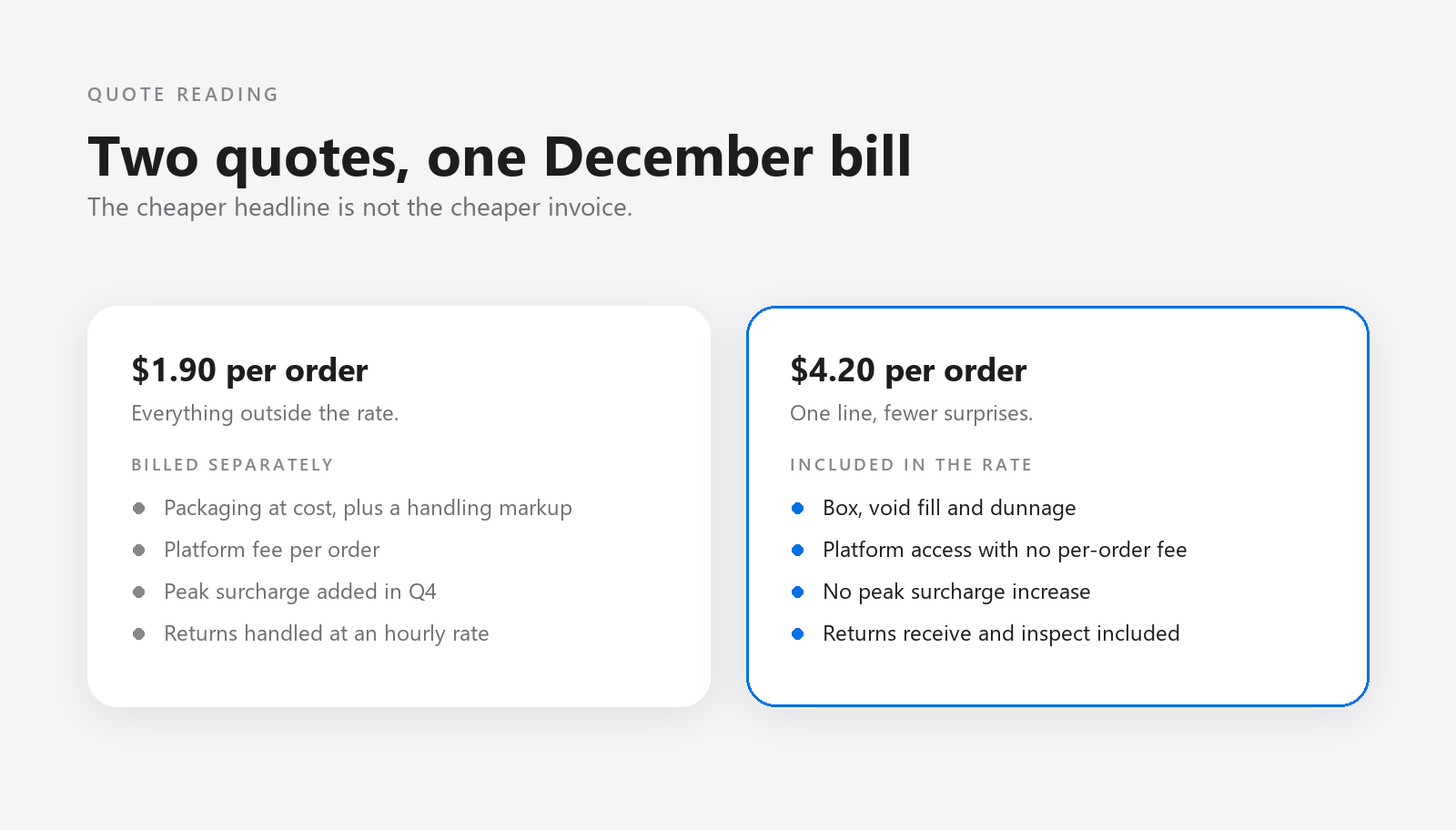
Now read a 3PL quote against it. "$4.20 an order, packaging and platform included, no peak surcharge" looks more expensive than $3.09 until packaging, peak, and labelling are added on the FBA side. A $1.90 quote with packaging, platform fee, peak surcharge, and returns handling billed separately usually clears $4 by the time a December order ships.
Before you sign
- Does the rate include packaging? Who chooses the box, and can you get a monthly box-size report?
- What is the peak surcharge, when does it start, and is it per order or per item?
- What is your order cap during peak, and how do overflow orders queue?
- What share of the picking team is temporary in Q4, and how long is training?
- Returns: receive only, or inspect and return to sellable stock?
- What's the liability basis for a wrong-item shipment — product cost, retail value, or a multiple of the fee?
The answers matter more than the rate table, because the rate table is the part everyone shows you.
Next step
If you're holding three quotes, send the item-count distribution per order, monthly volume, and whether packaging and peak surcharges are inside or outside the rate. We'll convert them into one comparable number before anyone talks about price.
If the orders in question are kits or bundles rather than single units, start with how the four kitting models differ — the assembly step changes what the pick actually costs.
References (Neutral Third-Party Sources)
Facts and concepts in this article were verified against public labour statistics, standards bodies, and carrier reference material. No competitor pages are cited.
- U.S. Bureau of Labor Statistics — Occupational Employment and Wage Statistics: wage benchmarks for packers and material movers. https://www.bls.gov/oes/
- GS1 — Global Trade Item Number (GTIN): how units and cases are identified so a scan confirms the right item. https://www.gs1.org/standards/id-keys/gtin
- GS1 — GTIN Management Standard: when a distinct trade item needs its own identifier, including multi-item packs. https://www.gs1.org/sites/default/files/docs/barcodes/GS1_GTIN_Management_Standard.pdf
- U.S. Customs and Border Protection — De minimis shipments: the value threshold below which low-value imports clear without duty. https://www.cbp.gov/trade/programs-administration/entry-summary/de-minimis-shipments