
Manufacturer vs Supplier: What's the Difference?
A manufacturer makes the product. A supplier sells it to you. Almost everything that goes wrong later — the mold you can't take with you, the certificate nobody can produce, the pallet that arrives crushed — follows from which of those two signed your purchase order.
Buyers spend two weeks comparing quotations and ten minutes checking who is quoting. That ratio is backwards. Two quotes for the same specification, one a few percent cheaper, are rarely competing on price. They are competing on how much work sits between you and the production line.
The words describe roles, not companies
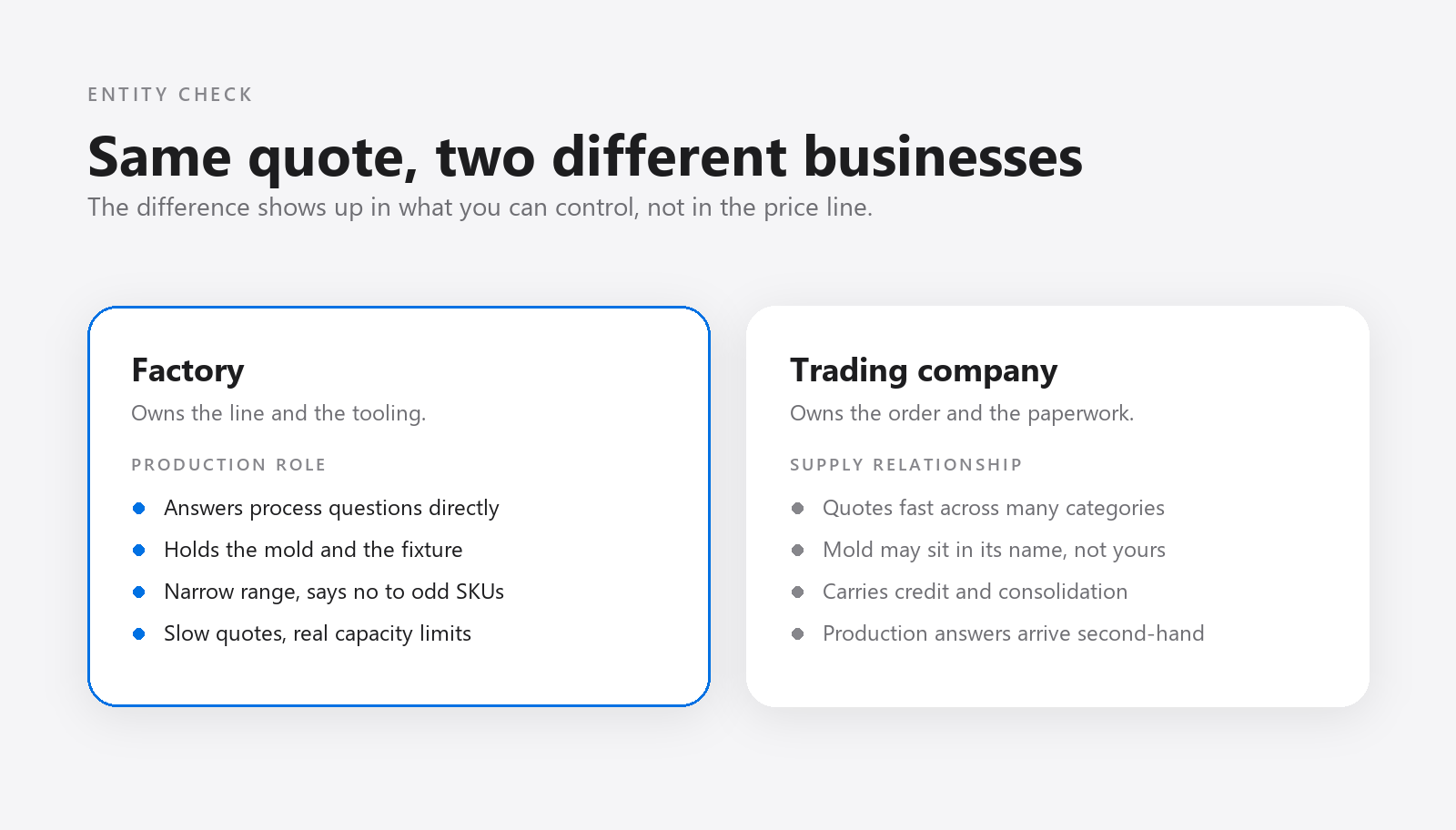
"Manufacturer" says what a company does. "Supplier" says what relationship it has with you. A factory that invoices you directly is both. A trading company with a quality team and its own warehouse is a supplier and nothing else. A factory with an export department is both — and will still buy two of your eight SKUs from the workshop next door.
So the useful question isn't "are you a factory". It is: whose name is on the proforma invoice, whose name is on the export declaration, and who can stop the line when you call at 9pm. Those three answers are often three different companies.
Three entities you will actually meet
| Entity | What it controls | Where your money goes | How to spot it early |
|---|---|---|---|
| Trading company | Orders, documents, consolidation, communication | Its account, then the factory's | Quotes fast, covers everything, answers production questions second-hand |
| Factory | Line, tooling, processes, schedule | Factory account | Quotes slowly, narrow range, says "we can't do that" |
| Factory with a trading arm | Some production in-house, some bought in | One company | Can quote the full range, but line photos look different per SKU |
The third type is the one buyers misread. It can walk you through a convincing line and still pass your second category to someone else, quietly. That isn't fraud, it's the business model. Ask which production steps happen in-house per SKU, and put the answer in writing. The same order may also be structured as a sale or as toll manufacturing, and the two treat materials, tooling and proof differently.
The price gap is smaller than either side claims
Two stories circulate. Factories say traders add 30–40%. Traders say factories quote small buyers high anyway. Both are advertising.
On a clear specification and a repeat order, the visible spread is usually a few percent, plus whatever the supplier charges for sampling, consolidation and credit. The 30% figure comes from a buyer who can't specify the product, so the middleman is really selling product development.
Volume is the real dividing line. In a small-goods cluster like Yiwu, price is negotiated in tenths of a yuan — one or two mao, sometimes a fen — across three or four conversations, not one meeting. At the other end, standard minimum order for decorated gift sets sits around 500 units; thirty units is possible at roughly 50% more per unit, with lead time falling from about 30 days to 7–15.
That 50% isn't the middleman's margin. It's tooling, sampling and line changeover spread over 30 units instead of 500 — which makes "the middleman is expensive" false at low volume. At high volume the maths flips: a carton that drops from $0.22 to $0.18 is four cents, until you multiply it by a hundred thousand units a day.
Who owns the mold
This is where the cheapest-looking quote becomes the most expensive decision in the file. Four things decide ownership: who pays the tooling fee, whose name is on the tooling invoice, where the mold physically sits, and what happens when you want to move it. Miss one and you have bought parts, not capability.
The common arrangement amortises tooling into the first order's unit price, so the quote says "no mold cost". It reads like a favour. In practice you never owned the mold, and the day you want a second source you start again from a drawing. If the trading company paid for the tooling, the trading company owns it.
The clause is short: tooling is buyer property, stored at a named factory, collectable on 30 days' notice, handed over in production-ready condition, freight paid by whoever moves it.
Early signal: ask how many cavities the mold has and where it is right now. The supplier who can't answer either question is not planning to hand it over.
Who can actually sign the certificate
A test report is issued to a legal entity, for a specific model, on a specific date. A trading company can forward the PDF and print its logo on the carton. It cannot make a report exist.
So "do you have CE / FCC / RoHS" is the wrong question — every supplier says yes. Ask who the certificate holder is, whether the model number matches the version you are buying, and whether the report predates the last material change.
Above that sits origin, which is decided by where the goods were substantially transformed, not by who invoices. Under US rules the sequence runs: wholly obtained or produced, produced entirely from domestic materials, or every foreign material undergoing the specified tariff shift — with minor processing and simple assembly excluded. The marking duty then lands on the importer: articles of foreign origin must carry the English country of origin conspicuously, legibly and permanently, and unmarked goods face an additional 10% duty on appraised value.
For US-bound goods there is a second layer. An unqualified "Made in USA" claim requires the product to be all or virtually all made in the US. A US brand name alone usually isn't a claim — a label is, and the FTC can pursue penalties on it.
Who pays when the goods arrive wrong
Incoterms decide the moment risk passes, and they are the most misread line on a quotation. FOB does not mean the seller is responsible until the goods reach your door.
What decides whether you get made whole is less comfortable: your claim runs against the party you contracted with, under that contract's terms — not against whoever caused the problem.
Read the liability cap before the price. Plenty of factory contracts limit compensation to the value of the defective units, or to the processing fee. That is reasonable until your defect is a $40 retail item with $12 of return postage attached.
Real chains break in the middle. A forwarder's financing collapsed and took more than a hundred small forwarders with it; the clearing bill ran to several million yuan, customers were asked to advance 22 yuan per kilogram, later 17, and anyone who didn't pay by the deadline was told they had abandoned title to their own cargo. The structure is the lesson: you can only chase the entity you paid. The factory upstream owes you nothing, because you never contracted with it.
A deposit plus the balance against the bill of lading means your leverage peaks the day you wire the deposit. Once the balance is gone, your only lever is the next order.
When the middleman is the better deal
Four situations, roughly in order of how often they apply.
Many SKUs, few units each. Three categories at a few hundred pieces apiece and coordination cost overtakes any unit-price saving. You are buying one throat to choke.
You need terms. A factory wants a deposit and the balance before shipment. A trading company with a balance sheet can carry 30–60 days. For a brand shipping into a marketplace that settles on its own schedule, that is frequently worth more than the unit price.
You need one container, not five pickups. Five factories means five addresses, five export declarations, one less-than-container booking.
You need someone to be the bad guy. Rework, short shipments, replacements — having that argument in Mandarin, in your time zone, is cheaper than having it yourself for three weeks.
Where it stops working: when the product is the business. Tooling, formulation, mold geometry, IP. Then every future change passes through an extra layer, and you never hear the line directly.
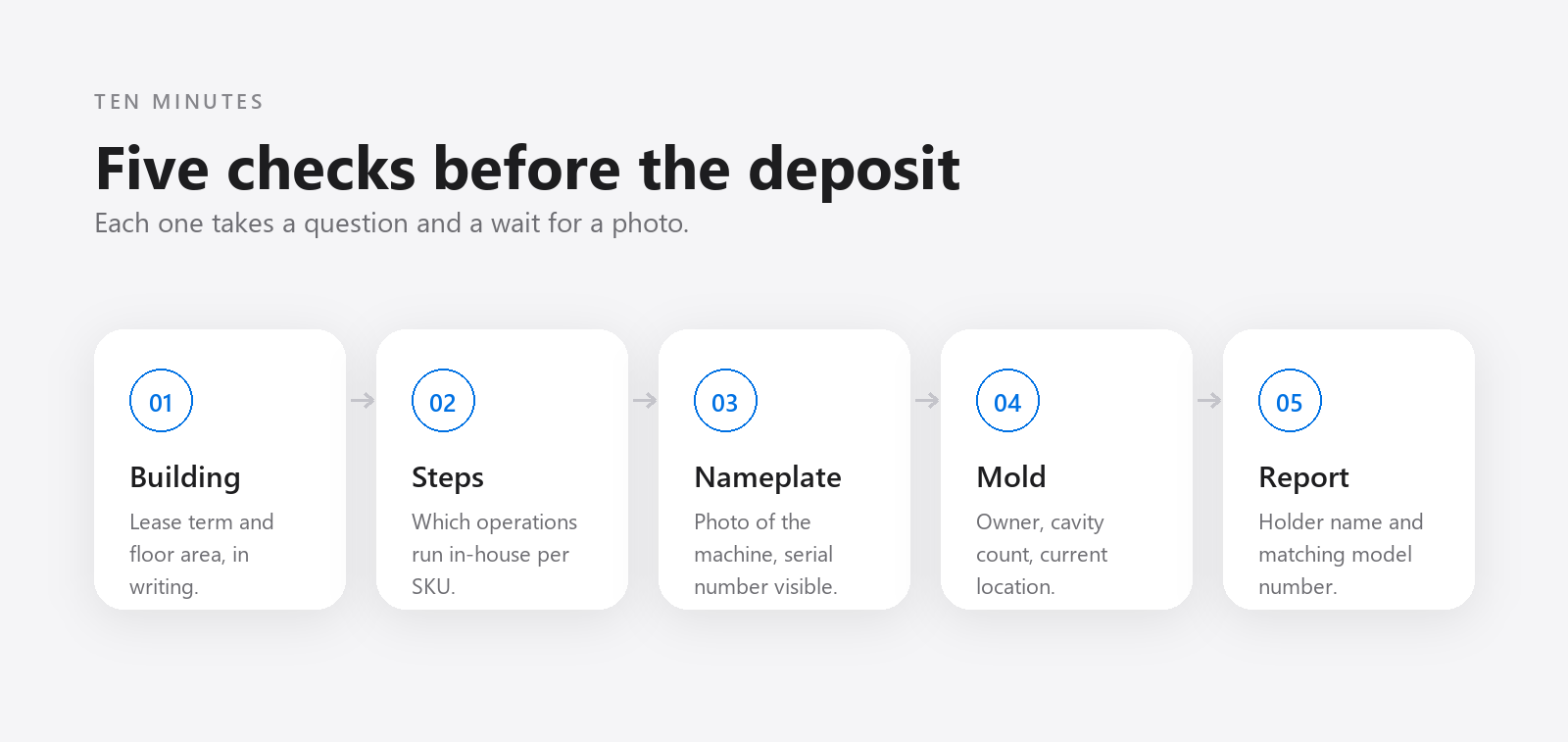
Ten minutes, eight questions
| Ask | Factory answer | Trader answer |
|---|---|---|
| Own or lease the building, until when | Gives years and floor area | "We work with many partner factories" |
| Which steps for this SKU run in-house | Walks the process, including the outsourced step | "We make all of it" |
| Send me the nameplate on the machine | Photographs it, with serial number | Sends a product photo instead |
| Whose name is on the mold, where is it | Names cavity count and workshop | "The mold is ours", can't say where |
| Who holds the test report, which model | Reads out certificate number and model | "We have all certificates", sends someone else's |
| Last customer in my market, which year | Names market and year | "Many customers" |
| When does lead time start | On deposit plus approved sample | "About 30 days" |
| Who signs off rework when it fails | Names the role and the process | "We will take responsibility" |
Then the test that isn't on the list: ask for a live video call walking from the office to the loading dock, no cuts. A factory does it in one take. A trading company spends the walk looking for signal.
Four clauses to agree before the deposit
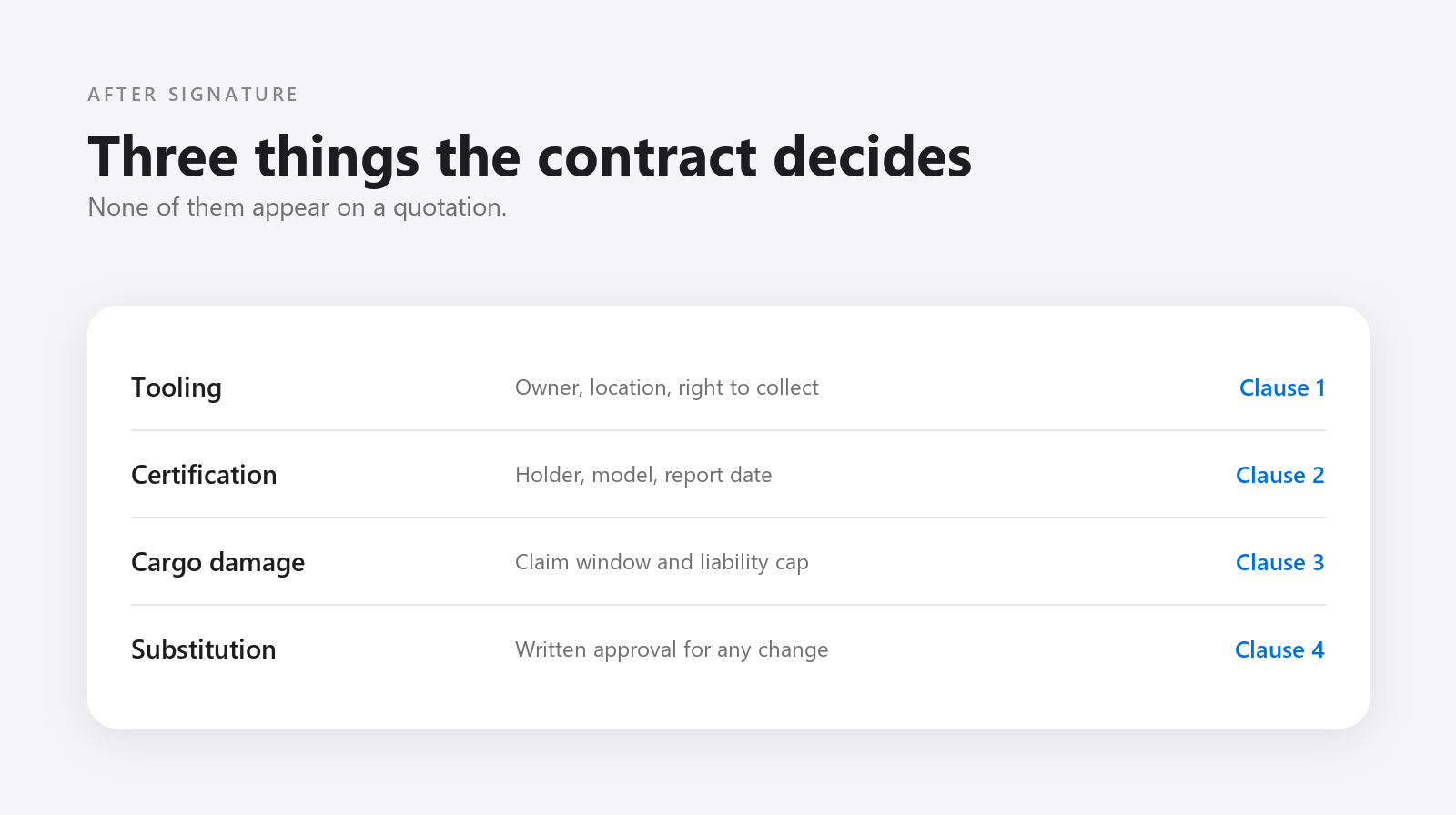
- Tooling. Ownership, storage location, notice period for collection, condition on handover, who pays freight.
- Documents. A named list, with certificate holder and model number on each line, plus one sentence: a document that doesn't match this product counts as not supplied.
- Claims. Days from delivery to notify, who pays return freight, and the remedy ladder — replace, then credit, then refund.
- Change control. Any substitution of material or component needs written approval. Verbal agreement is not approval.
None of these cost money to negotiate. All of them cost money to skip.
The short version
You are not buying a label, you are buying a counterparty. A factory gives you direct feedback from the line and a lower marginal cost. A middleman gives you flexibility, terms, and someone to absorb the arguments. Choosing wrong doesn't show up in the unit price — it shows up on the day something breaks and you find out who you can actually call.
If you are stuck between the two, send the SKU count, the units per SKU and the target market. We'll tell you which route the numbers support before we talk about price.
If the order needs assembly or multi-component packing before it ships, our kitting and assembly team can quote that separately, and you can request a quote with the sourcing route already decided.---
References (Neutral Third-Party Sources)
- eCFR — 19 CFR Part 134, Country of Origin Marking: the conspicuous, legible, permanent English marking requirement, the container-marking exception, and the 10% additional duty on unmarked articles. https://www.ecfr.gov/current/title-19/chapter-I/part-134
- eCFR — 19 CFR Part 102, Rules of Origin: origin determined by wholly obtained status, domestic materials, or a specified tariff shift, with minor processing and simple assembly excluded. https://www.ecfr.gov/current/title-19/chapter-I/part-102
- FTC — Complying with the Made in USA Standard: the "all or virtually all" test, what counts as an implied claim, and the civil penalty exposure created by the 2021 Labeling Rule. https://www.ftc.gov/business-guidance/resources/complying-made-usa-standard
- ICC — Incoterms® rules: the eleven three-letter terms that allocate tasks, costs and risk between seller and buyer. https://iccwbo.org/resources-for-business/incoterms-rules/