
Pre-Shipment Inspection: What It Is and Why You Need It
A pre-shipment inspection doesn't tell you whether your product is good. It tells you how much risk is sitting in that lot, and whether the money you just spent bought a cheap option or an early warning.
Most buyers read the last page, look for the word PASS, and file the PDF. The last page is the least informative part. Everything that matters is in the sample size, the defect count, and the three paragraphs the inspector wrote carefully enough to be deniable.
Here is how to read those, when to book the visit, and what to do when the answer is no.
What the report actually decides
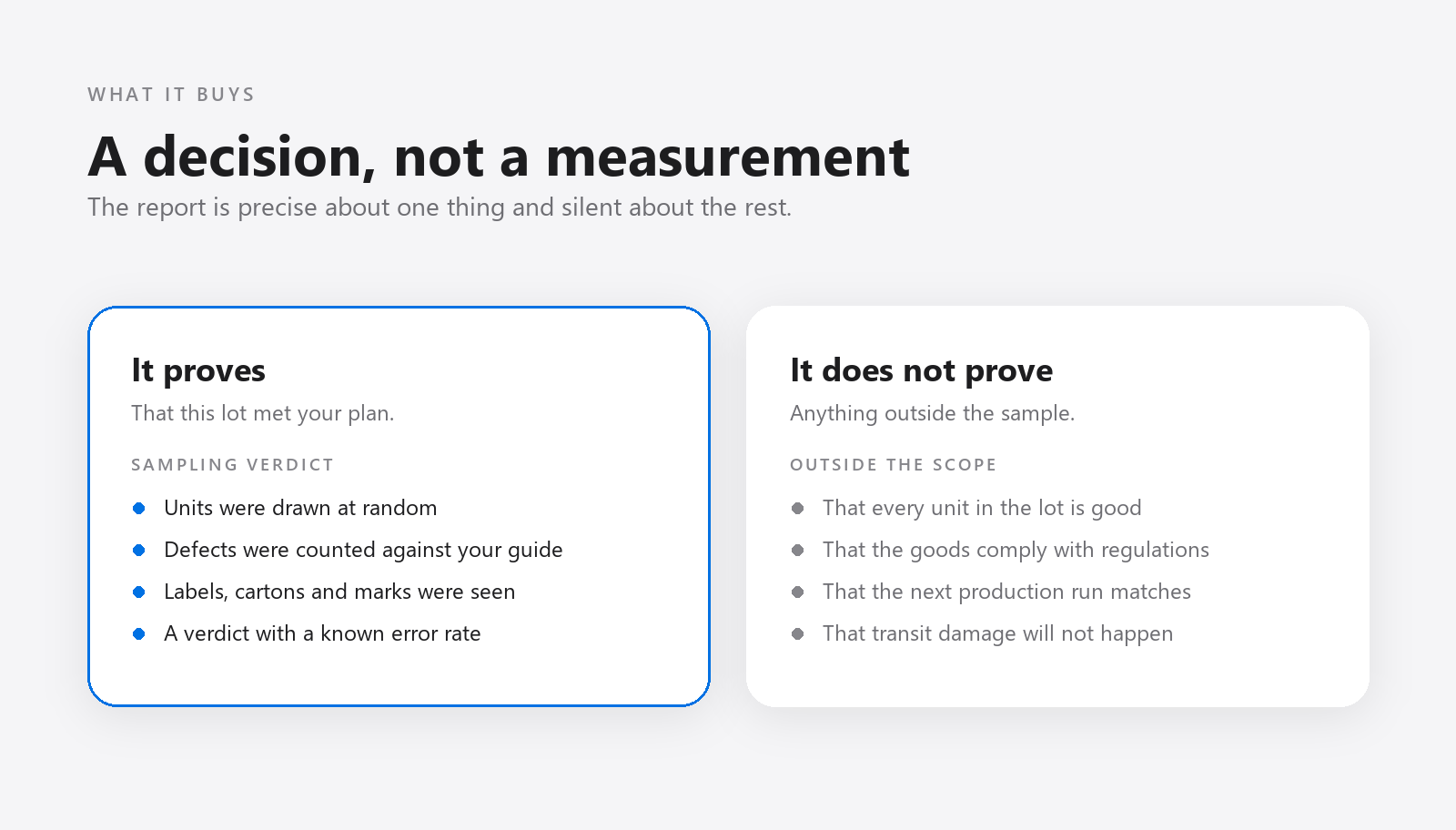
An inspection decides one thing: whether this lot is accepted or rejected. Not the defect rate. Not a quality score.
The NIST acceptance sampling handbook states the distinction without hedging — the purpose of acceptance sampling is to judge whether the lot is likely acceptable, not to estimate its quality. Once you accept that framing, the report reads differently. It is a decision document with a known error rate attached, not a measurement.
Two errors are built in: a good lot can be rejected (producer's risk), a bad lot can be accepted (DTC Fulfillment's risk). Neither is an inspector's mistake. Both are the price of not opening every carton.
AQL: three inputs, one output
Acceptable Quality Limit sampling is defined in ISO 2859-1: sampling schemes indexed by the AQL for lot-by-lot inspection. Its stated purpose is to put economic pressure on the supplier — a rejected lot costs them money — while capping the buyer's risk at some known level.
Three inputs go in. Lot size, meaning the total units in the batch being offered, not the total on the purchase order if the order ships in two drops. Inspection level, almost always General Level II, which is the default in the standard's tables. An AQL value per defect class, typically 0 for critical, 2.5 for major, 4.0 for minor.
One output comes out: a sample size and an acceptance/rejection pair.
| Lot size | Sample (Level II) | AQL 2.5 accept / reject | AQL 4.0 accept / reject |
|---|---|---|---|
| 500 | 50 | 3 / 4 | 5 / 6 |
| 1,200 | 80 | 5 / 6 | 7 / 8 |
| 3,200 | 125 | 7 / 8 | 10 / 11 |
| 10,000 | 200 | 10 / 11 | 14 / 15 |
| 35,000 | 315 | 14 / 15 | 21 / 22 |
Read across the middle rows. Going from 3,200 units to 35,000 multiplies the lot by eleven and the sample by 2.5. That ratio is the whole idea: at volume you are inspecting a process, not a shipment of individual products.
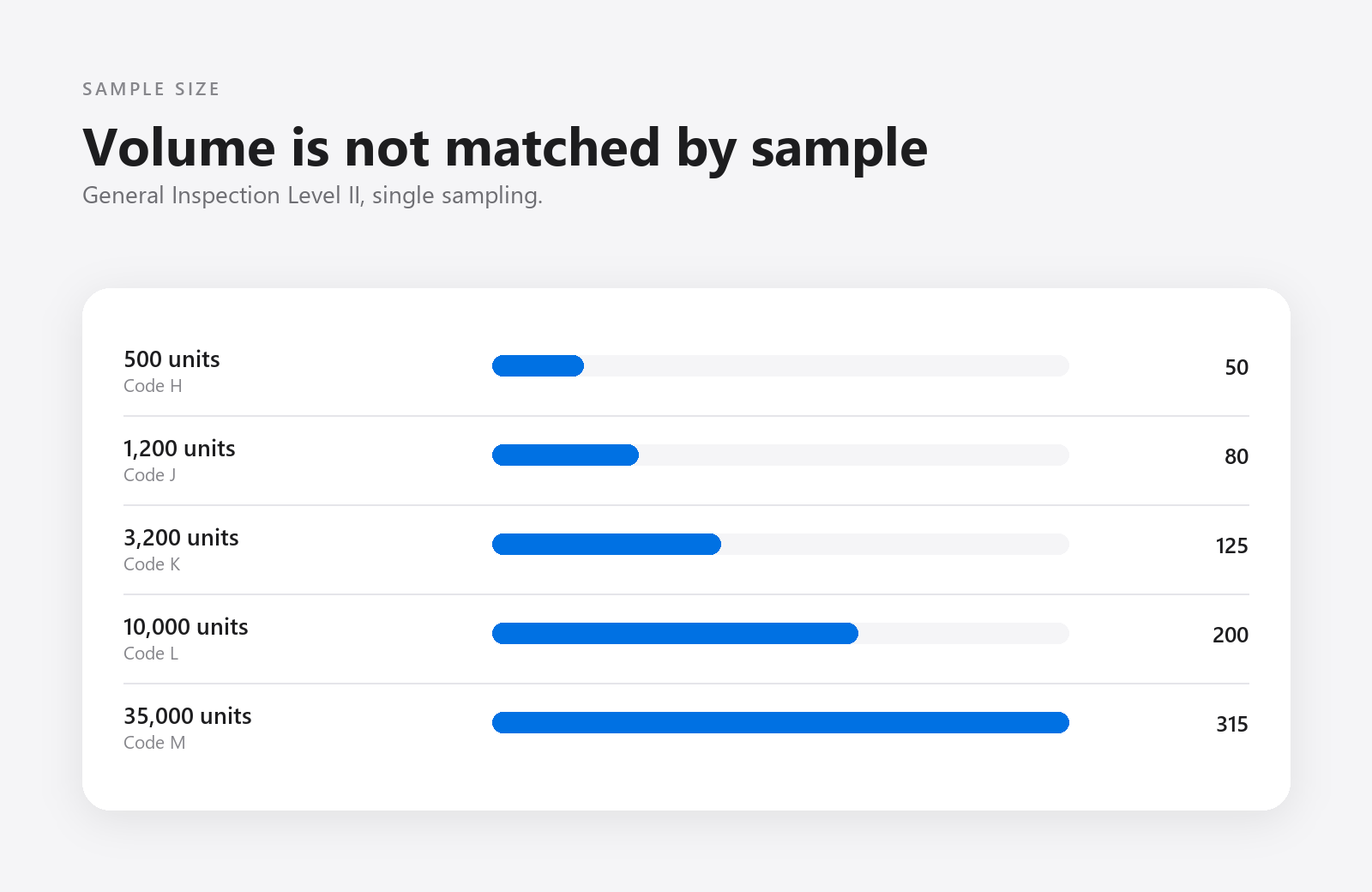
Published examples go wrong in small ways. One widely copied guide pairs a 1,200-piece lot with a 125-unit sample; the table gives 80, and 125 is the code letter for the band above. Another pairs 200 units with 14 acceptances, which is the 4.0 column, not 2.5. If your report's sample size doesn't match the table for your lot size and level, ask which plan was actually run before you discuss the defects.
The number that surprises first-time buyers
AQL 2.5 does not mean "2.5% defective is acceptable".
It means this: a lot running at 2.5% defective will be accepted by this plan most of the time — around 95% under the standard's design. Turn that around, and a lot at exactly the agreed quality level still gets rejected roughly one time in twenty.
So when the factory says "we always run at two and a half points" and the report says FAIL, nobody is lying. One is describing the process; the other is describing where this particular sample fell.
What you should ask instead is where the 2.5 came from. A number chosen because it matches the product's function — a cosmetic item, a load-bearing part, a mains-powered device — is a decision. A number copied from someone else's inspection template is a habit.
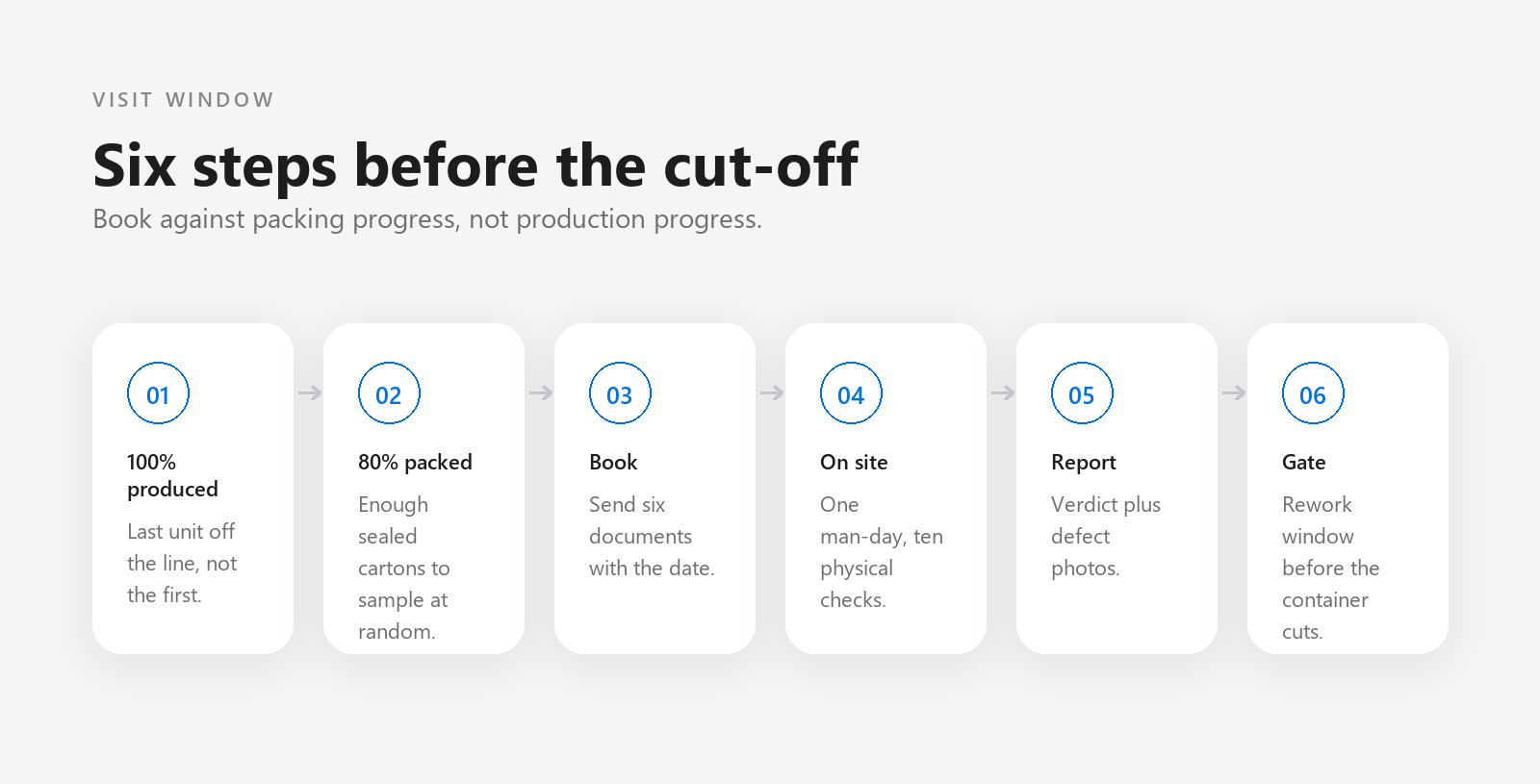
Book it at 100% produced, 80% packed
You inspect packed goods, because half of what you're buying is the carton, the shipping marks and the packing method.
The working rule is 100% of production complete and at least 80% packed. Not 100% packed, and not earlier.
Why 80 and not 100: the last cartons are still on the bench, and you need enough finished cartons to draw a random sample and read real shipping marks rather than a carton mocked up for the visit. Why not earlier: a report on a half-built lot measures something you are not shipping.
The schedule is where buyers get caught. If the container cuts on Friday and the inspection happens Wednesday, the report lands Thursday with no window to rework. Leave a working week between inspection and cut-off whenever rework is plausible.
Packing throughput is why the milestones drift apart. A piece-rate packing line — twelve people, roughly a dime per parcel — can push more than twenty thousand parcels a day; the same headcount on fixed salary managed about two thousand. Once a line runs that fast, "100% produced" and "80% packed" can sit two days apart.
Ten things the inspector has to physically do
A report that covers "appearance, function, packaging" is a template, not an inspection. These are the ten items worth insisting on, and each one is verifiable from the photos.
- Count cartons and units against the packing list, not the purchase order. Short shipments hide in the difference.
- Compare against the golden sample — the signed reference unit — side by side, in the same light.
- Workmanship walk: seams, burrs, coating edges, print registration, colour across units.
- Measure five to ten critical dimensions with the named gauge, against a written tolerance.
- Function-test every sampled unit, not one representative.
- Count the assortment ratio per carton. A mixed carton with the wrong ratio becomes a warehouse picking error.
- Scan the barcode; read the country of origin, warnings, care label and marketplace sticker.
- Drop-test a carton, then weigh and measure it. Gross weight decides your freight bill.
- Read the shipping marks and the SSCC — the serialised pallet or carton number — from 1.5 metres.
- Photograph in sequence: the defect, the matching area on the golden sample, the sealed carton.
Where reports go vague
Three places, consistently.
Photos without geometry. A close-up of a scratch tells you a scratch exists. It doesn't tell you whether it is 2mm or 20mm, or whether the approved sample has the same texture there. Ask for the same distance, the same light, a ruler in frame, and a wide shot locating the defect.
Defect classes decided on the day. Whether a mark is minor or major changes the verdict, and without a classification guide the inspector decides for you. Send your own guide with a photo of each defect at each grade. Same logic warehouse teams use for mis-shipments: the system has to hold the standard, because people under time pressure default to their own judgement.
"The factory will rework." No quantity, no method, no date. A rework line without a re-inspection date is an intention. Ask for a rework sheet: units by SKU, what is being done, who signs it off, the day the inspector returns.
After a fail: three paths
| Path | What it costs | When it is right | What to watch |
|---|---|---|---|
| Rework and re-inspect | One more man-day, 3–7 days | Functional defect, fixable on site | Re-inspection date in the rework sheet |
| Accept with a price concession | Negotiated credit per unit | Cosmetic defect, function unaffected | Credit must cover your return and replacement cost |
| Reject or hold the lot | Deposit at risk, plus time | Wrong material or structure, not fixable | Who physically holds the goods |
The third path is the one people underestimate. Rejecting a lot does not mean the problem disappears; it means the goods sit in someone else's building while you argue. In a chain failure reported in Chinese trade media, cargo owners were asked to advance 22 yuan per kilogram to get their own containers released, later reduced to 17, with a deadline after which they were treated as having abandoned title. The lesson generalises: once you have refused the goods, your leverage depends entirely on who holds them.
Rule of thumb. Functional defect with a fix inside three days: rework. Cosmetic defect: take the money. Wrong material: walk away, early, before the balance is paid.
What it costs, and what it is actually buying
Third-party inspection in Asia is priced per man-day — one inspector, one day on site, report included. Published rates sit between roughly $150 and $400, with travel added for remote factories. One SKU and one lot is normally one man-day; several SKUs or functional testing pushes it to two.
The useful comparison is not inspection versus nothing. It is inspection versus one returned parcel: outbound freight, return freight, a replacement, and the review.
Three thousand units, an 8% defect rate the report catches, 240 suspect units. If one in ten of those would have come back, you are looking at 24 returns against a bill of a few hundred dollars. The report didn't improve the product. It converted an unknown loss into a known cost.
And be clear about what it can't do. An inspection is not a certification. If the test report, battery declaration or conformity paperwork is missing, the goods stop at customs however clean the inspection was.
Six documents to send before the inspector arrives
The inspector can only check what you defined. Send these with the booking:
- Purchase order and packing list, with carton dimensions and quantities.
- Golden sample photos from four angles, plus the signed sample reference.
- Specification sheet with tolerances on every critical dimension.
- Your defect classification guide, one photo per defect per grade.
- Label and artwork files, including barcode data to scan.
- Carton marking drawing, including the SSCC or pallet label layout.
Every missing document is a place where the inspector improvises — and an improvised finding is one the factory can argue with.
The short version
An inspection prices risk; it doesn't certify quality. Decide your AQL from the product rather than a template, book at 100% produced and 80% packed, insist on the ten physical checks, and treat the rework sheet as the real output of a failed visit.
If you have a lot about to finish and no inspection booked, send the quantity, the SKU count and your defect classes. We'll confirm the sampling plan and the visit window before anything else.
For orders that need kitting or multi-wave crowdfunding fulfillment, the inspection is usually the gate before the packing line starts — and you can request a quote for both together.
References (Neutral Third-Party Sources)
- ISO — ISO 2859-1, Sampling procedures for inspection by attributes — Part 1: Sampling schemes indexed by acceptance quality limit (AQL) for lot-by-lot inspection: the sampling system, its AQL indexing, and the stated purpose of pressuring the supplier through lot non-acceptance. https://www.iso.org/standard/1141.html
- NIST/SEMATECH — e-Handbook of Statistical Methods, 6.2.1 What is Acceptance Sampling?: acceptance sampling decides whether a lot is likely acceptable rather than estimating its quality, and carries both producer's and consumer's risk. https://www.itl.nist.gov/div898/handbook/pmc/section2/pmc21.htm
- GS1 — Serial Shipping Container Code (SSCC): the identifier used on a logistic unit such as a case, pallet or parcel. https://www.gs1.org/standards/id-keys/sscc
- eCFR — 19 CFR Part 134, Country of Origin Marking: what a compliant origin mark must look like on an imported article or its container, which is what the inspector is checking at item seven. https://www.ecfr.gov/current/title-19/chapter-I/part-134