
Subscription Box Fulfillment: A 3PL's Guide to What Really Matters
A subscription box is a production run, not a pile of orders. One date — the day the subscriber list locks — decides everything upstream of it: when contents are approved, when components must land, when the assembly line starts, and how many days you have to hand the batch to a carrier. Miss that date by four days and you don't ship four days late. You ship a different box, to everyone, and you hear about it in the reviews.
The unboxing is the easy part. What breaks, month after month, is version control: contents change once per cycle, and every station, label and invoice line has to change with them.
One date decides the whole month
Pick the ship window, then count backwards. Corporate Gift Boxes that must land in the first week of the month leave in the last week of the previous one, so the build starts around the 20th, components were counted by the 15th, and the purchase order went out a month earlier.
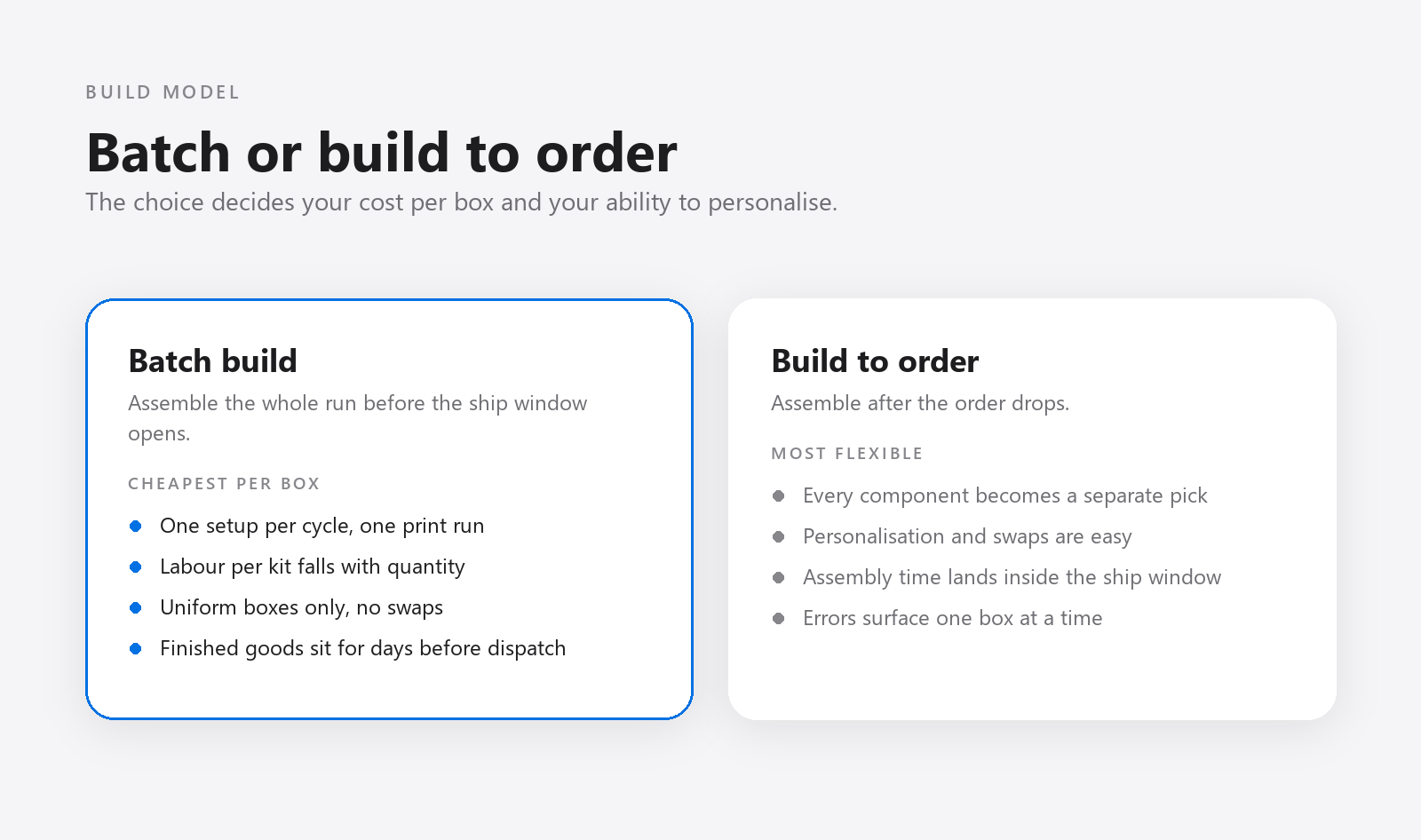
There is no slack at the end. A monthly cycle gives roughly 30 days between drops, and the assembly window inside it runs five to ten working days — less if the same crew also handles the store's one-off orders.
Operators who hit the date have a list-lock date they refuse to move, and a build that starts before the orders arrive. One accessories seller pre-packed popular items so a 100,000-order day still shipped 40,000 parcels; a 4,000-box drop is the same idea with eight components per unit.
The five gates of a monthly cycle
Every cycle passes the same gates, and each one freezes something different.
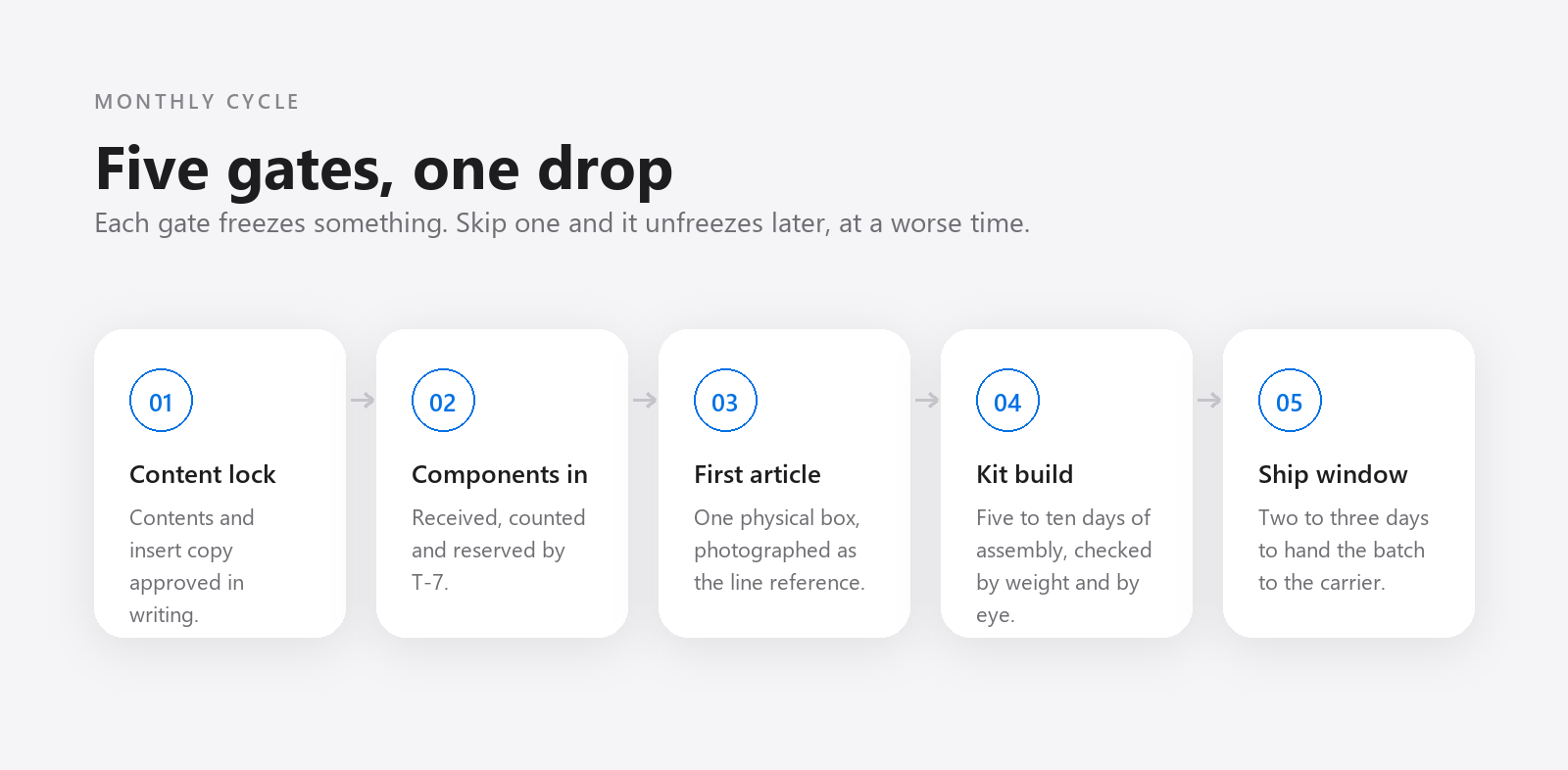
| When | What freezes | Who signs off | If it slips |
|---|---|---|---|
| T-28 | Contents approved, purchase orders placed | Brand | Components land late; the build compresses into three days |
| T-21 | Insert copy and packaging artwork released to print | Brand and printer | Dated cards arrive after the boxes are built |
| T-14 | Bill of materials and kit SKU loaded, first article built | Brand and 3PL | The wrong version ships to the whole list |
| T-10 | Subscriber list, addresses and skips locked | CRM owner | Late signups get skipped or double-built |
| T-7 | Components received, counted and reserved | 3PL | The line starts on stock nobody verified |
| T-3 | Build complete, QC sample passed | 3PL | The ship window opens with half a run |
| T-0 | Two to three day dispatch window | Carrier | Boxes miss the "arrives by" date you advertised |
Change the contents once, and every station changes
A kit is one saleable unit assembled from several SKUs, which is what kitting and assembly means in practice. The moment a kit exists it needs its own barcode and its own count, while the components behind it keep theirs — sell the kit and the components come down with it. Get that wrong and you oversell a component you thought you had.
The monthly version change is where the discipline is tested. Last month's card looks almost identical to this month's, except it advertises an offer that ended. A sachet from a previous campaign sits in the same bin as the current one. A substituted ingredient has the same weight and a different label.
Weight checks cannot catch that. A 5-gram gate on the finished box catches a missing item and is blind to a right-weight, wrong-version swap. Three controls do catch it: a version code printed on every insert and scanned at the station, a photo of the approved build taped to each station, and superseded print stock removed from the pick face.
Price the box, not the pick
A box with eight components billed as eight picks is not a subscription price; it is a pile of line items. Make the unit of work match the unit you sell.
| What you are billed for | Usual unit | What moves it |
|---|---|---|
| Kit assembly | Per finished box | Component count, insert count, presentation standard |
| Pick and pack | Per order, sometimes per unit | Whether the finished kit ships as one line |
| Inbound receiving | Per carton, per unit or per hour | Supplier carton count and labelling quality |
| Storage | Per pallet position, cubic foot or bin | Packaging and components, not just product |
| Setup or changeover | Per new bill of materials | How often the box changes |
| Returns processing | Per parcel, plus each extra item | Whether the box has to be un-built |
| Postage | Per parcel | Weight, zone and dimensional weight |
One line needs a warning. Carriers bill low-density parcels on dimensional weight: USPS applies it above 1,728 cubic inches, dividing by 139, with a 70-pound ceiling and an oversize price past 108 inches of length plus girth. A box that grows half an inch each way to fit one more sample can cross a billing band — for every subscriber at once.
Two questions separate a partner from a vendor. Is the assembly fee per kit or per pick? And what does a content change cost — a setup fee per new bill of materials turns a monthly redesign into a monthly surcharge.
Three cutoffs, and what each change costs
Most brands run one cutoff, then wonder why the list keeps moving. There are three, and they don't fall together.
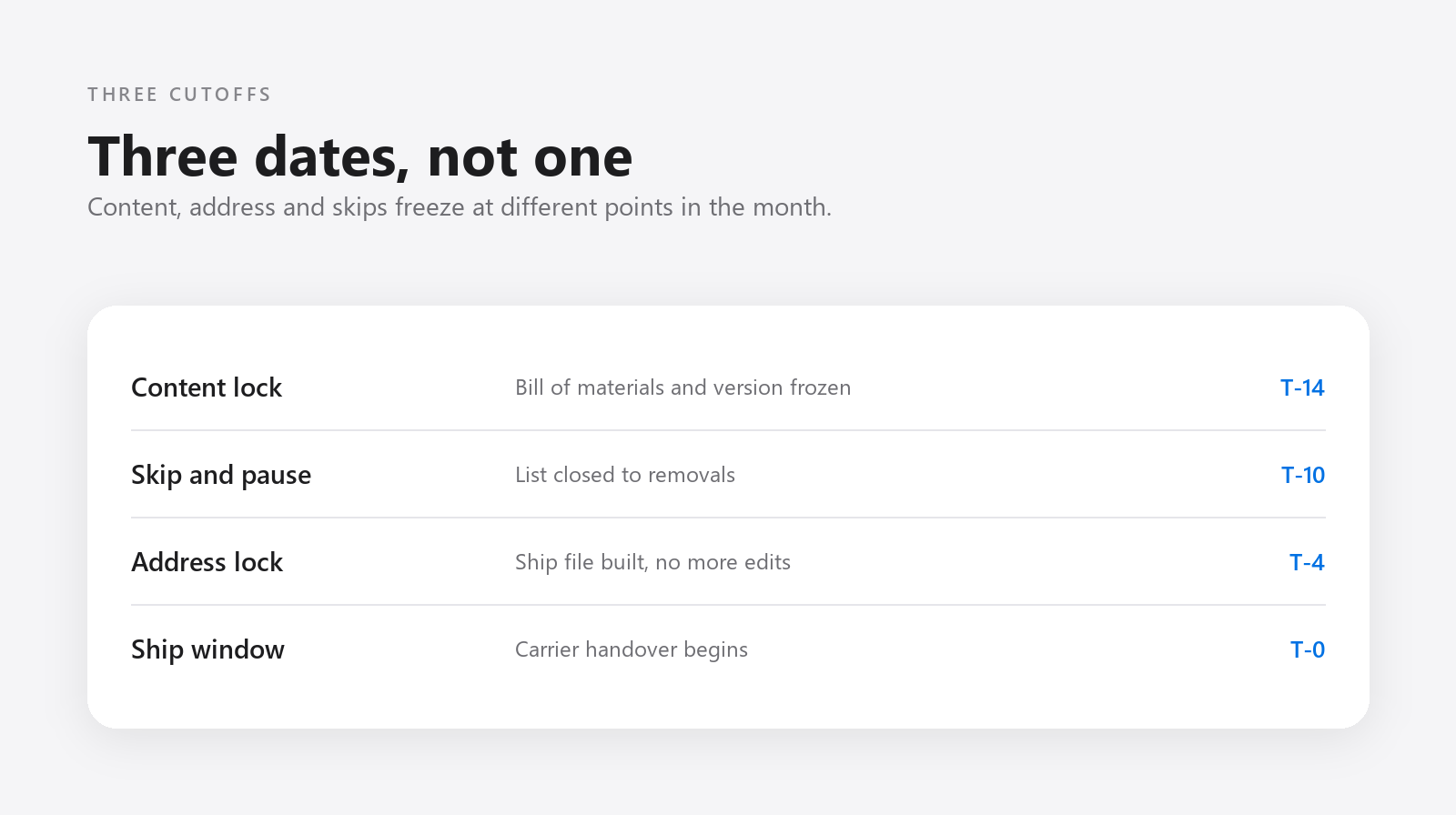
Content locks at T-14, when the bill of materials freezes; after that a substitution is a change order. Address locks when the ship file is generated, three to five days before dispatch — later than that, a change either misses the parcel or triggers a carrier correction fee, which USPS charges per notice when a parcel cannot be delivered as addressed. Skip and pause lock with the list at T-10, because a skip processed after the build starts leaves you with a finished box and no subscriber.
The cost ladder is short. An address change before the file is built is a field edit; after the file, a relabel; after dispatch, a reship. A skip before the build saves the price of a box. After the build it costs the components and the labor, and you carry the finished unit into next month hoping nothing dates.
A pause is a skip with a resume date: does the resumed box get current contents or the paused cycle's? Decide once, in writing — your partner builds what the file says, and the file says what your platform sends. Gift orders need their own file, because the recipient's address arrives separately.
Put all three dates on the account page, not just the FAQ: the most common ticket is someone changing an address on the 28th for a box that shipped on the 26th.
What a short box really costs
A box missing one item is not a partial refund. It is a full reship: the parcel has already travelled.
Run it: 4,000 boxes, 1% short, is 40 reships. Each carries the assembly cost, the postage again, and the original postage you never recover — roughly the price of the box twice. A service credit capped at the assembly fee reimburses a fraction of that.
Then the part that never appears on an invoice: if a fifth of short-shipped subscribers cancel and a subscriber is worth a year of boxes, the lifetime value lost in one cycle exceeds the whole reship bill. That is why "we'll catch it at packing" is not a control — packing is where a missing item is least visible, because the box is already closed.
The cheapest control is a checkweigher tight enough to catch one missing sachet, backed by a sample audit that opens boxes. Weighing catches absence. Only an opened box catches a wrong version.
Returns: the box has to be un-built
A returned box cannot go back on the shelf. It has to be opened, components sorted, dated cards discarded, and sellable items returned to stock with their counts restored. That is de-kitting, and it is the most under-quoted line in subscription fulfillment.
The accounting mirrors it: when a kit sells the components come down, and when it returns they go back up, with anything specific to that month's version heading to scrap. Operators who run bundles at Gifts That Scale treat this as a separate reverse process, not as "returns".
Two rules limit the damage. Keep current packaging and inserts out of the returns area, so a returned October box cannot be mistaken for November stock. And set the disposition rule per component before the first return arrives: resell, refurbish, donate or scrap.
The handoff file, and the first-run test
The file you send each cycle is the product. At minimum: subscriber ID, kit SKU and version code, component quantities, shipping address with country, gift flag and message, skip or pause status, tier or variant, ship window, carrier service, and which insert version to pack.
Send it once, in a fixed format, with a checksum row count. Two versions in one week is how a partner builds 4,000 boxes against last Tuesday's list.
Before committing a season, run one small cycle through the pick and pack service that will handle the drops. Build 10% of the list, ship it, and measure three things: boxes per labor hour, short-ship rate, and the time from list lock to carrier handover. A well-run line produces 30 to 60 boxes per hour per station, so 5,000 boxes need two to three days of a six-person line — if your build window is shorter, urgency will not fix it.
If you want a second pair of eyes on the calendar before the next drop, send the subscriber count, the components per box and the ship window. We will build the T-minus schedule and price the kit first — start here.
References (Neutral Third-Party Sources)
- GS1 US — What is a GTIN?: each distinct product variation needs its own identifier, and why an internal SKU is not a substitute once the box itself becomes a sellable unit. https://www.gs1us.org/upcs-barcodes-prefixes/what-is-a-gtin
- USPS Domestic Mail Manual 253 — Parcel Select Prices and Eligibility: dimensional weight above 1,728 cubic inches, the 70-pound ceiling and the length-plus-girth threshold for oversize pricing. https://pe.usps.com/text/dmm300/253.htm
- USPS Domestic Mail Manual 507 — Mailer Services: Address Correction Service, and the per-notice fee charged when a parcel cannot be delivered as addressed. https://pe.usps.com/text/dmm300/507.htm
- USPS — Mailing & Shipping Prices: commercial and retail prices diverge for the same service, which is why postage bought at low volume is not a benchmark. https://www.usps.com/business/prices.htm
- NIST — Handbook 44: Specifications, Tolerances and Other Technical Requirements for Weighing and Measuring Devices: the accuracy tolerances behind any weight-based verification step. https://www.nist.gov/pml/weights-and-measures/publications/nist-handbooks/handbook-44