
B2B Fulfillment: How It Differs from Consumer Fulfillment
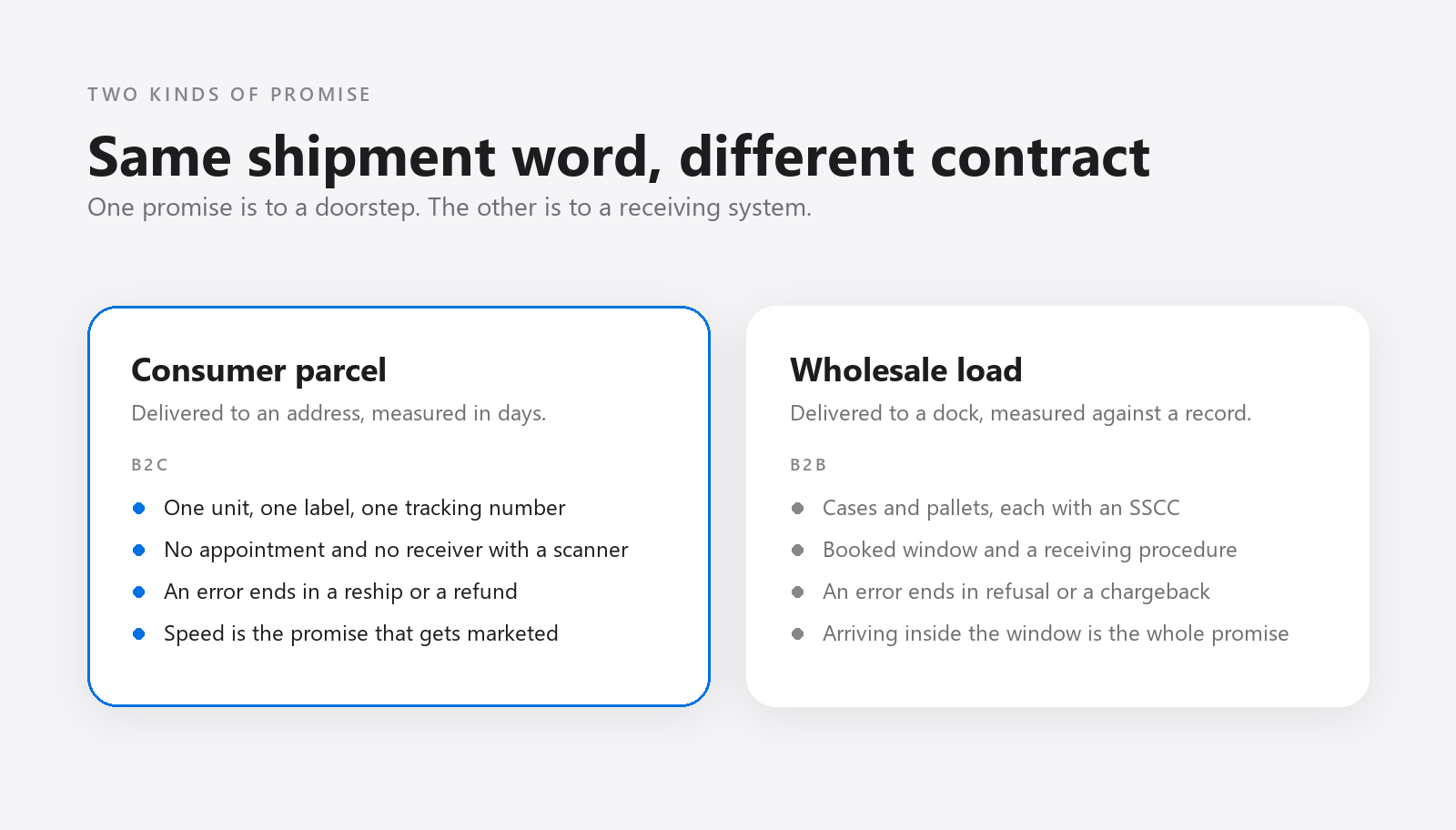
B2B fulfillment sells a delivery promise, not a bigger parcel. The promise names a quantity, a day, a dock window and a label on every carton. Break one clause and the goods are refused at the door or received and deducted from your invoice.
A consumer order that goes wrong costs a reship and a review; a retail purchase order costs return freight on a full truck and a buyer who does not reserve shelf space next season. Same word, different economics — because a parcel goes to an address, while a pallet goes to a receiving function: a dock with a schedule, a receiver with a scanner, and a system holding a record of what you said you were sending.
The order unit changes first
Every SKU carries at least three identities: the each, the inner pack, the case. A sales team saying "one" can mean any of them, and the warehouse only knows which because the item master says so.
Get that wrong and the pick list asks for something impossible. Either someone breaks a sealed case to pull a unit — and that case can no longer be sold as a case — or the system deducts a full case for a single unit and the count drifts.
Above the case sits the pallet. In North American mass retail the working standard is the 48 × 40 inch pallet, with a height limit set by the receiver and a Ti-Hi pattern that decides cartons per layer and layers per load. Carton size is a logistics decision: a modest carton change has been reported to lift pallet utilization by roughly 20%, which across a year of replenishment is real freight money.
Pallet breakdown means rebuilding a mixed or full pallet into something a single store can shelve. Some receivers want the pallet intact, some want a store-ready mixed pallet — work that belongs to kitting and assembly. Two pick paths in one building.
Eight differences that change the work
| Area | Consumer order | B2B order |
|---|---|---|
| Order unit | Single units, 1–2 per order | Cases, pallets, mixed pallets |
| Picking | Broken-case pick, unit scan | Full-case or pallet pick, pallet verify |
| Paperwork | Carrier label, optional packing slip | BOL, ASN, packing list, commercial invoice |
| Labeling | Carrier shipping label | GS1-128 carton label plus SSCC pallet label |
| Receiving | Delivered to a door, no appointment | Booked dock window at a fixed time |
| Speed target | As fast as possible | Inside the window; early is late |
| Cost of an error | Reship, refund, review | Refusal, chargeback, supplier scorecard |
| Returns | Consumer posts it back | RTV under agreement, with a credit memo |
The table invites a lazy conclusion, that B2B simply has more rules. The real dividing line is whether the receiver owns a written receiving procedure. Twelve cartons to an independent shop can be unloaded after a phone call; the same twelve to a chain distribution center need a booking number.
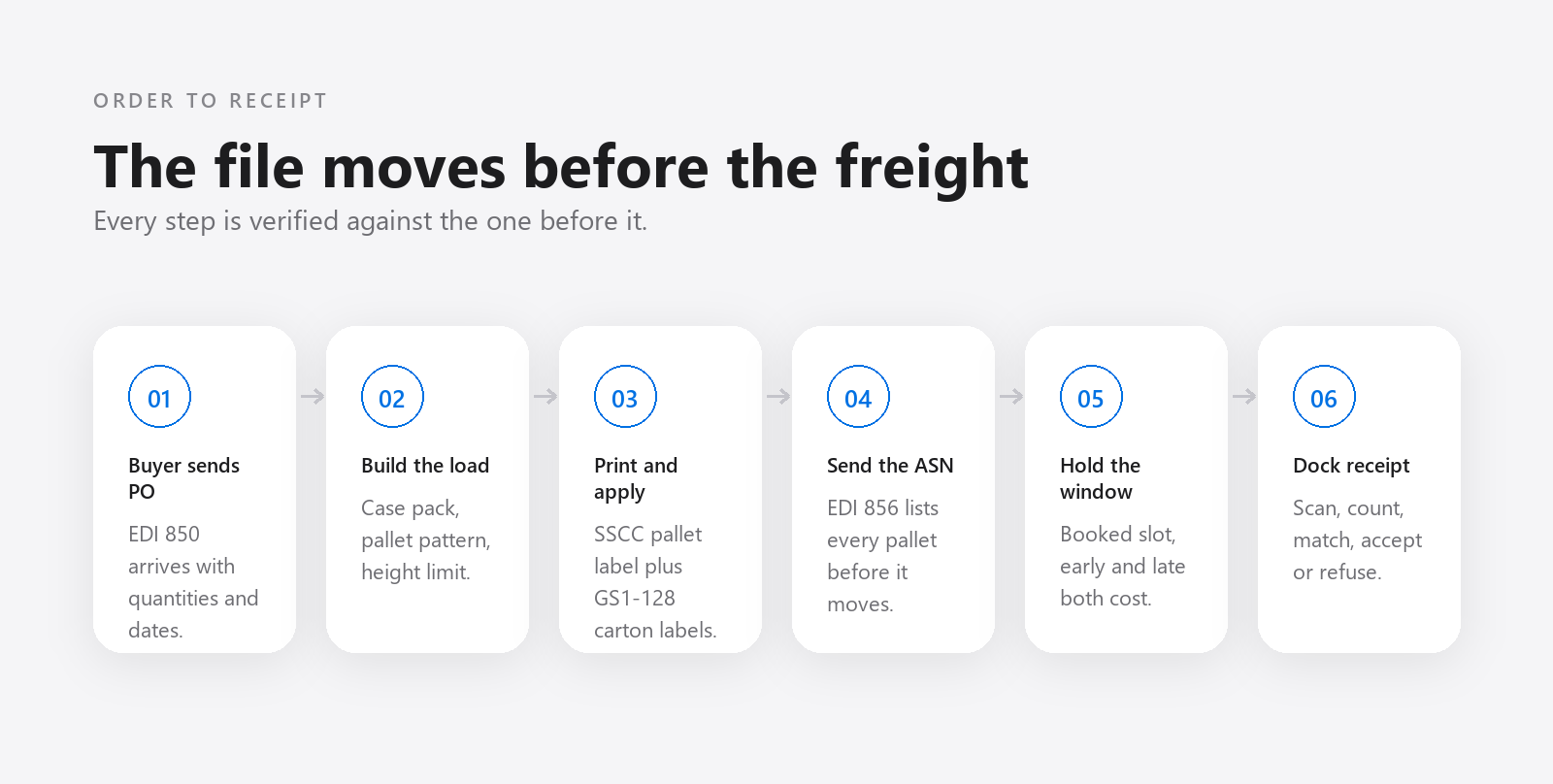
The ASN arrives before the truck does
Buyers do not text a replenishment request. They send EDI: 850 for the purchase order, 856 for the ship notice, 810 for the invoice. GS1 counted roughly 126,000 companies running its EANCOM standard in 2020, and the three most-used messages were the order, the invoice and the despatch advice.
The 856 is the ASN, or advance ship notice. It tells the receiver, before arrival, how many pallets are coming, which SSCC identifies each one, and how many cartons of each GTIN sit on each pallet.
The receiver scans the pallet's SSCC, the system finds it in the ASN, the expected contents appear, and the receipt takes minutes. If the SSCC is missing, the pallet goes to an exception lane. Hence the fixed order: ASN first, goods second. An ASN riding with the truck arrived too late.
Labels are where compliance failures start
GS1's logistics label guideline is blunt about hierarchy: the SSCC is the only mandatory element, eighteen digits, in the bottom barcode. Placement is specified too — on a pallet between 400 and 800 mm from the base and at least 50 mm from any vertical edge; on a carton, 32 mm from the natural base and at least 19 mm from the edge.
Those are not typography rules. A forklift driver scans from the seat at a fixed angle, so a label placed low gets scuffed by the fork pocket and one near the edge gets crushed under stretch wrap. A barcode that will not scan is a missing barcode, and a missing one stops the receipt.
This is where chargebacks come from: a deduction the receiver takes off your invoice because the shipment failed a rule — wrong label, missing ASN, pallet outside spec, late inside the window. Schedules vary, from a flat amount per carton to a percentage of the invoice. There is no universal number, so ask for the schedule in writing.
The heavier consequence is the supplier record. One missed window is a penalty; a pattern puts your vendor ID at risk.
The dock window is a deadline in both directions
Appointment systems release slots in blocks: a distribution center has fixed doors and slots per hour, and your booking is the only time your carrier can be at that door.
Late is a miss. Early can be one too: the door is still occupied, your driver waits outside, and the wait bills by the hour as detention. To hit a 6 a.m. Tuesday slot the load closes Monday midday, so picking and labeling finish Monday morning, so stock was put away before that. Work backwards from the appointment, never forwards from the order.
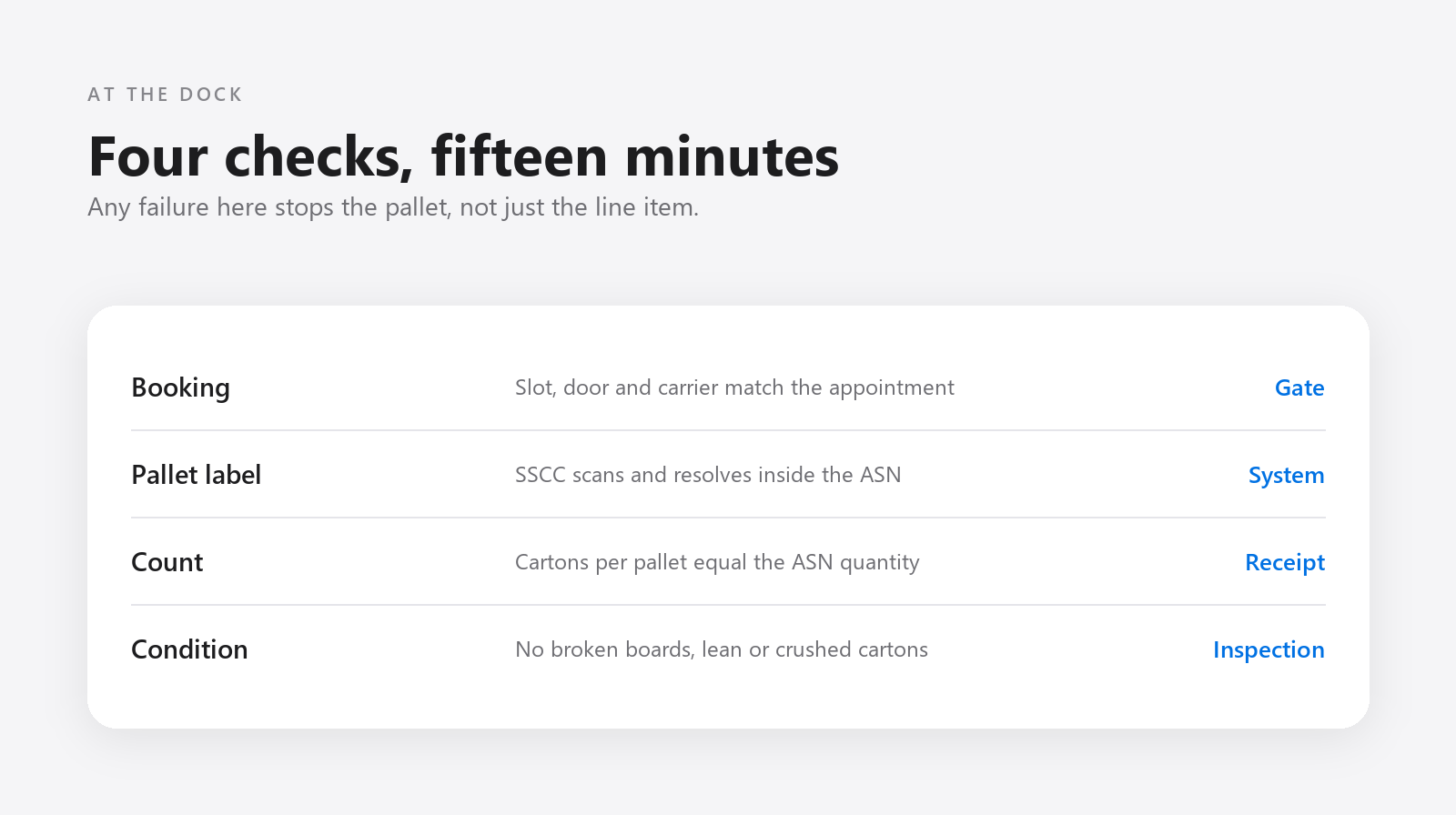
The pallet is inspected too. Broken deck boards, protruding nails, loose wrap, a load taller than allowed — any of these can turn it away. Wood pallets need the right heat-treatment mark for the destination.
One case short, and the whole pallet goes back
The receiver counts against the ASN. When the count disagrees, there are usually three options: receive the actual quantity against that PO line, refuse the pallet, or refuse the load. Which one happens is in their receiving procedure.
Most chain operations record the difference as OSD — over, short, damaged — and give the supplier a fixed number of days to dispute with evidence. When that window closes, the difference becomes a deduction.
The counterintuitive part: over-shipping is also a discrepancy. One extra carton and one missing carton both mean "does not match the ASN", and both start the same exception process.
So the final count before dispatch runs pallet by pallet against the SSCC, not SKU by SKU against a total. A total that reconciles while individual pallets do not is the common version of this error.
Case picking is a different warehouse
The error-proofing from a good e-commerce operation transfers, and should. Scan location and item so a wrong pick cannot advance. Weigh each packed order against a stored expected weight, tight enough to catch a missing insert — one Chinese warehouse describes a 5 gram trigger. Scan the carrier label against the order so the two cannot disagree. Sites running all three report error rates near five per hundred thousand units.
What does not transfer is the labor model. Broken-case work has a natural unit: one Chinese seller moved from a fixed wage, where twenty-odd people shipped about 2,000 orders a day, to piecework at roughly ¥0.10 per parcel, where six packers and six pickers shipped more than 20,000. Same twelve people, tenfold output, because the unit of work is small and countable.
Case picking has no such unit. Output is measured in pallets and cases, and a few hundred cases is a solid day. That is the real reason parcel warehouses decline B2B work: not the scanning, the aisle. Shelving and pack benches on a pick and pack line are built for single units; pallets need forklifts, wider aisles, floor loading limits and a dock at the right height.
Cost follows the pallet, not the parcel
Warehouse rent is fixed. A 40,000 square meter building costs the same at 100,000 orders a day or 10,000. Packaging is variable: one retail operation calculated that cutting a carton from ¥1.50 to ¥1.20 saves ¥30,000 a day at 100,000 orders, over ¥10 million a year.
B2B cost sits elsewhere — pallet positions, dock time, and value-added work such as labeling, mixed-pallet building, wrapping and banding. None of that appears on a parcel rate card, which is why B2B quotes read per pallet received, per position stored, per case picked, with value-added work and freight on separate lines.
Converting fixed into variable is the logic behind outsourcing. One retail group reported 10–20% annual logistics savings from splitting transport and delivery out by region and function — though the range depends on volume and policy.
Six things to confirm before the first purchase order
| Item | Get in writing | What goes wrong without it |
|---|---|---|
| Routing guide | Full PDF, not a summary email | Carrier and label rules differ from your assumption |
| EDI 856 test | End-to-end in production | Receiver cannot resolve your SSCC |
| Label sample | Signed approval with tolerance | Scans here, fails at their dock |
| Appointment access | Login, release time, reschedule rule | You learn the slot system too late |
| OSD process | Dispute window and named contact | Differences turn into deductions unopposed |
| Chargeback detail | Reason codes on the statement | You pay deductions you cannot trace |
If a row is vague, ship one test pallet first.
The verdict at the dock is binary: inside spec or outside it, no category for close. Get the unit right, send the ASN first, measure the label, hold the window, count by pallet. Price is a conversation you can only have after those five are boring.
If your first retail PO is still ahead of you, send the case pack, the pallet configuration and the receiver's label sample for a quote. We will run a compliance pre-check against their routing guide before anyone talks about rates.
References (Neutral Third-Party Sources)
- GS1 — Serial Shipping Container Code (SSCC): defines the identifier used on a logistic unit such as a case, pallet or parcel. https://www.gs1.org/standards/id-keys/sscc
- GS1 — GS1 Logistic Label Guideline, Release 1.3: SSCC as the only mandatory label element; pallet label placement at 400–800 mm from the base and 50 mm from edges; carton label at 32 mm from the base. https://www.gs1.org/standards/gs1-logistic-label-guideline/1-3
- GS1 — GS1 EDI: order, invoice and despatch advice as the most-used messages; about 126,000 companies implementing EANCOM in 2020. https://www.gs1.org/standards/edi
- GS1 — Global Trade Item Number (GTIN): how trade items are identified at each packaging level. https://www.gs1.org/standards/id-keys/gtin
- GS1 — Global Location Number (GLN): identification of legal entities, functions and physical locations, including receiving points. https://www.gs1.org/standards/id-keys/gln
- U.S. Bureau of Labor Statistics — Wholesale and Manufacturing Sales Representatives: the commercial side of B2B selling. https://www.bls.gov/ooh/sales/wholesale-and-manufacturing-sales-representatives.htm
- U.S. Bureau of Labor Statistics — Heavy and Tractor-Trailer Truck Drivers: the freight labor that carries palletized loads. https://www.bls.gov/ooh/transportation-and-material-moving/heavy-and-tractor-trailer-truck-drivers.htm