
Omnichannel Fulfillment: What It Is and Why It Matters
Omnichannel fulfillment means one pool of stock is sold through every channel you run, and every channel makes a delivery promise against that same pool. The stock is the easy part. The promises are not.
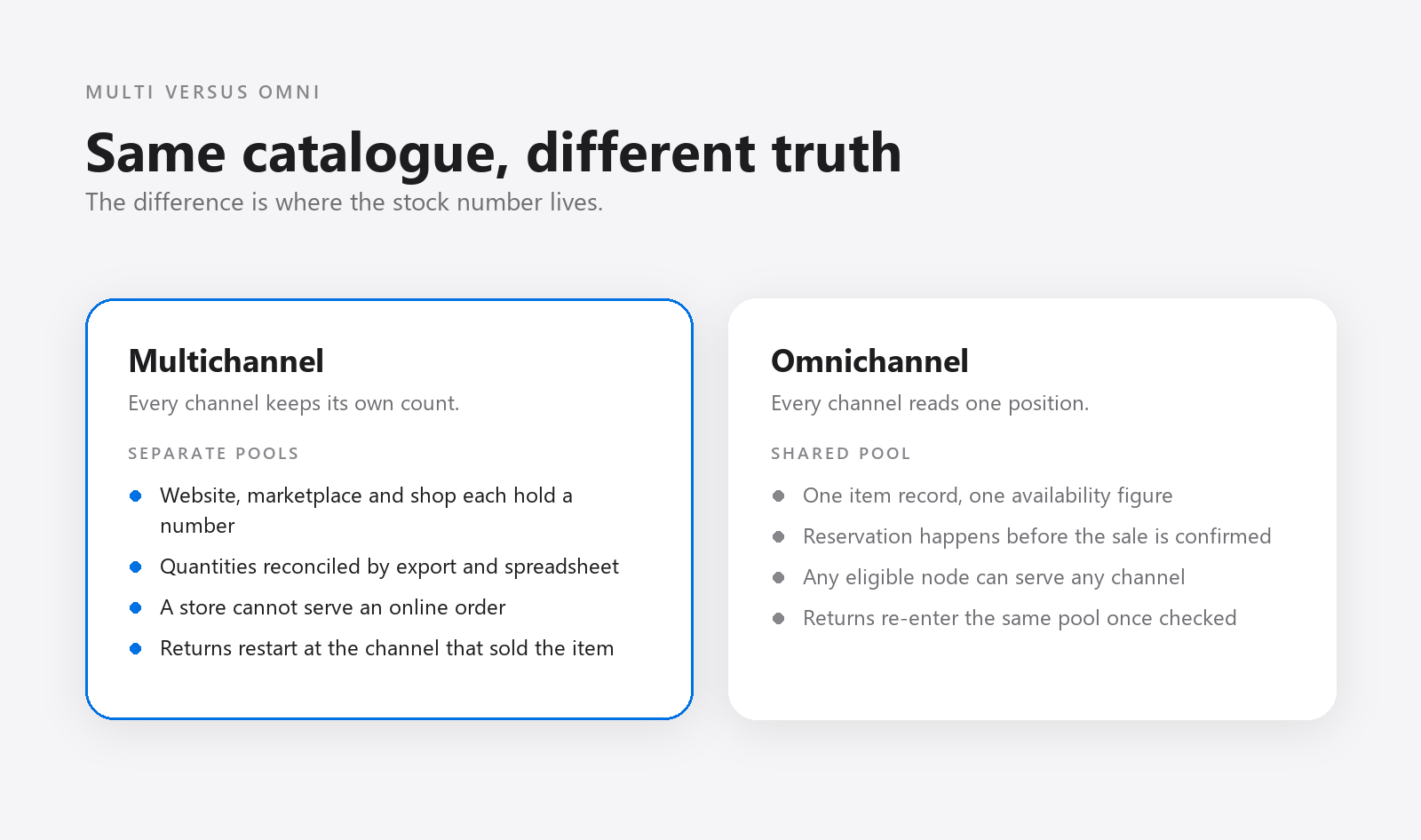
A multichannel retailer keeps a website, a marketplace storefront and a shop, and each one has its own number for the same SKU. An omnichannel retailer has one number, and the hard part is deciding, between checkout and pick, which promise that number can still keep.
Most failures look like warehouse mistakes and are not. They are decisions about inventory truth and delivery promises that were never made explicitly, so the system made them by default.
What omnichannel actually changes
The word gets used for anything with more than one sales channel. The operational definition is narrower: inventory is shared, orders can be served from more than one node, and the customer can move between channels without restarting the order.
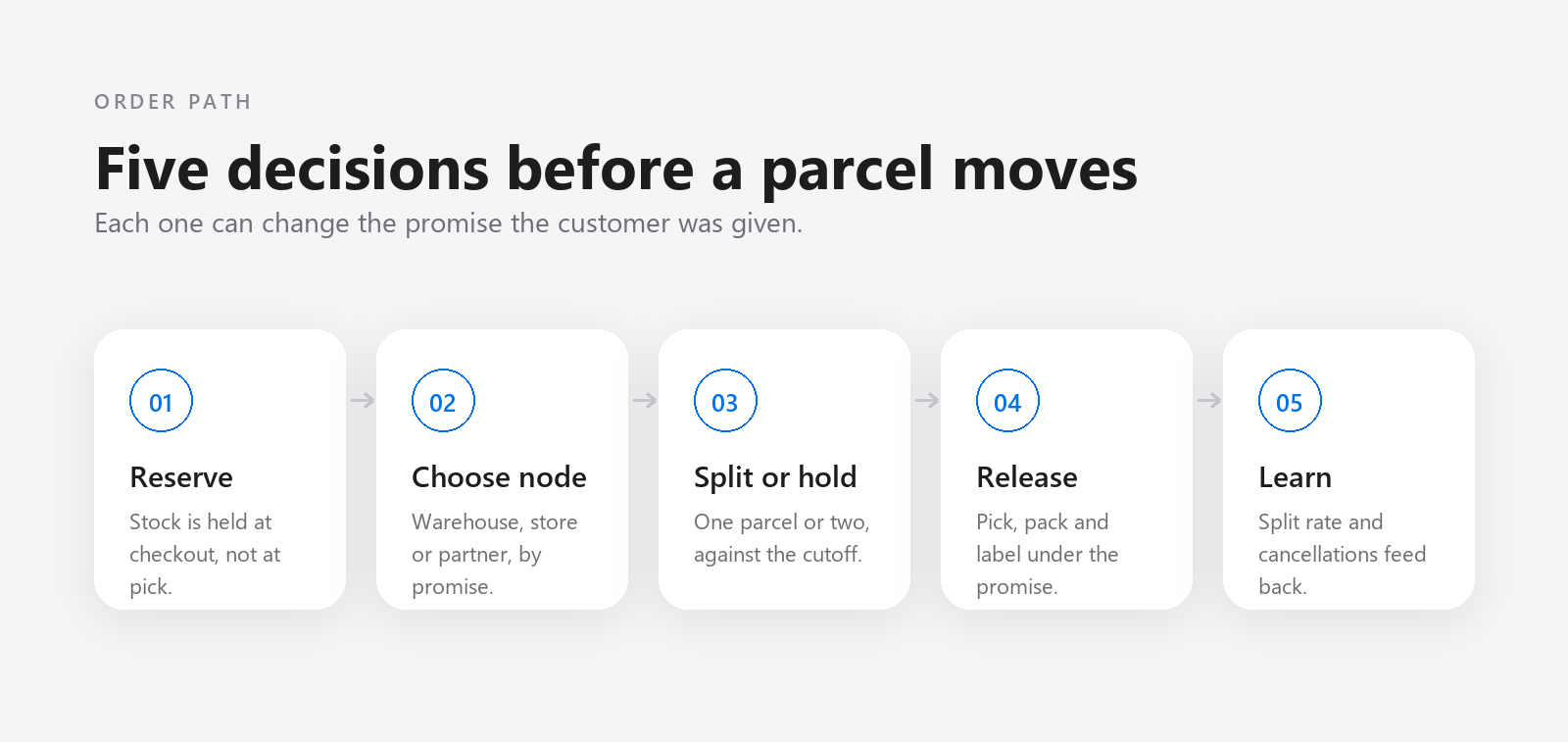
That third part separates omnichannel from "we also sell on Amazon". Buy online and pick up in store, return an online purchase in store, order in store for home delivery — each is a routing decision, and each assumes the store and the warehouse read the same stock position.
Once a store holds sellable stock it needs an identity in the same system as the warehouse — a location code the order platform can route to. GS1's Global Location Number exists for this: identifying a physical location or function in a way other systems can read.
Three ways to sync inventory, and what each costs
Most builds use one of three sync patterns.
| Method | Data lag | What it protects | Where it breaks |
|---|---|---|---|
| Scheduled batch | 15 minutes to a few hours | Simple builds, low order velocity | A flash sale outruns the job |
| Event push | Seconds, if the event fires | Normal trading across channels | Missed events leave silent gaps |
| Live reservation | Immediate | High-velocity SKUs and marketplaces | Needs one owner of the stock record |
Batch is the default because it is cheap. A job runs every quarter hour and everything looks fine until a promotion moves several days of stock in twenty minutes. Event push improves the lag but not the logic: if the warehouse never sends the pick event, the channel keeps believing the unit is there.
Live reservation removes the gap structurally, because the channel asks permission before it sells instead of reporting afterwards. It also concentrates risk: one service decides what every channel may promise, so when it is wrong, it is wrong everywhere at once.
How overselling actually happens
Overselling — selling a unit twice — usually gets blamed on a slow sync. The arithmetic is more specific than that.
Say 120 units sit in one location and are listed on three channels. If each channel is told "120 available" rather than being given a share, all three can sell the same units in the same hour. The warehouse then receives three pick lists that cannot all be filled, and the last order to be picked is the one that gets cancelled.
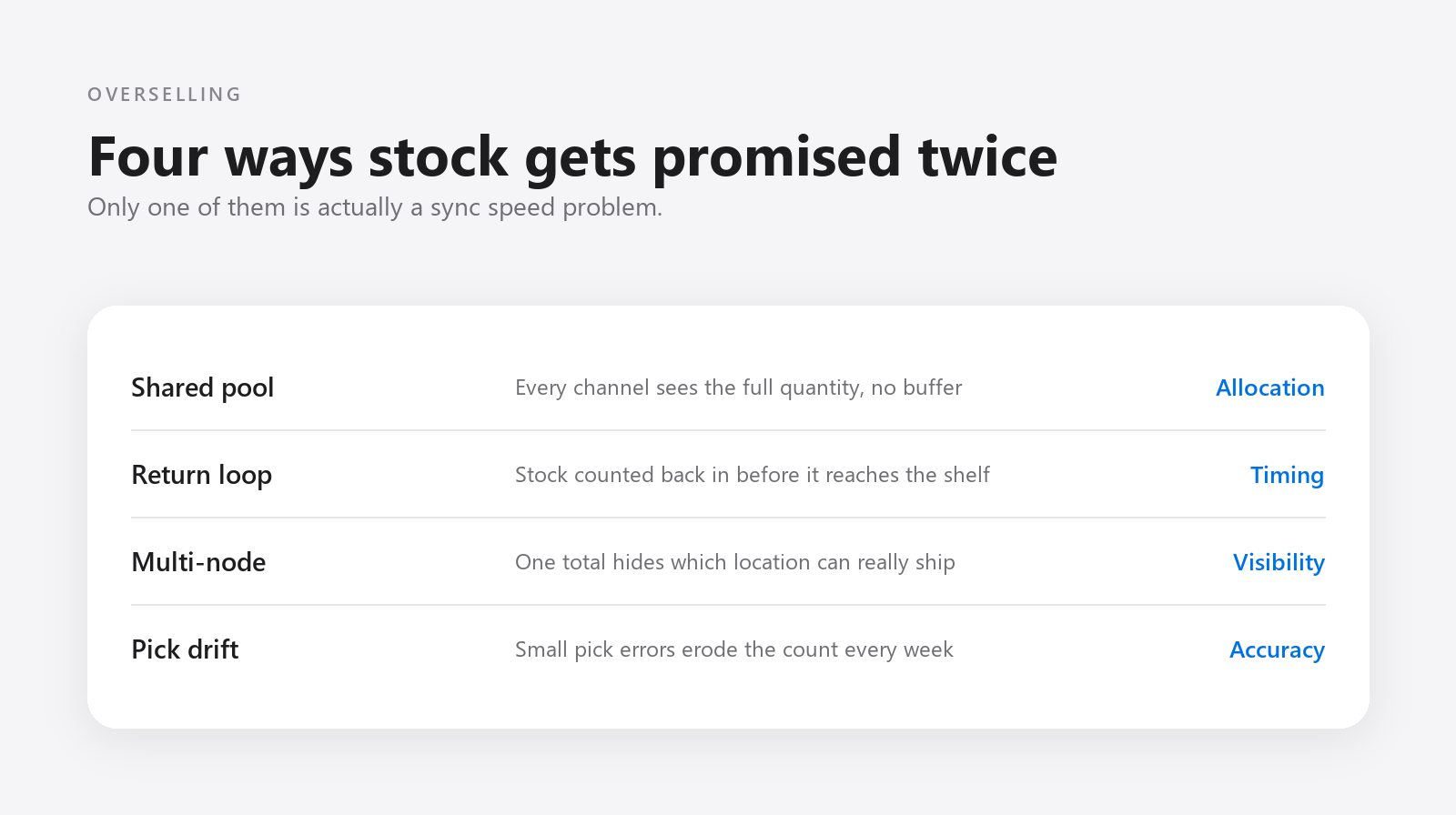
Four ways in, and only one is a timing problem:
- A shared pool with no buffer. Every channel sees the full quantity and nobody holds back a safety margin.
- The return loop. A returned unit is marked available when the label is scanned, not when it is physically back on the shelf. Orders land against stock that is still in a parcel network.
- Multi-node blindness. Stock sits in three locations, but the sync tool reads a single total, so no channel knows which node can actually ship.
- Pick-level inaccuracy. A warehouse running 0.3% pick error still drifts, and no sync cadence fixes that.
The cheapest control is a threshold, not a technology: set a safety level per SKU and let the channel pause before the count reaches zero. One warehouse operation describes exactly this — a stock floor that warns when the count drops below a set value, so the listing stops selling before the shelf empties.
Split or merge: the shipping math nobody models
An order for three items shipping from two locations becomes two parcels, two labels and two last-mile charges. Customers read "part of your order has shipped" as a delay.
The usual cause is routing logic that optimises for the nearest node and ignores the split. A closer node saves a zone; a second parcel costs a full base rate, a second residential surcharge and a second chance at a damage claim. On low-value orders the split can consume the entire margin.
The merge window is set by the carrier cutoff, not by the customer. If last dispatch is 22:00, an order at 15:00 has seven hours to wait for a second item from another node; an order at 21:40 has none. Systems that ignore it either split too eagerly or hold orders past the promise.
Two rules make this manageable. Penalise splits explicitly in the routing score rather than hoping proximity wins, and decide a value threshold below which an order never splits regardless of distance.
The store is now a warehouse node
Ship-from-store and curbside pickup assume staff can run a pick and pack shift on a floor never designed as a pick face. They can, for a while. The failure is not the first hundred orders but the two hundredth, on a Saturday, with a queue at the till.
Three things decide whether the store node holds up:
- Reservation, not deduction. Reserve on order, release if nobody picks it within the promised window. Without the release, abandoned orders quietly remove stock from the shelf.
- A pick path that respects the floor. Store picking competes with customers; a backroom-first rule keeps staff out of the aisle at peak.
- Shrink visibility. Store stock passes through more hands than warehouse stock. If accuracy is not measured, ship-from-store keeps cancelling orders the system thought it could fill.
Store networks are staffed for selling, not picking, and the labour Which Logistics Model does not change because an order arrived online.
Channel promises decide the network
The promise usually gets set by marketing and then handed to operations as a constraint. It should run the other way.
A two-day promise across the whole country requires inventory positioned within a one-day ground radius of most of the demand. That is a node-count decision, not a carrier decision. A five-day promise can run from two coastal warehouses. A same-day promise cannot run from a warehouse — it requires the store.
Marketplace promises are stricter than most brands realise, because the platform measures dispatch and cancellation rates, not just delivery. Miss the dispatch window twice and the listing loses visibility, which is a slower and more expensive penalty than a late parcel.
In the US, the baseline for any consumer promise is the FTC's Mail, Internet, or Telephone Order Merchandise Rule: ship within the advertised time, or within 30 days if no time is stated, and if you cannot, get the buyer's consent to the delay or refund. Set a promise you cannot hold and you have created a legal obligation, not a marketing claim.
Where these projects fail in month three
Launch week is a mess and everyone expects it. Month three is where the design shows.
Watch five numbers, weekly, and read them together:
- Split rate. If it climbs while order value is flat, routing is choosing proximity over consolidation.
- Cancellation rate by channel. A single channel spiking means its stock allocation is wrong, not that the warehouse is slow.
- Store rejection rate. Orders accepted by a store then cancelled at pick time. Above a couple of percent, store stock accuracy is not real.
- Negative inventory count. SKUs showing below zero. Each is a promise against stock that did not exist.
- Hours spent reconciling. If someone still exports three files on Monday morning, the channels are not integrated regardless of what the dashboard says.
Cost per order is not a single line: rent, labour and packaging land on the same order. Keep dividing total 3PL Third-Party Logistics cost by shipped orders and watch the trend. When the split rate rises, cost per order rises even if every invoice looks normal.
A readiness check that fits on one page
| Question | Why it matters | A bad answer sounds like |
|---|---|---|
| Who owns the stock record? | One system must be able to say no | "Each channel keeps its own count in sync" |
| What is reserved, and when? | Reservation is the only real protection | "We deduct when it ships" |
| How fast does a pick update availability? | The lag is the oversell window | "It refreshes overnight" |
| Which node serves which promise? | Promise and network must match | "The system picks the closest warehouse" |
| Are splits penalised in routing? | Splits hide inside shipping cost | "We optimise for distance" |
| Is store stock measured for accuracy? | Ship-from-store depends on it | "The store counts at year end" |
| What happens to an abandoned pickup? | Unreleased reservations remove stock | "The order just expires" |
| Who reconciles, and how often? | Manual work is the tell | "Finance does it monthly" |
If three or more answers land in the right column, this is a multichannel build with omnichannel branding, and the overselling will surface in the first peak.
The short version
Omnichannel fulfillment is not a software purchase. It is a decision about where the truth lives, followed by a decision about which promise each node is allowed to make.
Get one stock record with real reservations, penalise splits, measure store accuracy, and set promises from the network you actually have rather than the one the campaign needs. The rest is configuration.
If you are about to add a channel, a store or a marketplace, send the node list and the promise per channel for a quote. We will map which promises the network can keep before you switch anything on.
References (Neutral Third-Party Sources)
- GS1 — GS1 Global Data Synchronisation Network (GDSN): how product master data is shared between trading partners from one source. https://www.gs1.org/services/gdsn
- GS1 — Global Location Number (GLN): identifying legal entities, functions and physical locations such as stores and warehouses. https://www.gs1.org/standards/id-keys/gln
- GS1 — Global Trade Item Number (GTIN): identifying a trade item at each packaging level, the basis for one stock record per sellable unit. https://www.gs1.org/standards/id-keys/gtin
- GS1 — GS1 EDI: the order and despatch messages that move between retail trading partners. https://www.gs1.org/standards/edi
- Federal Trade Commission — Mail, Internet, or Telephone Order Merchandise Rule: ship within the stated time or 30 days, and obtain consent or refund if you cannot. https://www.ftc.gov/legal-library/browse/rules/mail-internet-or-telephone-order-merchandise-rule
- U.S. Bureau of Labor Statistics — Retail Sales Workers: the labour model inside stores, which ship-from-store has to borrow from. https://www.bls.gov/ooh/sales/retail-sales-workers.htm
- U.S. Bureau of Labor Statistics — Transportation and Material Moving Occupations: the warehouse and material-handling labour behind each node. https://www.bls.gov/ooh/transportation-and-material-moving/