
What to Do When a Shipment Is Delayed: A Merchant's Guide
A late parcel costs you the days it is late. A late parcel nobody talks about costs you the customer. Buyers forgive weather, customs and a carrier that lost a trailer; they rarely forgive discovering it themselves on a tracking page that has said "in transit" for eleven days.
The instinct is to fix the parcel first and communicate when there is something to say. That order is backwards: there is almost never a moment of complete information, and by the time there is, the review has been written. What follows is the communication sequence and the carrier escalation path, in the order the clock runs.
The damage is silence, not days
Ask a support team what delayed-order complaints are about and the honest answer is usually "they're not really about the delay". The customer has already accepted that the parcel is late. What they object to is eleven days of not knowing, with a static tracking page as the only source of information.
Cross-border operations write this up the same way from the other side: when tracking cannot be shown to the end customer, the brand cannot report progress, and the negative reviews arrive before the parcel does. The fix is not a better tracking page. It is a person who says something specific on a schedule.
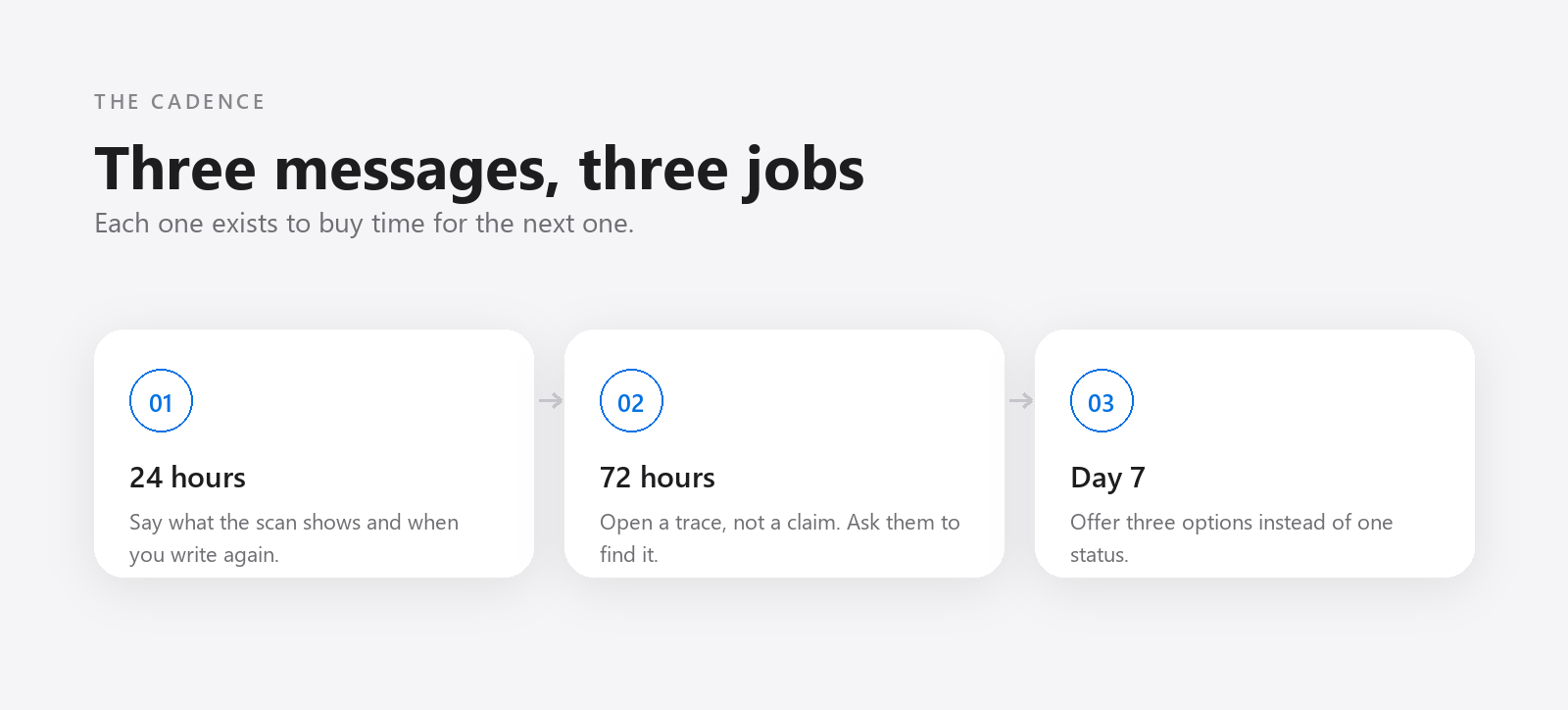
T+24 hours: the message that buys you a week
Send the first message 24 hours after the parcel misses its first checkpoint — not 24 hours after the delivery date passes. At that point you know one thing (it has stopped moving) and nothing else, which is enough.
Four lines do the work:
- What the scan shows, in plain language, with the location and the date. "Last scan 14 November, Memphis hub" is worth more than "in transit".
- What happens next, and when you will write again. Name the day. "I will update you on Thursday either way" is the sentence that stops the second email.
- A realistic window, expressed as a range. If you do not have one, say that you do not and give the date of the next update instead. An invented date is worse than no date, because it will be quoted back to you.
- What you are prepared to do if the window is missed. Hold the remedy in reserve; do not spend it on day one.
Do not open with an apology longer than the information. The customer is not measuring remorse; they are measuring whether you know anything.
T+72 hours: open a trace, not a claim
A trace asks the carrier to find the parcel. A claim asks them to pay for it. They are different processes, and merchants routinely file the second one on day three because the form is easier to find.
For USPS, a formal Missing Mail search can be submitted starting seven days from the mailing date, with the sender and recipient addresses, the container type, the tracking number, a description of the contents and photographs if you have them. Before that window opens, your only lever is the carrier's own case line or the account manager, and it is worth using — a parcel held at a depot for a bad address can often be released with one phone call.
Whatever you file, file it with the same evidence pack: two addresses, contents description, value, tracking history, photographs of the packed carton. Rebuilding that pack per case is how a 20-minute job becomes an afternoon.
Day seven: the decision point
Day seven is when a delay stops being a logistics problem and becomes a commercial one.
In the US, the FTC's Mail, Internet, or Telephone Order Merchandise Rule sets the baseline. If you cannot ship within the time you stated — or within 30 days if you stated nothing — you must contact the customer and seek consent to the delay. That notice cannot arrive later than the date you originally promised, or 30 days if you promised nothing. The consent mechanics matter: if your revised date is 30 days out or less, silence can be treated as consent; if it is further out, or you cannot give a date, silence means the order is cancelled and must be refunded.
Refunds under the rule go back within seven working days for cash, cheque or money-order payments, in one billing cycle for house credit accounts, and they cannot be paid in store credit or vouchers. That last line is the one to memorise, because offering credit is the reflex that turns a delay complaint into a chargeback.
The merchant version is simpler than the rule: on day seven, give the customer a choice rather than a status. Ship it anyway, ship it faster, or cancel and refund — three options, one message, no conditions.
What the carrier will actually do
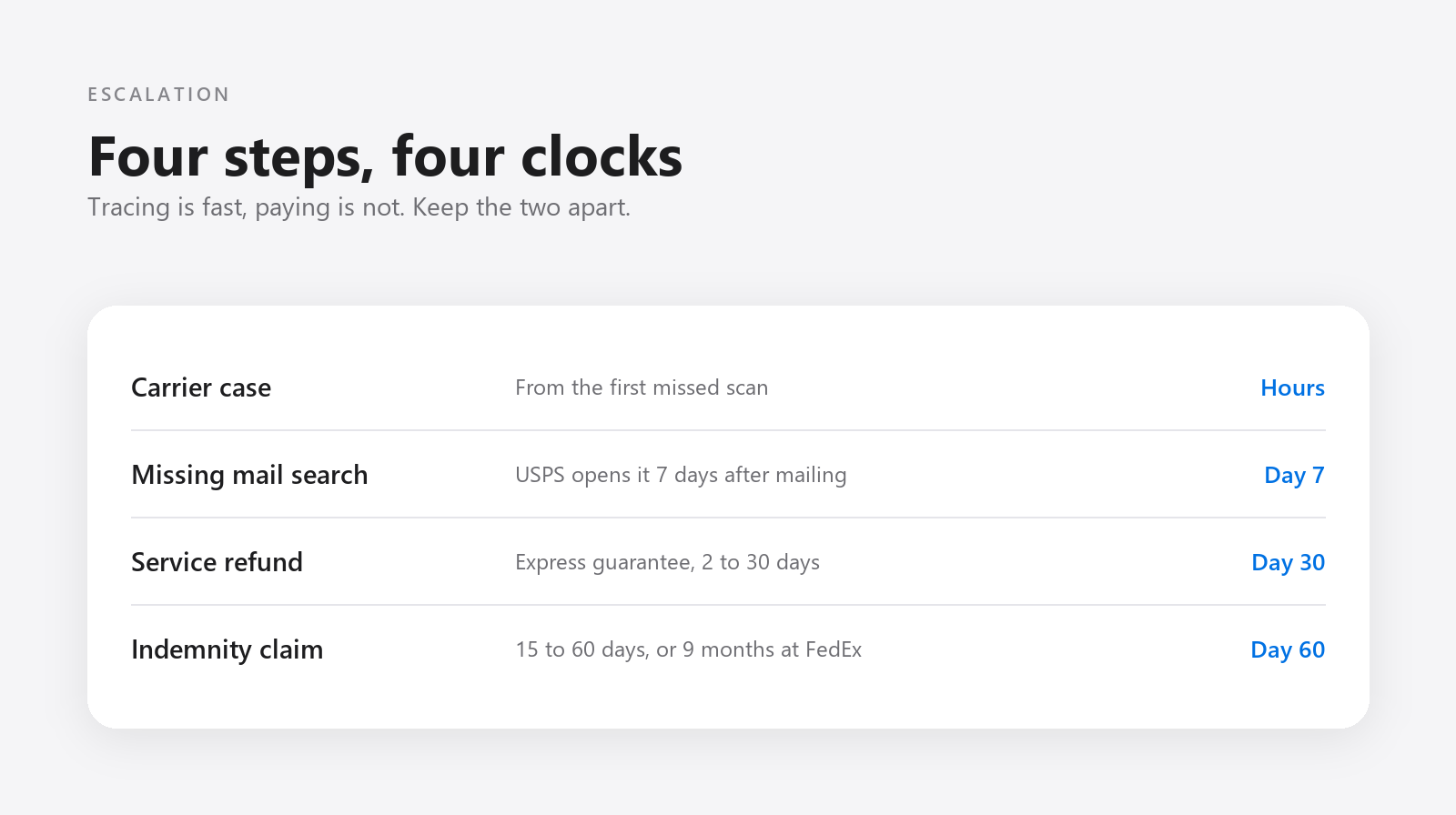
Carriers trace quickly and pay slowly; the gap between those clocks is where merchants lose money.
| Stage | When it opens | What you file | What you get |
|---|---|---|---|
| Carrier case | Immediately | Tracking number plus a description | A scan, a location, or a status change |
| Missing mail search | USPS: 7 days from mailing | Addresses, contents, photos | A search, not a payment |
| Service refund | USPS: 2–30 days for Priority Mail Express | Receipt and tracking number | Postage back, if the guarantee was missed |
| Indemnity claim | USPS: 15–60 days for loss, up to 60 for damage; UPS: 60 days from scheduled delivery; FedEx: 60 days domestic damage, 21 international, 9 months for loss | Receipt, proof of value, photos, the packaging | Up to declared value, minus exclusions |
A service refund gets your postage back when a guaranteed service misses; an indemnity claim pays for goods that were lost or damaged. Separate forms, separate evidence, and on one parcel you may be owed both.
The other confusion is the size of the window. USPS wants a lost-package claim filed no sooner than 15 days and no later than 60 for Ground Advantage, Priority Mail and insured mail, with a decision in 5–10 days and 30 days to appeal. FedEx allows up to nine months for an undelivered shipment. That tail exists because the parcel might still turn up — which is why you cannot let the claim define when the customer gets an answer.
Bulk delays: one notice instead of four hundred replies
A port backlog produces not one delayed parcel but a cohort, and a cohort produces four hundred emails on the same afternoon. Storage charges accrue daily while the container sits, and the support queue grows faster than the pile does.
One announcement beats four hundred replies, but only if it contains five things: how many orders are affected and which ones, what the new window is and what it is based on, what you are doing this week, what you are not going to do (partial shipments, priority by request), and where the authoritative update will be posted. Put a date on the next update and keep it even when there is no news: "no change, still expected 3 December" is still an update.
Segment before you send. Shipped and not-shipped are different messages; domestic and international are different messages; a backer from the first 48 hours of a campaign is a different conversation from someone who ordered last week. Keep the order sequence honest: shipping the newest orders first is the fastest way to turn a delay into a public thread.
Rank the remedies by cost
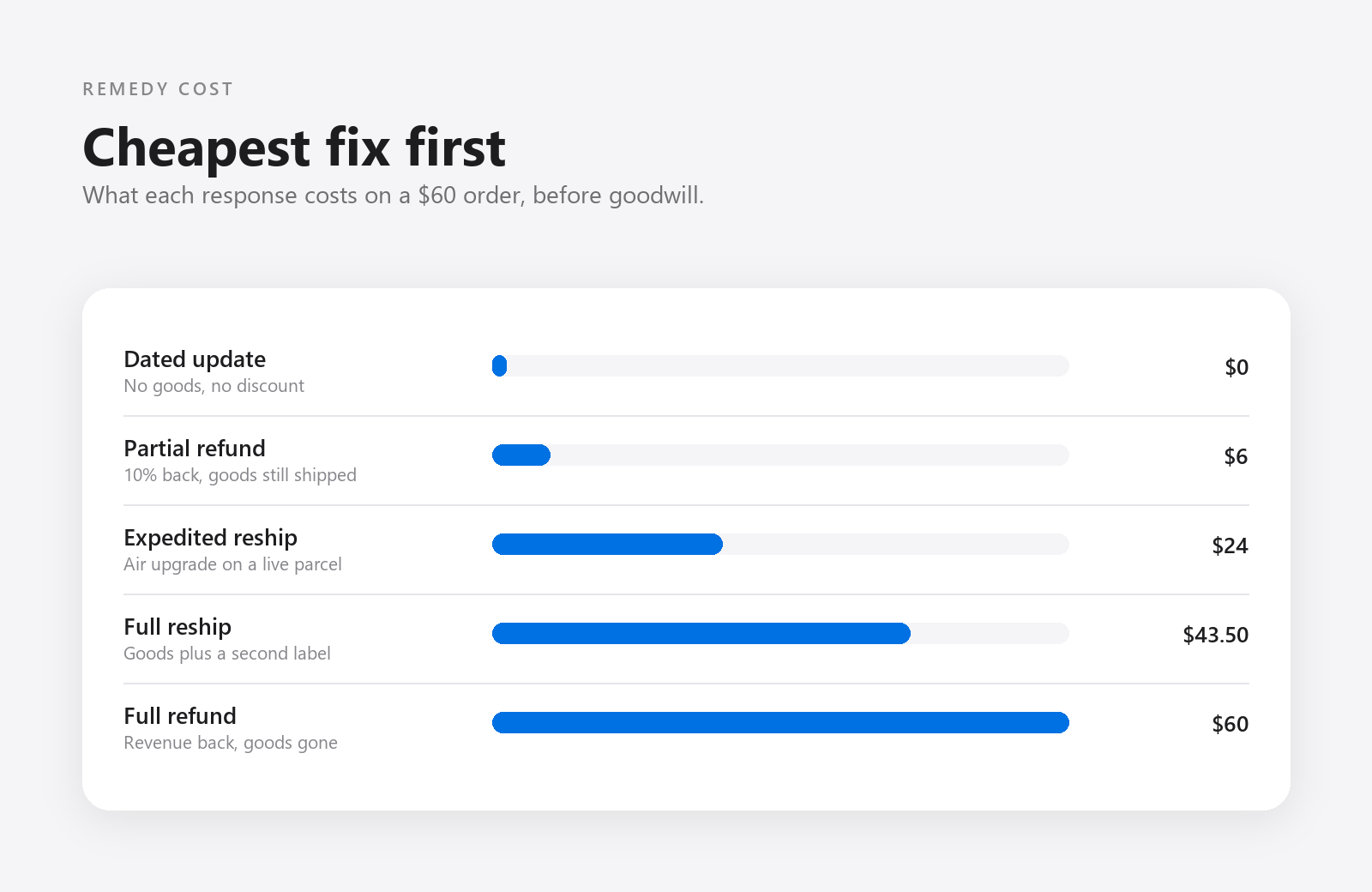
Choose the remedy on cost, not on how bad you feel.
| Remedy | Use it when | What it signals |
|---|---|---|
| A dated update | Always, first, and repeatedly | You are watching the parcel |
| Partial refund | Delay is real and the customer still wants the goods | You are sharing the cost |
| Expedited reship | Only when the original is confirmed lost | You are solving it, not explaining it |
| Full refund | Customer has opted out, or the goods are replaceable at low cost | The relationship is over unless you recover it |
The cheapest remedy is the one most merchants skip: a specific, dated update costs nothing and is worth more than a 10% discount to a customer who has heard nothing for a week. The most expensive is an expedited reship on a parcel that is merely slow, because you pay air freight on top of the original postage and the original parcel still arrives.
One upgrade is worth buying: when the parcel is stuck in the last mile — the final carrier leg between the local depot and the door — a reship on the same lane will fail the same way. Change the lane, not the speed.
Fix the promise, not the parcel
Every delay conversation starts with a promise made at checkout, and most were written by someone with no visibility into transit time. Publish a range, not a date. A two-day-wide range that is honest will out-perform a single date that is wrong once.
Then match the service to the promise. A domestic ground parcel typically lands in two to five days in metro areas and up to seven in remote ones, and the distance between those numbers is a postcode lookup, not luck. If the cheap lane cannot hold the window you advertise, the fix is a better lane or a wider window — a bigger support team is not a fix.
Say the cutoff out loud, too. "Orders placed after 3pm Friday ship Monday" prevents more delay tickets than any tracking integration, because half of what customers call a delay is a weekend they did not count.
The short version
Write at 24 hours, open a trace at 72, and force a decision at day seven instead of waiting for one. Let the carrier chase the money on its own clock; never let that clock set the customer's expectation. When the delay is a cohort rather than a parcel, one dated announcement beats four hundred replies — and the cheapest remedy you own is telling someone when you will speak to them again.
If delays keep landing in the same lane, the problem is upstream of the message. Our crowdfunding fulfilment team maps transit windows by lane before a campaign ships, so the promise on the page matches what the carrier can actually do.
References (Neutral Third-Party Sources)
- Federal Trade Commission — Business Guide to the FTC's Mail, Internet, or Telephone Order Merchandise Rule: the 30-day shipping rule, delay notice requirements, consent by silence, and the seven-working-day refund. https://www.ftc.gov/business-guidance/resources/business-guide-ftcs-mail-internet-or-telephone-order-merchandise-rule
- USPS — Find Missing Mail: the seven-day wait before a Missing Mail search, and the information a search requires. https://www.usps.com/help/missing-mail.htm
- USPS — File a Claim: Domestic: 15-day and 60-day filing windows by mail class, 5–10 day decisions, 30-day appeals. https://www.usps.com/help/claims.htm
- USPS — Request a USPS Refund: Domestic: the Priority Mail Express money-back guarantee and its 2–30 day refund window. https://www.usps.com/help/refunds.htm
- UPS — File a UPS Claim: the 60-day window from scheduled delivery and the 8–10 business day resolution. https://www.ups.com/us/en/help-center/claims-support.page
- FedEx — File a Claim: 60-day domestic and 21-day international damage windows, nine months for lost shipments. https://www.fedex.com/en-us/customer-support/claims.html