
Gift Cards for Employees: The Flexible Perk That Never Misses
A gift card is not a cheaper stand-in for a real present. It is the one perk that hands the decision to the person who actually knows what they want — and that is exactly when it works. The trade-off is that flexibility arrives with a tax bill and a shelf life. Get those two wrong and a well-meant card becomes payroll paperwork, or twenty dollars nobody ever redeems.
Here is how to use gift cards deliberately: when to pick them over a physical gift, how to size the amount, and the two failure points most teams only discover after the cards have gone out.
A wrong guess costs more than a blank card
When a company buys physical Client Appreciation Gifts for a group, it is betting it can guess forty different people's taste in one purchase. The bet almost always loses somewhere. The wrong item does not sit in a desk drawer harmlessly; it reads as a signal that nobody tried, and it is the kind of thing people remember next time a recruiter calls.
A card removes that particular risk because the employee does the choosing. The gesture you are making changes too: a mug says "we picked something for you", a card says "you pick". Neither is better in the abstract. For a team that spans a 22-year-old intern and a 52-year-old warehouse supervisor, the second message is the safer one, because no single object answers to both.
The honest limit is that a card has no memory. A physical object with a name engraved on it can sit on a desk for five years; a card gets spent and vanishes. If the goal is a lasting artifact, buy the object. If the goal is that the person gets something they will actually use, buy the card.
Gift card versus physical gift: what you are actually trading
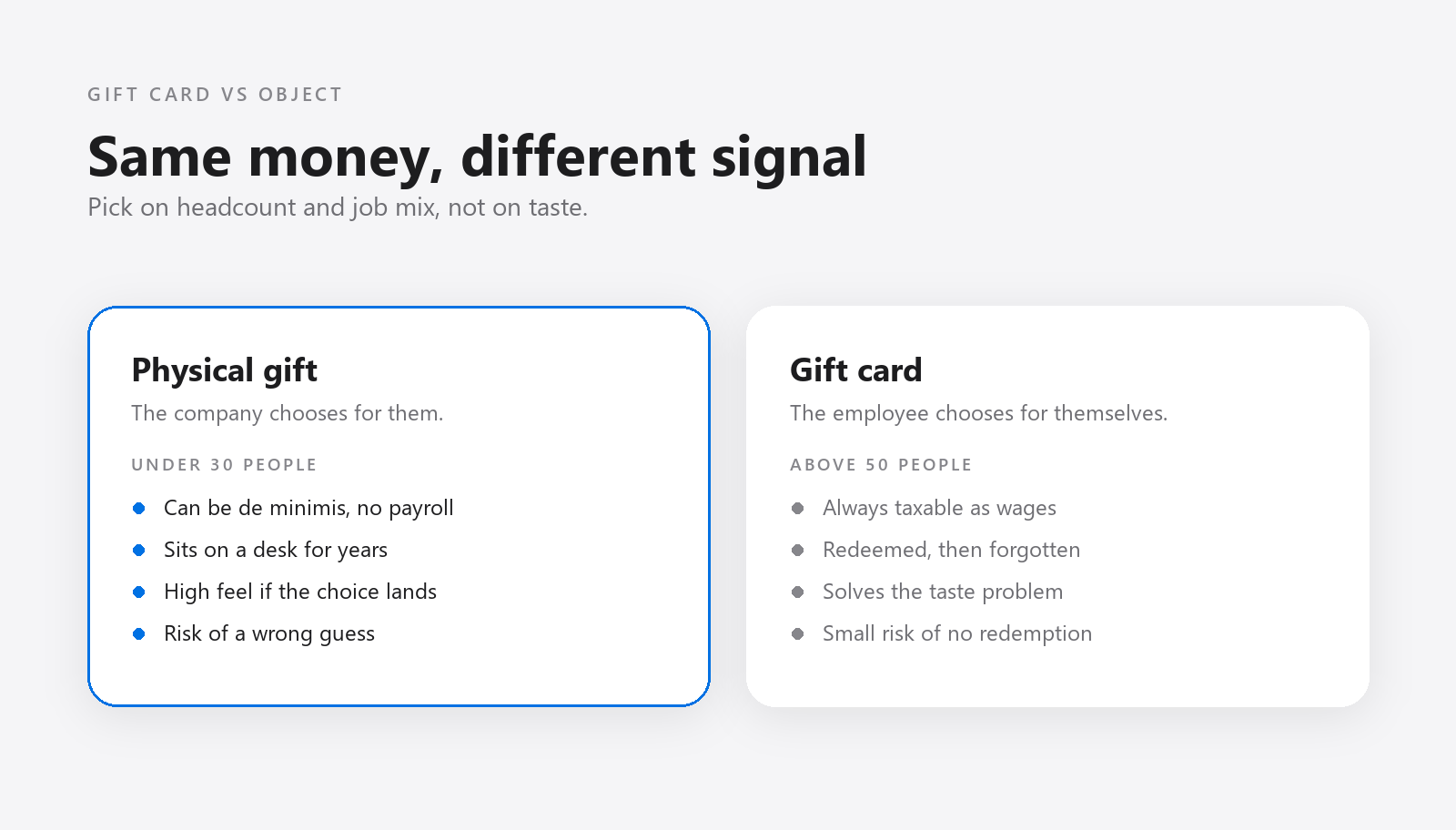
| Question | Physical gift | Gift card |
|---|---|---|
| Who chooses | The buyer | The employee |
| Tax treatment (US) | Can be de minimis if low-value and not cash | Always taxable wages, any amount |
| Stays visible | Sits on a desk, a reminder for years | Redeemed and forgotten |
| Risk of a miss | Wrong size, wrong taste, goes to a parent | Small chance it goes unredeemed |
| Personal feel | High, if the choice lands | Low on its own, needs a note to help |
| Fulfilment | Needs storage, packing and home shipping | A code, or a thin envelope |
The table hides the real decision, which is scale. Under about 30 people, a thoughtful object usually beats a card, because you can know 30 people's taste. Above 50, the card starts winning, because the cost of a wrong guess multiplies across the whole group. The awkward middle — 30 to 50 people of very different ages and jobs — is where a card plus a short handwritten note is the practical answer.
Set the amount in tiers, not one number
The most common mistake is a single flat amount for every occasion, which quietly says a five-year work anniversary and a birthday weigh the same. Split the amounts by what the moment is doing.
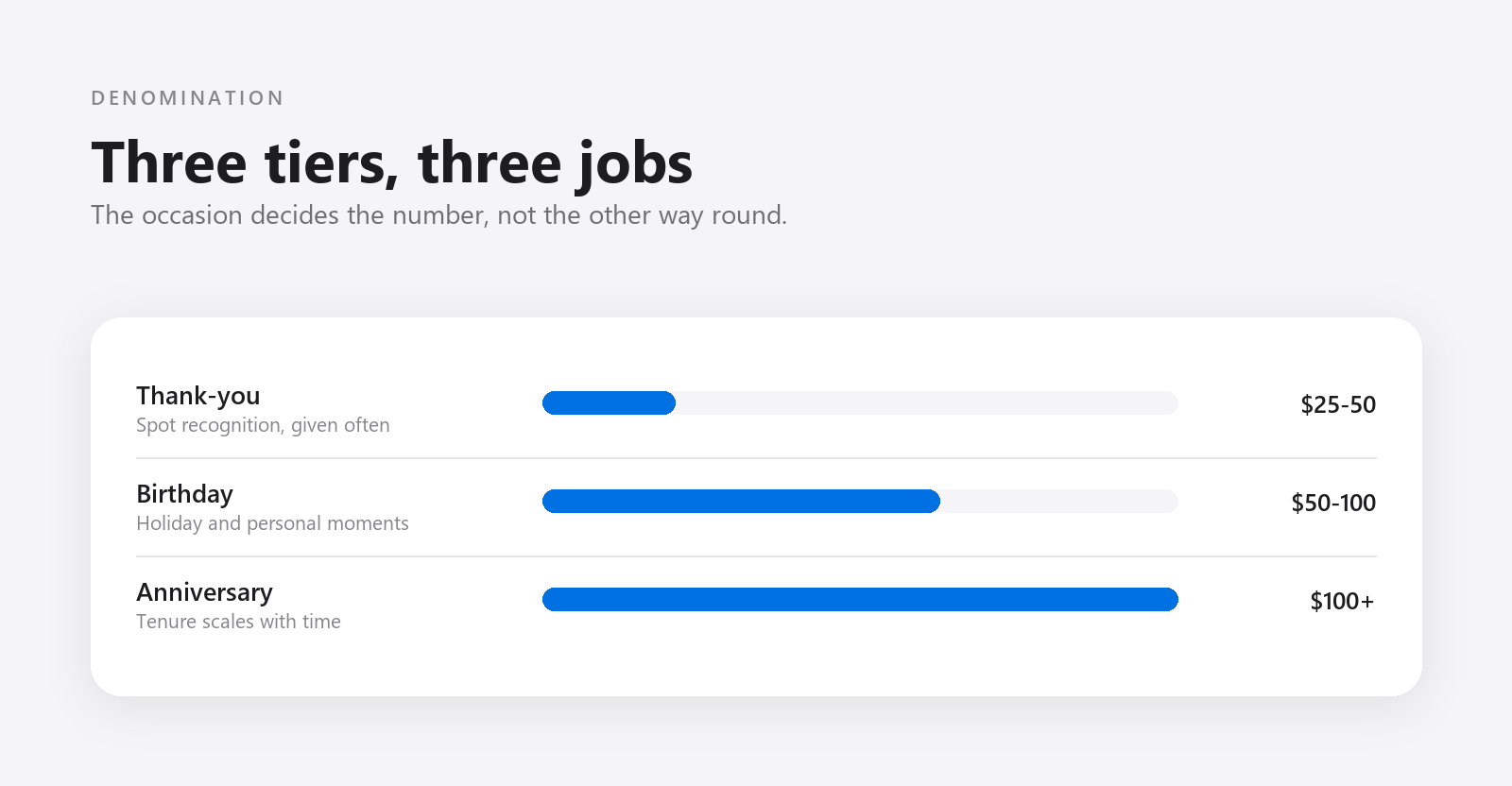
- Thank-you and spot recognition — $25 to $50. Small enough to give often, large enough to buy a real thing. This is the tier that should happen most.
- Birthday and holiday — $50 to $100. A gift the person could not quite justify for themselves.
- Work anniversary and milestone — $100 and up. Tenure is the one variable that should scale, because an anniversary is recognition of accumulated time, not a one-off.
Two rules sit under those numbers. First, keep the tiers fixed and published, not discretionary. When the budget is whatever the nearest manager decides, the person who sits closest to HR gets the better card and everyone notices. Second, never let a single occasion inflate into cash by another name: a $500 card is a bonus wearing a gift costume, and it should be treated — and taxed — as one.
The tax rule that decides the whole programme
This is the part almost no gift guide covers, and it determines whether a self-serve catalogue is even possible.
Under U.S. federal fringe-benefit rules, a gift card is a cash equivalent, full stop. The IRS rule is blunt: cash and cash equivalents — gift certificates, gift cards, charge cards — are never excludable as a de minimis benefit, no matter how small the amount. A $25 coffee card is wages. A $25 mug, on the other hand, is a low-value non-cash item and can usually be excluded as de minimis.
That single sentence flips a lot of "free perk" plans on their head. If you want to thank someone without touching payroll, you give a low-value tangible object, not a card. If you give a card, the value lands on the employee's W-2 and your payroll runs the withholding. The recipient experience is nearly identical; the accounting is not.
Outside the U.S., assume nothing and confirm with local finance before designing the programme. Several jurisdictions treat stored-value cards differently, and a programme built on a wrong assumption is expensive to unwind.
Where a gift card quietly goes to waste
Three failure points, none of them obvious until after the send.
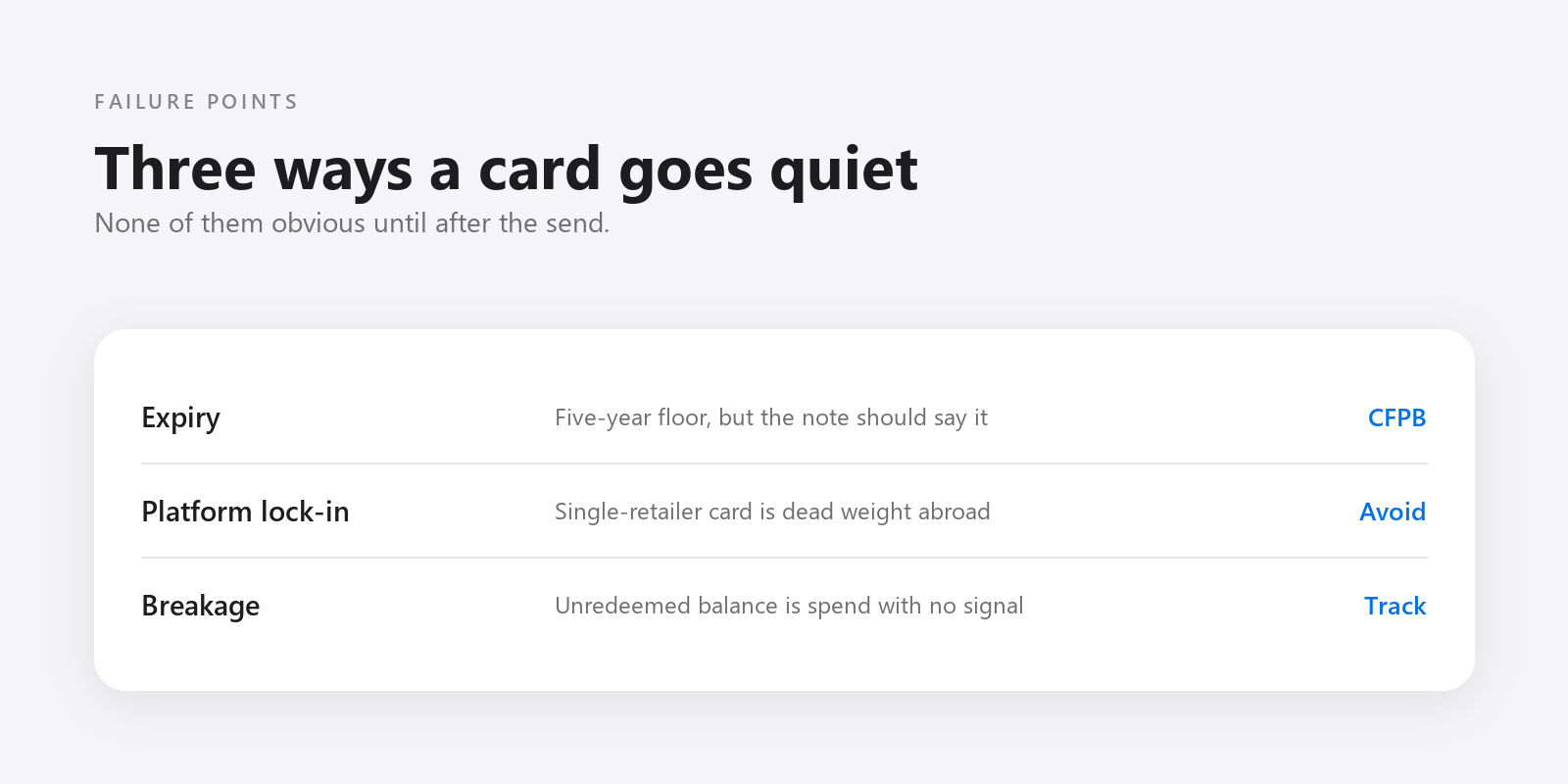
Expiry. Under U.S. federal rules, a gift card generally cannot expire earlier than five years from issue or last load, and dormancy or inactivity fees can only be charged after a full year of no activity, with the terms printed on the card. Five years sounds generous, but a card given in year one and "saved for a rainy day" is often still sitting there at year four. Put the expiry in the note you send, not buried in the card's fine print.
Platform lock-in. A card for a single retailer is useless to someone who never shops there — and a card for a market-specific platform is useless to an employee in another country. For a distributed or global team, an open-loop network card, or a multi-brand redemption list, is the difference between "useful" and "the company sent me something I can't spend".
The silent cost of unredeemed balances. Industry observers put the value of unused gift card balances in the tens of billions of dollars a year. For an employer the loss is smaller but real: a card that never gets redeemed is budget spent with no recognition delivered. Track redemption, and treat a low redemption rate as a sign the card choice was wrong, not that staff were ungrateful.
Physical card or digital code: choose, don't drift
A physical card in a box with a printed note reads like a gift; a digital code in an email reads like a rebate. The difference matters more than most teams expect.
Physical cards make sense when you want the opening moment — a box, a card, a name. They also carry two burdens: a minimum order quantity and lead time on anything you want branded, and the risk of loss or tampering in transit. If you do print a branded card carrier, expect the usual small-batch economics: a factory that runs 500 units for you will often price a 30-unit order around 50% higher per unit, because tooling and sampling are fixed costs that do not shrink with the order.
Digital codes remove the shipping problem entirely and arrive the same day, which is why they win for a large, remote or international group. Pair a digital code with a short personal note from a manager and it lands far better than a bare code. A bare code with no note is the version employees describe as "the company clicked a button". If you do ship physical cards to home addresses, treat it as a pick-and-pack job with address validation attached, and quote it as one.
A checklist before you order
- Confirm the tax treatment with payroll before you commit to a denomination.
- Split amounts by occasion, and publish the tiers so nobody negotiates in the hallway.
- Pick open-loop or multi-brand for any mixed, remote or international group.
- State the expiry and any platform limits in the note, not just in the fine print.
- Order the branded carrier early — sampling and production eat three to four weeks on a custom run, and gift kitting for the box, ribbon and card is priced separately from the card itself.
- Track redemption, and read a low rate as feedback about the card, not the people.
The short version
A gift card is the right tool when you cannot guess the taste of forty people and you would rather they guessed for themselves. Size it by what the occasion is doing — thank-you, birthday, milestone — and keep the tiers fixed. Remember the tax line: a card is wages, a low-value object usually is not. Then spend a little effort on the wrapper, because a code in an inbox and a card in a box with a name on it are the same money with a very different effect.
If you have a headcount list and a budget per head and you are not sure whether to go card or object, send both over — we will come back with a tier plan and a delivery schedule before we talk about price.
References (Neutral Third-Party Sources)
Facts in this article were checked against the following public sources. No gift supplier, gift card reseller or fulfilment provider is cited.
- Internal Revenue Service — Publication 15-B, Employer's Tax Guide to Fringe Benefits: states that cash and cash equivalents (gift certificates, gift cards, charge/credit cards) are never excludable as de minimis benefits, and that low-value non-cash holiday or birthday gifts can qualify. https://www.irs.gov/publications/p15b
- Consumer Financial Protection Bureau — § 1005.20 Requirements for gift cards and gift certificates: the federal rule that gift cards cannot generally expire in less than five years, and that dormancy or inactivity fees require a year of no activity and clear on-card disclosure. https://www.consumerfinance.gov/rules-policy/regulations/1005/20/
- Federal Trade Commission — Avoiding and Reporting Gift Card Scams: guidance on inspecting physical cards for tampering and checking that the PIN is not exposed before purchase. https://consumer.ftc.gov/articles/gift-card-scams