
Uniform Order Fulfillment: How to Ship Company Apparel Without the Chaos
Uniforms are not shipped by order — they are assembled by person. A normal e-commerce order is "one SKU, one box". A uniform order is "one employee, one box", and the contents of that box are decided by a matrix of size, color, department and a name embroidered on the chest. Get the matrix wrong and you do not have a few wrong orders — you have two hundred wrong people wearing the wrong shirt.
This guide walks the whole path: the SKU explosion, the roster as your order file, decoration, and the reorders and size swaps that never stop.
Why uniforms break normal order fulfillment
A regular warehouse is built around the SKU. A polo shirt in six sizes is six SKUs. Give it four colorways and three department logos and you have 72 line items — before a single name is added. Now stitch a name or badge onto each one and the number of distinct items approaches headcount: 200 Gifts for Employees, 200 unique garments, 200 correct pairings of shirt to person.
That is the core of the problem. Most systems count inventory; a uniform program has to count who wears what. Treat it as 200 orders of one shirt each instead of one person-sized assembly each, and you lose the pairing and the chaos starts.
The roster is the real order file
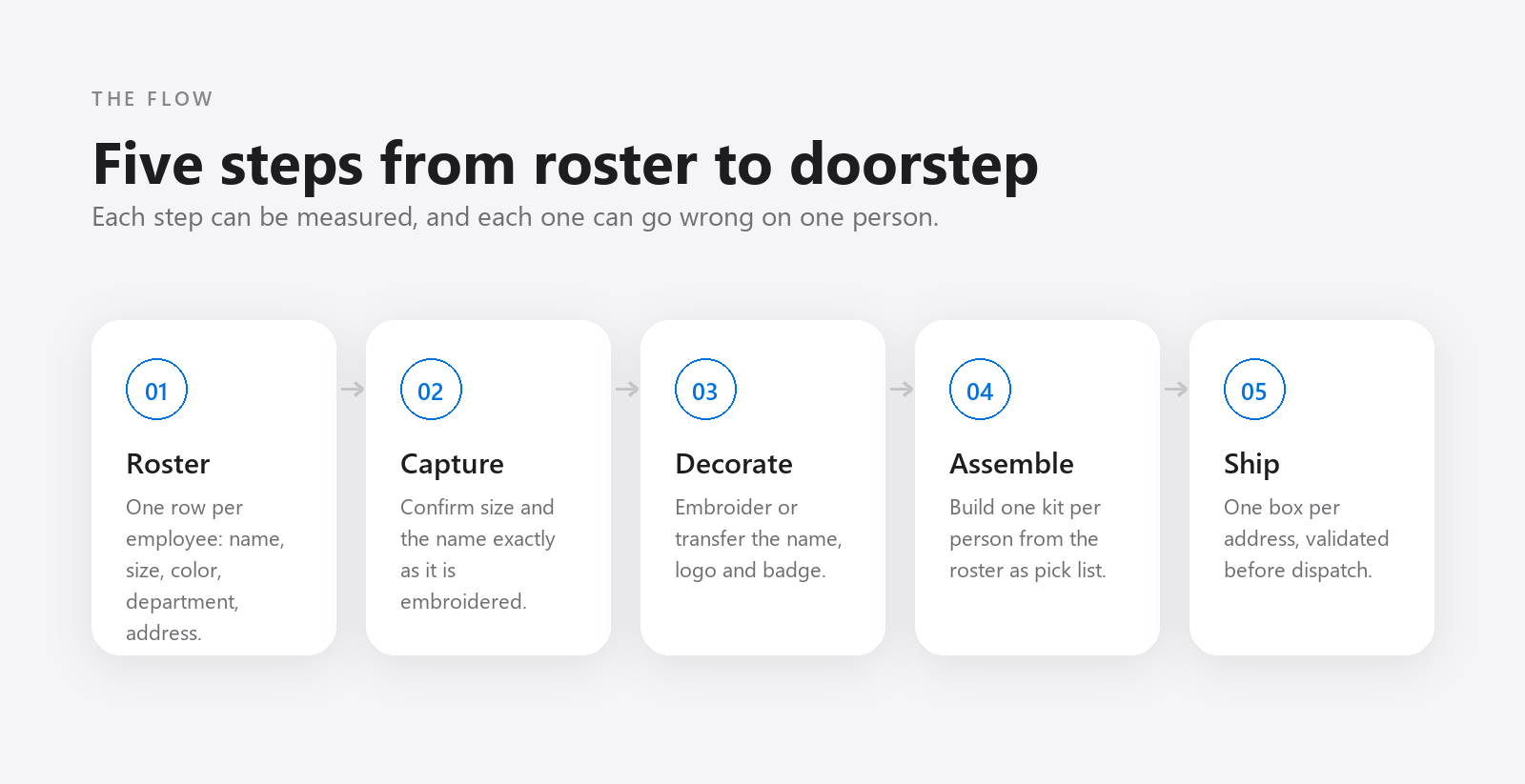
Before you think about shirts, build the roster. One row per employee, with the columns that matter: name as it should appear (not the payroll spelling), size, color, department or role, and a shipping address. The name field is where programs silently fail — payroll shows "J. Smith", the embroidery needs "Jessica" or a nickname, and whoever fills the form from the HR export never asks.
Two rules save the roster. First, sizes should be collected by someone who has seen the person, not self-reported into a spreadsheet — a fitting (taking actual measurements or trying samples) catches the person who insists they are a medium when the jacket says otherwise. Second, freeze the roster a few days before production; every change after that becomes a manual exception with a cost.
Size and name: the two fields that must survive the whole run
If a size is wrong, the shirt cannot be quietly used anyway. If a name is wrong, the shirt is worse than useless — it is a public, wearable typo. Both fields have to survive collection, production, decoration and packing without degrading.
Sizes should be normalized to a single size chart at the start, because "medium" means something different in a polo, a jacket and a hoodie. Names should be confirmed character-by-character against the person, not copied from payroll. A misspelled name on a chest is not a small defect; it is the one mistake the recipient will never un-see, and it means a full re-embroider, not a patch.
Decoration: embroidery, heat transfer, or screen print
Decoration is where the per-person cost hides, and the method should be chosen before you price, not after.
| Method | Best for | Durability | The catch |
|---|---|---|---|
| Embroidery | Names, logos, polos, jackets | Highest, survives washing | Highest setup; each name needs digitizing |
| Screen print | Bulk logos, flat cotton tees | Good, cheaper at volume | Needs a screen per color; weak on stretch |
| Heat transfer | Names, small runs, fine detail | Medium | Can crack or peel over time |
| DTF / digital | Small runs, photos, gradients | Medium | Newer; feel can be stiffer |
Embroidery is the default for names and left-chest logos because it survives industrial washing. Heat transfer — pressing a name or logo onto the fabric with heat — is cheaper and fine for fine detail or short runs, but it cracks sooner. A rule of thumb from apparel shops: embroider what has to last years, print what is a one-season campaign tee.
Pick and pack by person, not by SKU
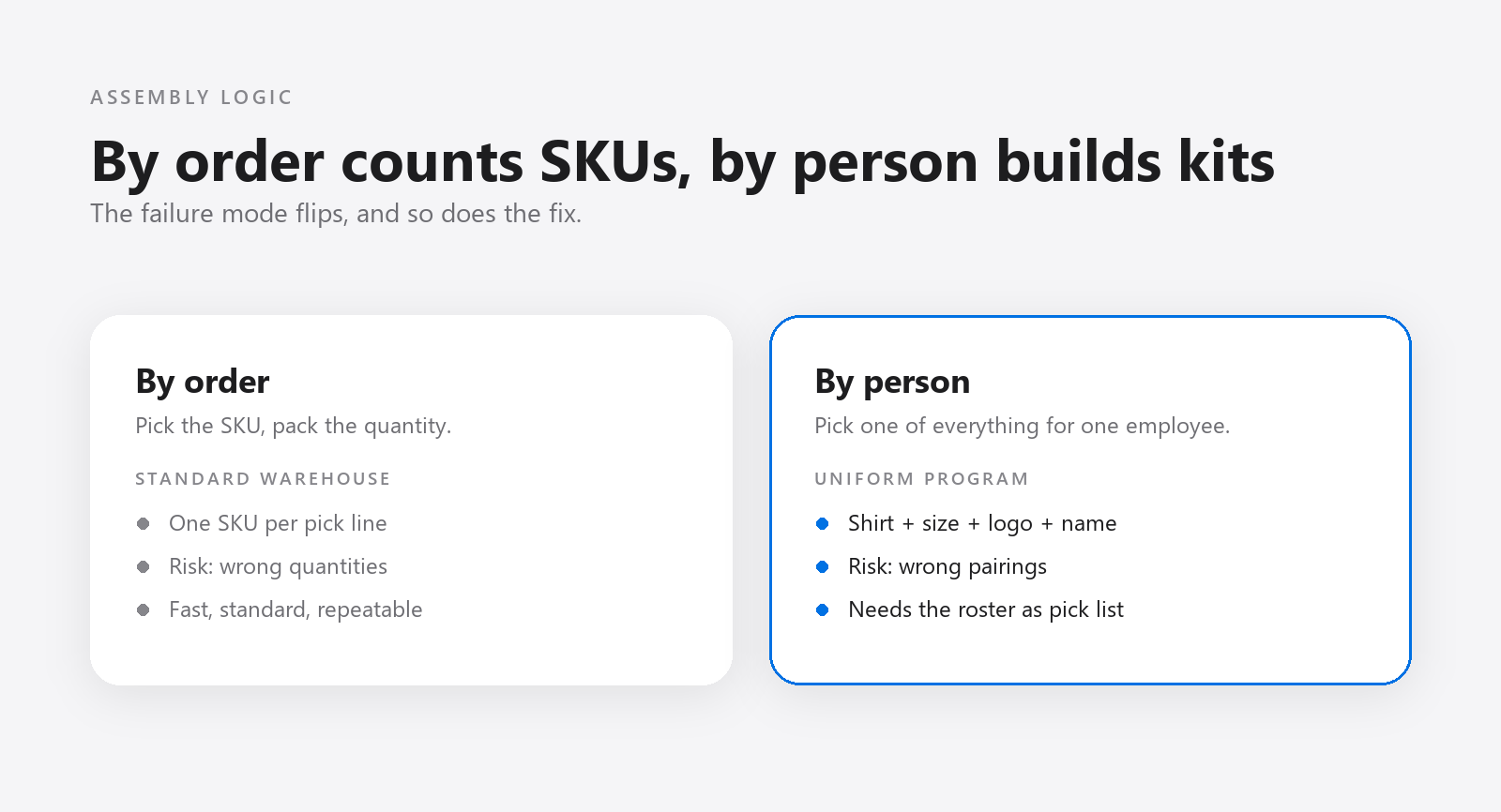
This is the part that separates a uniform program from a normal warehouse. In a normal order you pick the SKU and pack the quantity. In a uniform program you pick one of everything for one person — shirt, size, color, department logo, name — and assemble it into a single kit, like a kitting job where the "kit" is a person.
The practical setup is a staging area with the roster as the pick list: each row is a person, and the picker walks the row, not the bin. That flips the failure mode too — in a SKU system you count wrong quantities; in a person system you make wrong pairings, and a wrong pairing (Jessica's name on Marcus's shirt) is caught only when someone opens the box. A quick final check — name against the packing slip against the shirt — catches most of it before it leaves.
New hires, reorders, and the spare you forgot
Uniform programs never end; they just change personnel.
Two realities follow. First, a reorder (a repeat order, usually for the same spec) should cost less than the first run — the tooling and screen already exist — but only if you wrote the reorder price into the first contract. Second, you need spare inventory. Apparel shops routinely advise building about 3% spare pieces into the first run. The reasons are concrete: people leave, people join, and a dye-lot variance (a slight color shift between fabric batches) means a single replacement shirt ordered later may not match the rest of the team. Spares baked into the first run cost almost nothing per unit and save you from a mismatched solo replacement at full price plus freight.
Size exchanges: the second assembly
No size chart survives first contact with a real workforce. Some number of shirts will come back because they do not fit, and every one of them is a second assembly job: receive, check the size tag, reissue, and re-ship — plus the returned garment goes back into stock as a slightly-used unit that has to be tracked separately.
Design for it. Set a clear exchange window, collect the correct size on the same form as the return reason, and keep a small reissue buffer in the most common sizes (medium and large) rather than a flat spare count. The goal is to make the exchange a one-touch process, because every back-and-forth email is labor on top of the garment cost.
Getting 200 Assembly Custom Kits to 200 addresses
The final leg — the last mile of delivery to each employee — is where a tidy bulk shipment turns into two hundred small parcels. If the team sits in one office, ship one box to one dock and be done. If it is remote or multi-site, you are running a pick-and-pack operation with address validation attached.
The address list is the weakest link. The U.S. Postal Service's change-of-address dataset holds roughly 160 million permanent forwarding records, and its Move Update standard asks mailers to refresh address data within 95 days of a mailing. A roster that sat untouched for a quarter already contains dead addresses. Validate the file before dispatch, have each person confirm a current address, and freeze the list a few days before shipping — a Friday-afternoon change will not make Monday's pick list.
What a uniform order actually costs
Uniform pricing looks opaque because four things move the number at once, and only one of them is under your control.
| Cost driver | What it is | How it moves the price |
|---|---|---|
| Fabric | Fiber, yarn count, weave, weight | One grade up can move unit cost by several dollars |
| Decoration | How many placements, colors, area, method | Every added placement is another setup and check |
| Quantity | Fixed setup spread over the run | Small runs carry heavy per-unit setup cost |
| Lead time | Normal schedule vs rush | A rush order jumps the line and costs more |
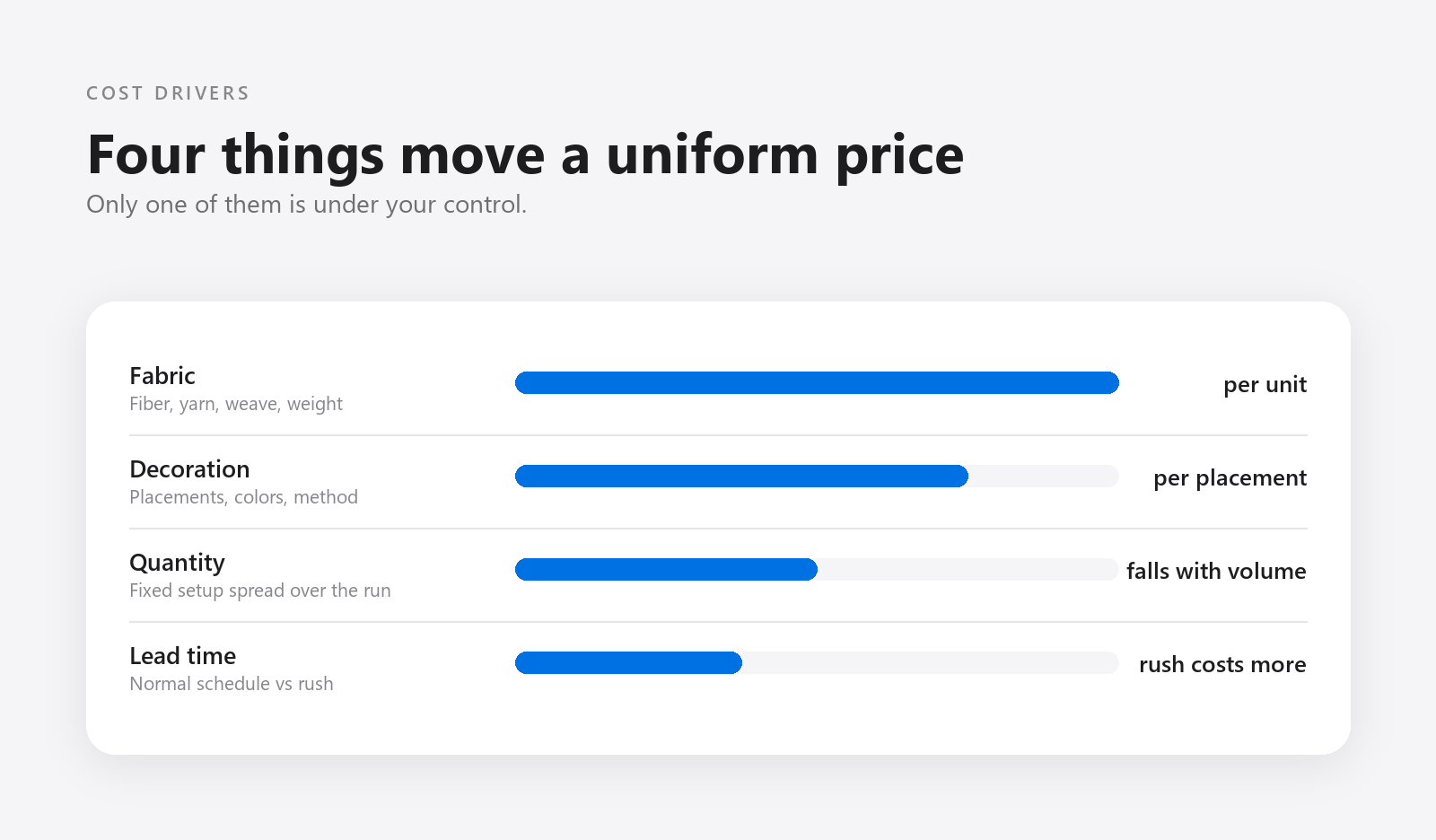
The quantity line is the one to think hard about. There is a minimum order quantity (MOQ) — the smallest run a shop will take — and fixed costs like sampling (the pre-production sample you approve), pattern setup and fabric minimums do not halve with the order. A shop that runs 500 pieces happily will often price a 30-piece run about 50% higher per unit. The lead-time line matters too: a standard custom run is often quoted from the day you confirm the sample and quantities, not from the day you first asked, and a rush order — jumping the production queue — always costs more.
One correction worth keeping: thicker fabric is not automatically better. A hot kitchen or a machine floor needs light, breathable fabric; a gate guard working outside needs wind resistance. Match the fabric to the job, not to the price, or you will buy the "premium" version of the wrong shirt.
The short version
Treat uniforms as person-level assembly, not order-level picking. Build the roster first, get the size and name right, choose the decoration method before pricing, and assemble one kit per person from a staging area where the pick list is the roster. Bake in 3% spares, write the reorder price into the first contract, and put the address freeze on the same calendar as the ship date. If the pairing of shirt to person is right at the end, the program works; if it is wrong, no amount of on-time shipping fixes it.
If you have a roster and a spec and you are unsure how to assemble it, send both over and we will come back with a per-person plan before we talk about price.
References (Neutral Third-Party Sources)
Facts were checked against the following public sources. No apparel decorator, uniform vendor or fulfilment provider is cited.
- Federal Trade Commission — Threading Your Way Through the Labeling Requirements Under the Textile and Wool Acts: the fiber-content, country-of-origin and manufacturer-identity (RN) labels a garment must carry, and the permanent care label requirement, which apply to decorated and personalised apparel. https://www.ftc.gov/business-guidance/resources/threading-your-way-through-labeling-requirements-under-textile-wool-acts
- GS1 — GS1 Barcodes: the GTIN and barcode standards used to identify product variants such as size and color across a supply chain. https://www.gs1.org/standards/barcodes
- United States Postal Service, PostalPro — Address Quality Solutions: the national change-of-address dataset, the 95-day Move Update window, and delivery-point validation used to keep a home-shipped uniform list current. https://postalpro.usps.com/address-quality