
Best Corporate Swag and Unique Swag Ideas That People Actually Keep
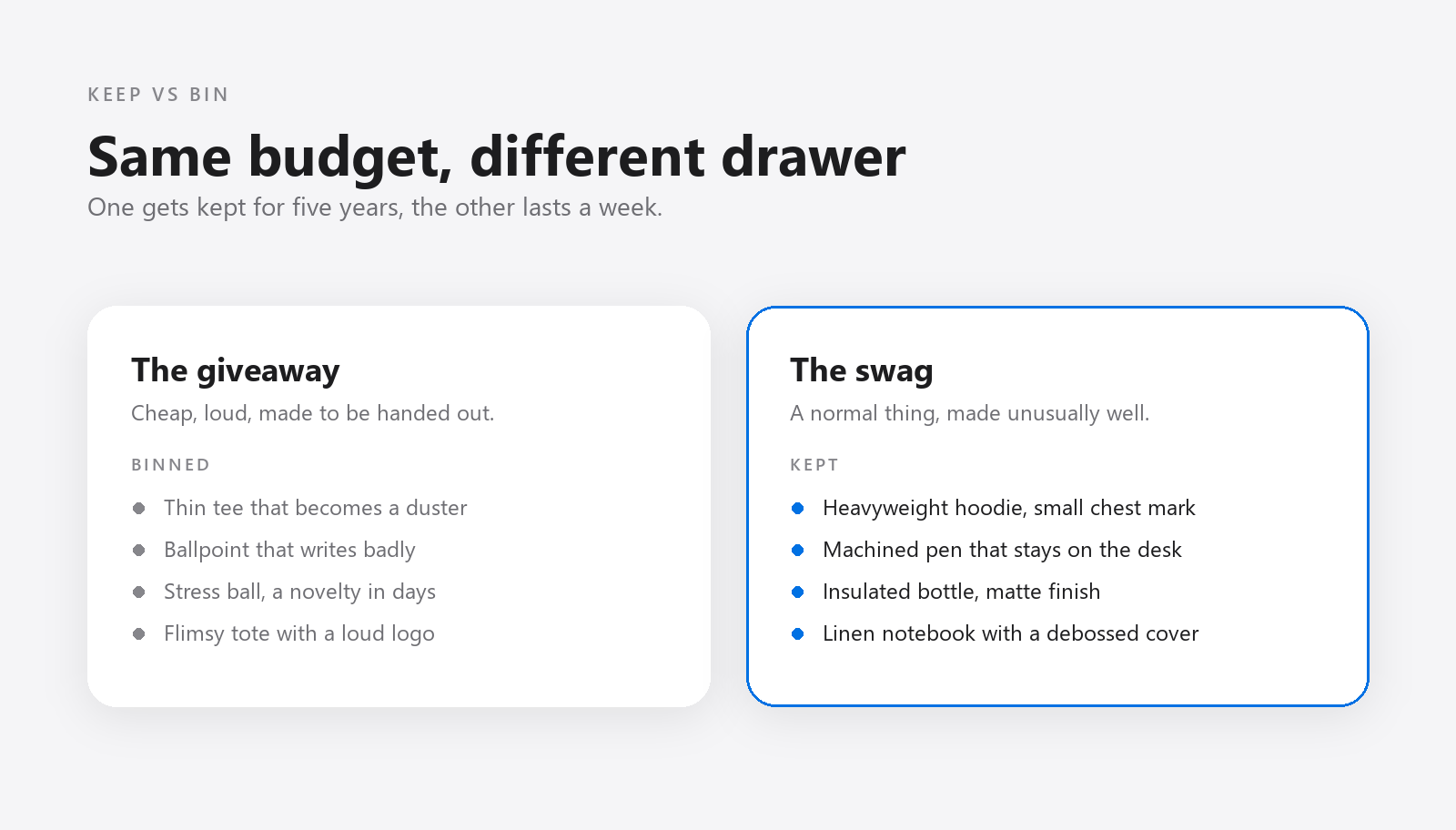
Good swag has one test, and it isn't "does our logo look nice." It's "would this person use it if the logo weren't on it." Most branded merchandise fails that test and lands in a drawer, then a donation bin. The items people keep are the well-made versions of everyday things — a better water bottle, a better hoodie, a better notebook. This guide picks by category, with per-unit price anchors and the customization cost you should expect on top.
Here's the number that explains the whole category. In a 2021 study by PPAI, the promotional-products trade association, the most common reason people kept a promotional item — by a wide margin — was that it was useful, at 75.4%. Almost half of respondents had kept one for more than five years. Usefulness is not a nice-to-have; it's the only retention driver that matters.
The drawer test
Before you order anything, run the drawer test on it: if you handed this to a colleague with the logo covered, would they still want it? If the answer is no, you are about to buy a branded donation.
The Chinese gift-supplier world has a matching phrase for what fills the drawer — "food without taste, abandoned but not thrown away." It's the item someone can't bring themselves to throw out, so it sits there, quietly doing nothing for your brand. The gifts people keep are the quiet ones: reasonably priced, well made, comfortable to use. One Chinese gift-picker writer puts it plainly: a simple, low-key item people genuinely want to keep and even re-gift beats a flashy hamper every time.
Drinkware that earns a spot
The insulated bottle is the workhorse of the entire category. It's used daily, visible on a desk or in a car, and it takes a small logo without turning into a billboard. Chinese corporate-gift sellers call the thermos a steady hot-seller because the same product works as a meeting gift, a business gift, and an anniversary gift.
The details that separate a kept bottle from a binned one: a double-wall vacuum seal and 304 stainless steel inside, a matte powder-coat finish, and a laser-etched mark instead of a printed graphic. Skip the gloss promo finish. A travel tumbler is the sibling pick — check that it fits under a coffee machine before you commit to a shape, or you've just bought a lid that drips.
Apparel people choose, not wear out of duty
A hoodie is the single item employees fight over, so it's the highest-emotion swag you can order — but only if it's a hoodie someone would buy. Thin event tees become dusters; a heavyweight hoodie in a retail cut becomes a weekend default. A small chest mark or a tonal print keeps it wearable outside the office.
The hidden cost in apparel is sizing. You need a size curve, and you need it before the order, or you'll be holding a stack of mediums nobody wants. A practical starting split from the field is roughly 1:3:4:2:1 across XS to XL, then fix the tails once you see who actually ordered what. Embroidery suits caps and sweatshirts; screen print suits tees and bags.
Desk items that stay on the desk
The notebook is the quiet champion. A hardback with a debossed cover — a blind impression, not a printed logo — gets carried into meetings and kept for a year. Pair it with a weighty pen; cheap pens get "lost on purpose," while a machined pen with a clean engraving stays on the desk.
A felt or leather laptop sleeve earns its spot because it goes everywhere the laptop goes, and it never needs a charger. These are the pieces that read "considered" rather than "promotional," which is exactly the signal you want on a client's desk.
Tech that doesn't need a charge first
Tech accessories are the easiest place to overspend, and the rule is simple: avoid anything that needs a battery the recipient has to charge before first use, anything that duplicates hardware they already own, and anything that goes obsolete with the next connector change.
The two picks that survive those filters: a braided USB-C cable in a small printed sleeve, and a wireless charging desk mat for the high-end recognition tier. The cable is shockingly cheap and shockingly useful; the desk mat is a genuine "they wouldn't buy this for themselves" gift for senior hires.
What to skip
Three things end up in the trash on day one, and they're still the most-ordered swag in the catalog. The cheap ballpoint pen — it writes badly and gets thrown away on purpose. The stress ball — it's a novelty, and novelty has a half-life measured in days. The flimsy tote — thin handles and a loud logo make it a grocery bag nobody wants to be seen with.
The pattern underneath all three: they're cheap, and they read as cheap. A single item someone loves does more than a bag full of forgettable freebies. This is the one place "unique swag" claims often mislead — the weird novelty item is usually expensive per unit, hard to reorder, and used once. The real differentiator is making a normal thing unusually well.
Unit-price anchors
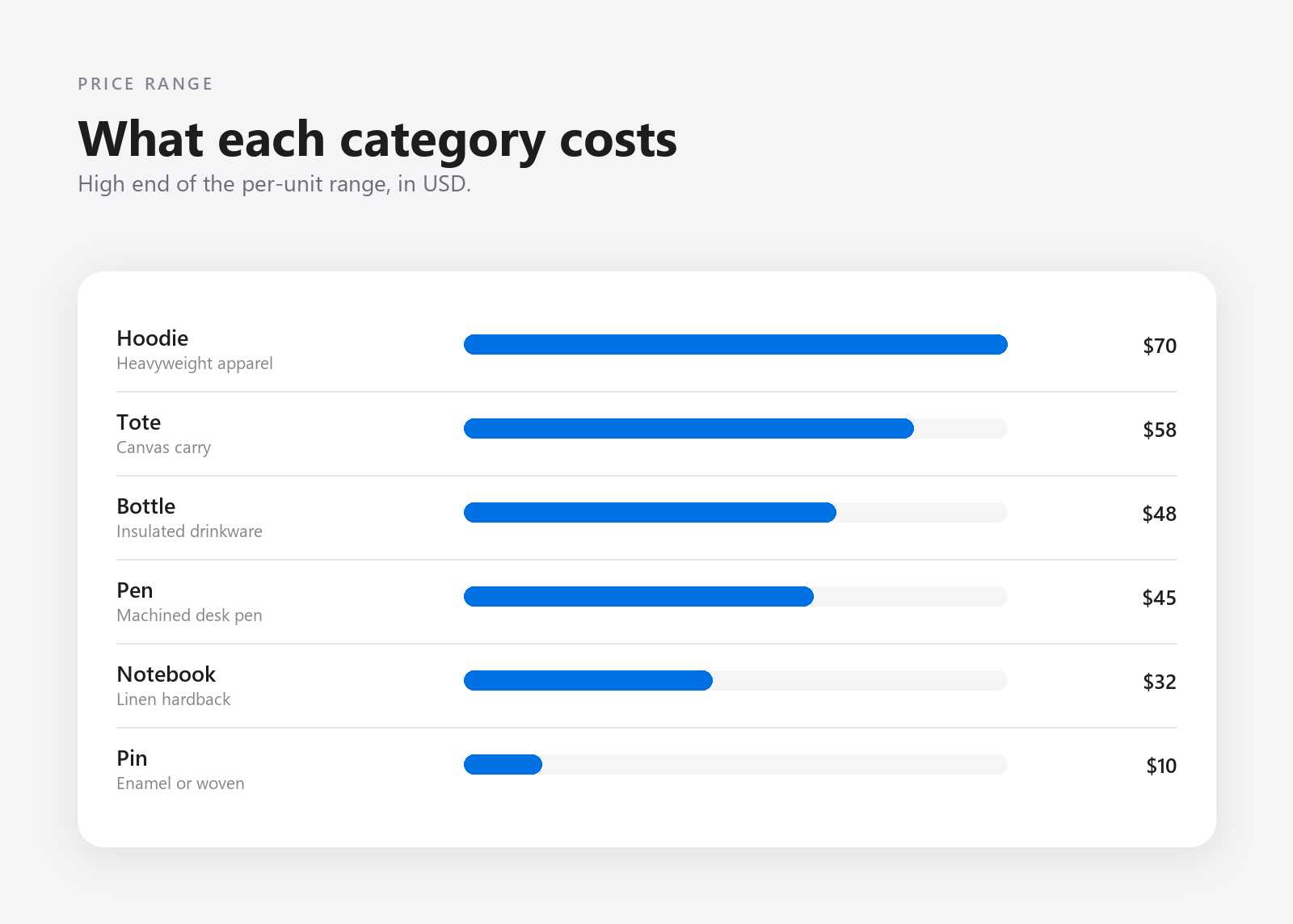
These are the per-unit prices that show up across supplier guides, before any customization fee or minimum. Treat them as a planning range, not a quote.
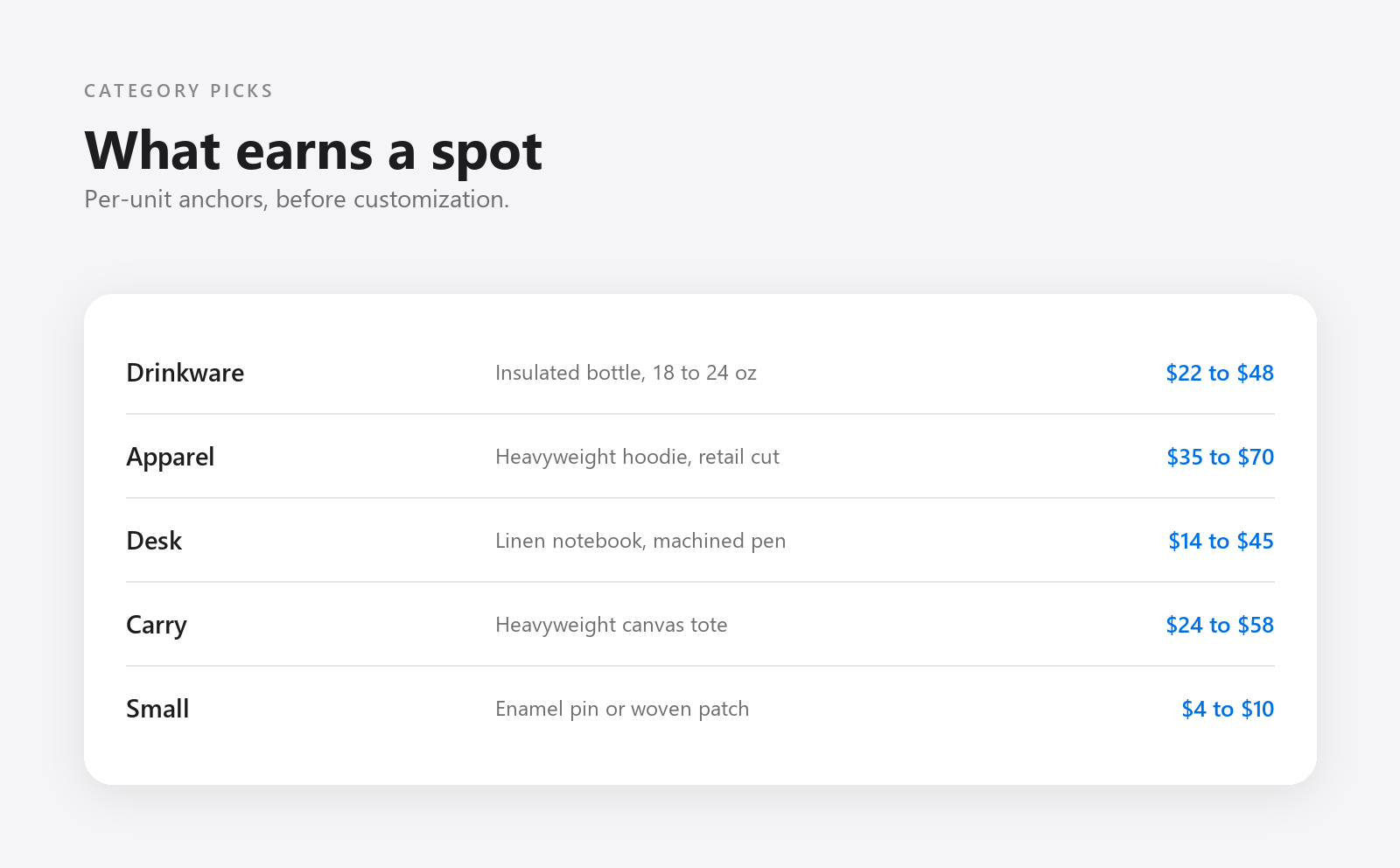
| Category | Pick | Per-unit anchor | Branding method |
|---|---|---|---|
| Drinkware | Insulated bottle, 18–24 oz | $22–$48 | Laser etch or print |
| Apparel | Heavyweight hoodie | $35–$70 | Embroidery or screen print |
| Desk | Linen hardback notebook | $14–$32 | Deboss |
| Desk | Machined pen | $18–$45 | Engrave |
| Carry | Heavyweight canvas tote | $24–$58 | Screen print |
| Small | Enamel pin or woven patch | $4–$10 | N/A |
The customization handoff
The anchors above are for the blank item. Customization is where the budget bends. Minimum order quantity — MOQ, the smallest run a supplier will take before charging a setup fee — is the usual surprise. Many factories will take thirty units only if you pay fifty percent more per piece, because the fixed cost of the mold or the screen doesn't shrink with a small order.
Match the process to the object: embroidery for caps and sweatshirts, debossing for notebook covers, screen print for tees and bags, laser engraving for bottles and pens. And leave time — a small custom run takes seven to fifteen days of production where a large one starts at thirty. For the full mechanics of how a swag order actually gets made — the MOQ math, the size curve, the marking rules for cross-border shipping — our company swag guide covers the service side in detail.
Three questions before you order
- Would this person use it if the logo weren't on it?
- Is the per-unit anchor inside my budget after the customization fee and the MOQ penalty?
- Can I reorder the same item in six months, or is it a one-off novelty?
If you can't answer "yes" to all three, you're buying a giveaway, not swag. Giveaways have their place at a trade-show booth. They don't belong in a welcome kit or a client's desk.
The short version
The best corporate swag is a normal, useful thing made unusually well. Pick for the drawer test, not for the logo placement. Anchor your budget to the per-unit price, then add the customization fee and the MOQ on top before you commit. And skip the novelty — the insulated bottle you got right will still be on someone's desk in five years, which is more than you can say for the branded stress ball.
References (Neutral Third-Party Sources)
- PPAI — New PPAI Research Shows Why Consumers Take And Keep Promo Products: 75.4% of consumers keep a promotional product because it is useful, and 48.7% keep one for more than five years. https://www.ppai.org/media-hub/new-ppai-research-shows-why-consumers-take-and-keep-promo-products/
- PPAI — 2021 Consumer Study: 94% of participants like receiving promotional products, and three out of four keep one because the item is useful. https://legacy.ppai.org/media/7062/21consstdy-info-ol.pdf
- Wikipedia — Promotional merchandise: an overview of the promotional-products industry, common item categories, and its role in marketing. https://en.wikipedia.org/wiki/Promotional_merchandise