
China Haul: What It Is, What People Buy, and How It Actually Gets Home
A China Haul is a trip to China where the shopping becomes the point — travelers arrive with an empty suitcase, fill it with Chinese goods, and film the unboxing afterwards. But the part that decides whether the trip works is not what you buy. It is whether that box crosses the border as luggage, as a parcel, or as inventory. Those are three different sets of rules, and treating them as one is how a good haul turns into a customs bill, a confiscated battery, or a carton nobody can account for.
This guide answers the question the videos skip: what the term means, why it surfaced now, what people actually carry, and how the goods get home in one piece.
What "China Haul" actually means — and what it doesn't
Chinese reporting defines the term plainly: overseas visitors buy goods in China and post videos showing what they found. Coverage by Workers' Daily cites more than 110 million views of related videos on TikTok alone. That number gets repeated everywhere, usually without its qualifier. It is a single-platform view count, not a cross-platform total and certainly not a sales figure — one Chinese supply-chain newsletter went through fourteen claims in the original reporting and found eight confirmed, five doubtful, and one multiple misstated.
The word is also loose in a second way. Some people use it for the in-person shopping trip; others use it for ordering from Chinese marketplaces and having several parcels combined into one shipment. Both end with a box of Chinese goods arriving somewhere else, but the paperwork is not remotely the same. If you are reading this because you saw the videos, the useful question is not "what should I buy" — it is "what is this box for?"
Why it became visible in 2026
The trend sits on top of ordinary friction being removed. Reporting from People's Daily Overseas notes that China's unilateral visa-free list had expanded to 50 countries, with 240-hour transit visa-free entry applying to 57 countries. Departure tax refunds moved to a "refund on purchase" model, and domestic coverage describes a single 28-day departure window that lets travelers shop in one city and leave from another.
The administrative detail is more telling than the headline. From July 1, 2026, refund applications under RMB 10,000 at Nanjing Lukou airport shifted to random physical checks rather than item-by-item inspection; the airport handled over 2,200 such applications worth more than RMB 49.5 million in the first nine months of the year. When the queue at the refund desk gets shorter, a suitcase full of small purchases starts to look like a reasonable plan.
Supply helps too. A Yiwu market operator describes roughly 300,000 daily visitors, more than 1,000 new products appearing each day, 80,000 shops, and 2.1 million product lines — with warehousing, packing, inspection and freight forwarders all inside the same city. A design can go from sample to shelf in days. That density is why a shopping trip can quietly turn into a sourcing trip.
What ends up in the suitcase
The lists in Chinese coverage have moved well beyond souvenirs: drones, action cameras, folding phones, AI glasses, blind-box toys, domestic cosmetics, new-Chinese-style clothing, herbal syrups and moxa boxes, ceramics and novelty sweets. One small detail from a Chinese retail write-up: at a White Rabbit candy flagship on Shanghai's Nanjing Road, foreign visitors accounted for about 30% of orders in peak season. These are low unit prices, high piece counts, and a surprising number of batteries, liquids and powders — which is exactly where the trouble starts.
| What people buy | Typical items | Where it gets awkward | Best way home |
|---|---|---|---|
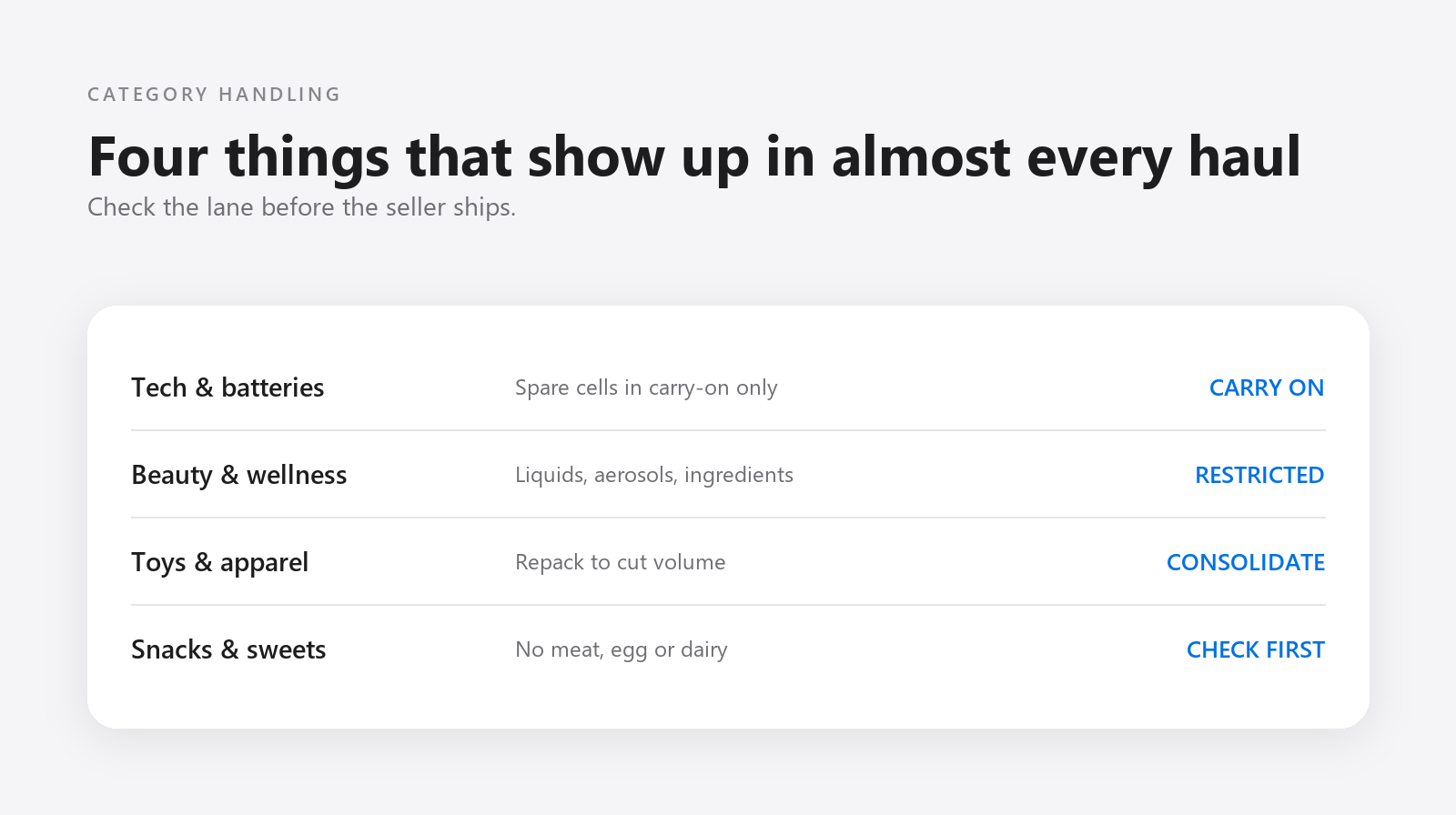
| Tech and gadgets | Drones, action cameras, AI glasses, folding phones | Spare lithium batteries, declared value, warranty | Carry the batteries on; ship the bulk |
| Beauty and wellness | Cosmetics, perfume, herbal syrups, moxa boxes | Liquids, aerosols, ingredient and food rules | Restricted-goods lane, or leave it |
| Toys, apparel, ceramics | Blind boxes, bags, new-style clothing, tea sets | Breakage, retail packaging inflating volume | Consolidated parcel after repacking |
| Snacks and novelty sweets | Candy, biscuits, local specialties | Meat, egg and dairy ingredients are widely refused | Food-only lane, checked before buying |
The tax line most travelers miss
Here is the mistake worth a paragraph of its own: assuming that a suitcase you carried yourself is automatically "personal use." UK rules are a clean example. GOV.UK sets the personal allowance for other goods at £390 (£270 if you arrive by private plane or boat), and it applies only to goods you transport yourself and use yourself or give as gifts. Goods brought in to sell or use in a business have no personal allowance at all and must be declared as commercial goods. Go over the allowance and duty is charged on the total value of the goods in that category, not just the excess. You cannot pool allowances with the person next to you, and declarations can be filed online from five days before arrival.
Three matching collectible sets are a different object from one set you actually plan to keep, even if both fit in the same bag. Thresholds differ by country and change; check your own destination's current figure before you fly, and treat this as a decision framework, not tax advice.
Three ways a haul gets home
| Route | Cost logic | Timing | Works for | Fails when |
|---|---|---|---|---|
| Carry-on plus checked baggage | No freight bill, but airline excess-baggage fees | Same flight | A few high-value, battery-light items | Many pieces, resale quantities, spare batteries |
| Direct international courier | One first-weight charge per parcel | Fastest door-to-door | One or two urgent parcels | Five sellers shipping separately: you pay the first weight five times |
| Consolidation warehouse | One first-weight charge after parcels are merged | Air lane about 7-12 days; sea about 30-45 days | Multi-seller buys, bulky goods, repeat restocking | Two or three tiny items: the fixed handling eats the saving |
Chinese consolidation guides explain the arithmetic without euphemism: international freight has a steep first weight — the opening charge on every shipment — and cheaper continuation weight, so five parcels sent separately pay five opening charges. Merging commonly saves 30-50% of freight. Stripping gift boxes and paper inserts cuts volume 20-40%; vacuum-compressing padded clothing can cut it by more than 60%. That matters because carriers bill on dimensional weight, the larger of actual weight and volume-derived weight, not on the scale reading alone. These are operator-published figures, not a guarantee — get a written rate for your own carton.
What a consolidation warehouse actually does
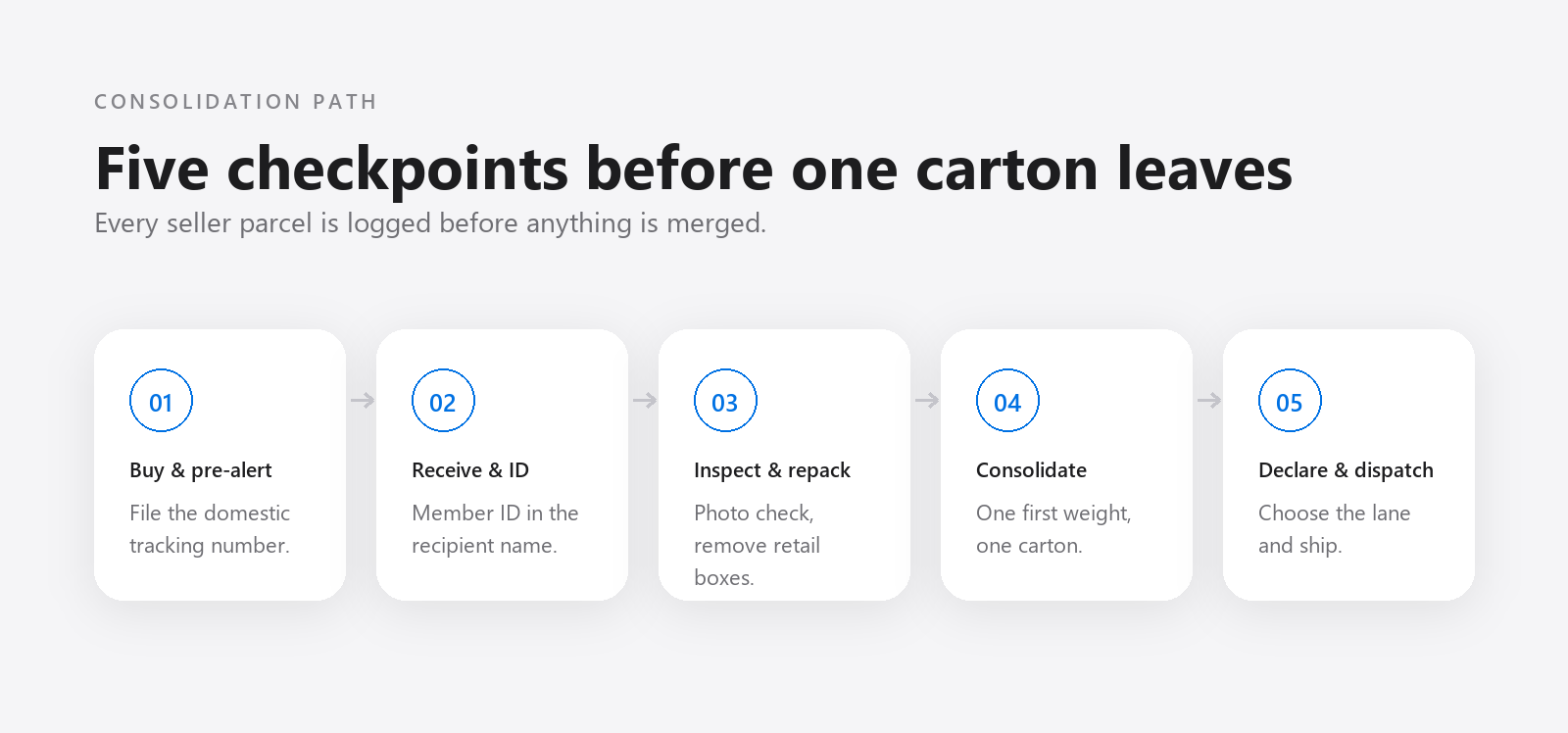
The process has more checkpoints than "forward my parcels." You register, receive a warehouse address and a member ID, and put that ID in the recipient name — one guide gives the format as "platform name + 123456", because a parcel without it becomes an unclaimed box. After the seller ships, you file a parcel pre-alert with the domestic tracking number. On arrival the warehouse logs the tracking number, weight and dimensions, and can photograph or open the parcel for a receiving inspection before you approve anything. Once everything has landed you submit a consolidation request, noting what to remove, compress or reinforce; the repack is often filmed so you can check it; then you declare the contents, choose a lane, pay, and the warehouse dispatches the carton to a last-mile carrier.
Chinese operators commonly advertise 90 days of free storage so buyers can wait for a sale and build a worthwhile weight. That buffer is the real product — not the box. One caveat that only shows up after you have used one: a repacking note added late on a Friday often misses that day's dispatch, and cutoff times are not standardised between warehouses. Ask for the cutoff and the claim terms in writing before your first parcel arrives; compensation is frequently capped at a multiple of freight, not the value of what was inside.
What will not fly: batteries, food, and grey-area goods
The FAA's PackSafe rule is blunt: spare lithium batteries and power banks travel in carry-on baggage only, terminals protected against short circuit, with a common 100 Wh ceiling per battery. Batteries carried for resale or distribution — vendor samples, in the rule's own words — are prohibited outright. A drone battery in your hold luggage and ten identical ones in a carton are not the same question, and the popular China Haul shopping list is full of the first one.
Consolidation lanes add their own refusals: meat, egg and dairy products, snacks with meat seasoning sachets, counterfeit brands, unlabelled powders, strong magnets and pressurised sprays. Food, cosmetics and built-in batteries usually need a restricted-goods lane instead of the standard one, and batteries need original packaging. The expensive failure is misdeclaration — declaring sensitive goods as clothing or stationery. Once an X-ray check finds it, operators typically keep the freight and the goods are not recovered.
When the haul is inventory, not luggage
Once the box is for sale, the useful work happens before it leaves China. One Chinese supply-chain analysis put the gap neatly: a viral clip has to clear four gates — identifiable orders, confirmable payment, traceable overseas repeat purchases, and attributable margin — and what nobody has is the repurchase rate for this crowd. Views are the top of a funnel, not the bottom of a ledger.
So the jobs change from allowances to SKU discipline: agree an inspection standard, photograph the first article, decide the barcode and label, and set a restock batch you can repeat. Starting with product sourcing and a documented pre-shipment inspection costs less than discovering a defect after the carton has cleared customs. If the goods are going out to creators in small batches rather than to a warehouse, the PR box fulfilment path handles the split without pretending it is one parcel.
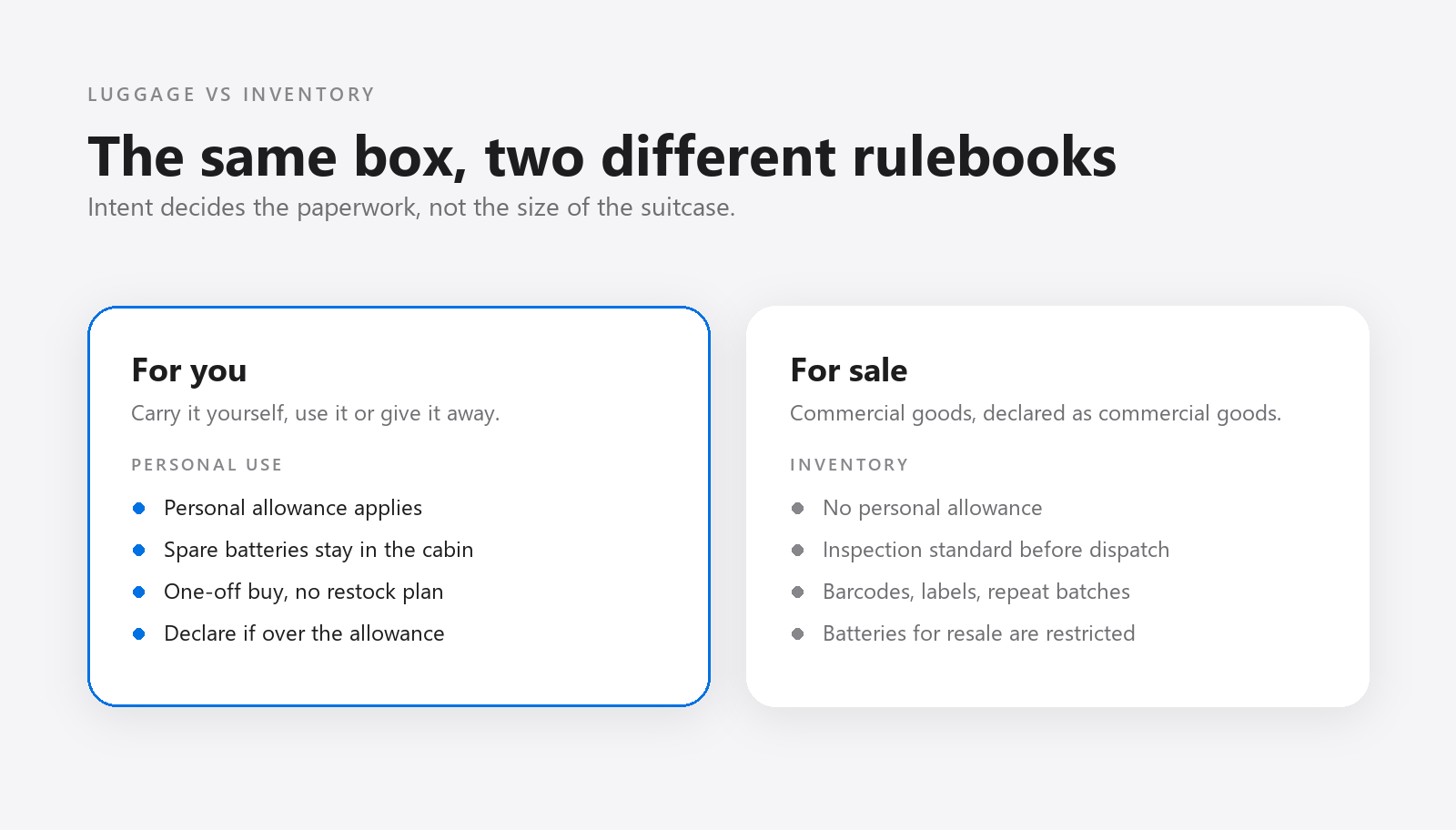
There is a plain test we use: a haul becomes a shipment the moment it stops being for you. Everything else — the declaration, the lane, the insurance, the inspection — follows from that one answer.
A field checklist before you check in
- Item name, quantity and unit price for each SKU, with the original invoice.
- Material, and whether it is liquid, powder, aerosol or lithium-powered, including the Wh rating.
- Domestic tracking number for every seller parcel, plus your warehouse member ID.
- Your destination's current personal allowance, and whether any item is intended for resale.
- The operator's restricted-items list, dispatch cutoff, and compensation terms in writing.
- A decision for each category: carry it, consolidate it, or leave it behind.
Most of this is dull. It is also the difference between "which parcel was the damaged one" and a photo, a tracking number and an answer.
The short version
China Haul is a shopping trend, but the deliverable is a shipment. Know whether your box is luggage, a parcel or inventory before you buy the fifth identical item; keep spare batteries with you, declare commercial goods as commercial goods, and consolidate only when the weight justifies it. If the haul is meant to become repeatable stock, sort the inspection and labelling in China first — you can send your SKU list and destination for a quote and we will map the receiving and dispatch steps before anything ships.
References (Neutral Third-Party Sources)
- GOV.UK — Bringing goods into the UK for personal use: personal-use conditions, commercial goods requiring declaration, and the 120-hour advance declaration window. https://www.gov.uk/bringing-goods-into-uk-personal-use
- GOV.UK — Arriving in Great Britain: the £390 personal allowance (£270 by private plane or boat), no pooling of allowances, and duty on total category value. https://www.gov.uk/bringing-goods-into-uk-personal-use/arriving-in-Great-Britain
- Federal Aviation Administration — PackSafe: Lithium Batteries: spare batteries in carry-on only, 100 Wh ceiling, terminal protection, and the ban on batteries carried for sale or distribution. https://www.faa.gov/hazmat/packsafe/lithium-batteries
- Workers' Daily (中工网) — 财经聚焦|"中国购物开箱"走红,让世界看到活力中国 (Oct 31, 2026): the definition of China Haul, the TikTok-only 110 million view count, product categories, 240-hour transit visa-free policy and departure refund growth. https://www.workercn.cn/c/2026-10-31/8928699.shtml
- People's Daily Overseas (海外网) — 出海记|"China Haul"里藏着怎样的中国吸引力 (Nov 6, 2026): 50 unilateral visa-free countries, 57 countries under 240-hour transit visa-free entry, the shopping list, and orders delivered to hotels. https://m.haiwainet.cn/middle/3545024/2026/1106/content_32995794_1.html
- Xinhua Daily via CRI (国际在线江苏) — "China Haul"火爆海外 "购在中国"体验再升级 (Oct 19, 2026): the July 1, 2026 random-inspection change for refund applications under RMB 10,000 and Nanjing Lukou airport's nine-month figures. https://js.cri.cn/20261019/57aadb8c-da59-49f9-a1de-e62e2629ea9f.html