
Product Sourcing: How to Find Reliable Suppliers (Avoid Getting Burned)
Due diligence does not remove risk. It moves the moment you find out about it. Earlier is cheaper: before the deposit, before the tooling, before the container. So the job is not to find a good factory. It is to know, while you can still change your mind, what you are betting on and how much.
First-time buyers treat sourcing as a pass/fail test — gather documents, judge the supplier, move on. It is closer to a sorting exercise. A few things must be checked before money moves, some can wait for production, and a few cannot be checked at all — so they have to be handled by contract terms instead.
A calendar, not a verdict
The question at each stage is not "is this supplier good" but "what can I still find out, and what does it cost now". Before the deposit, a licence check costs an afternoon. After the deposit, the same information costs a negotiation. After the shipment, it costs a lawyer. The evidence does not change; only the price of learning it does.
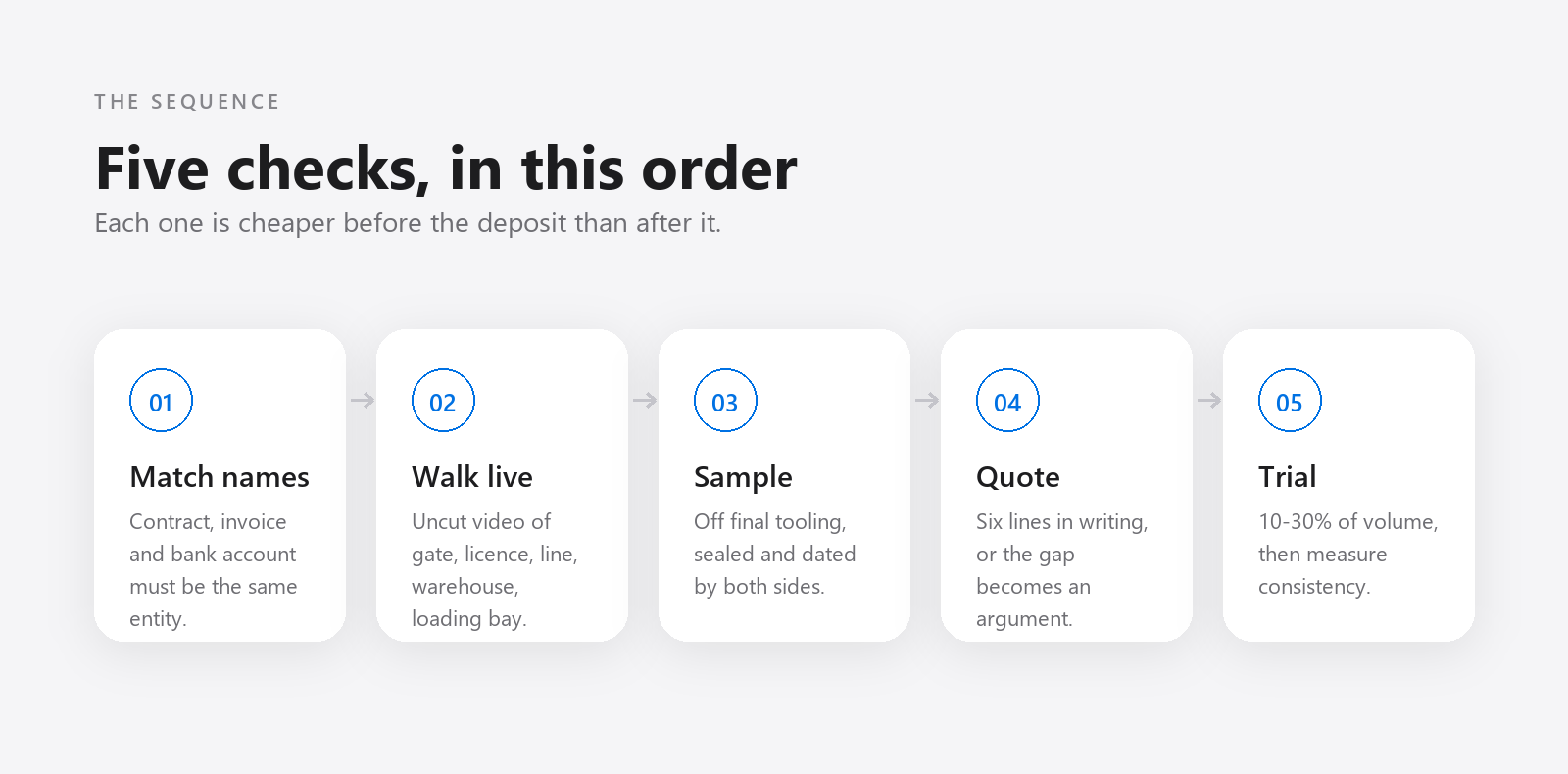
Three pieces of hard evidence
The names have to match, three times. The company on the contract, the company on the invoice, the name on the receiving bank account. A mismatch is not proof of fraud — trading companies sign and factories produce all the time — but it is the one signal you can catch for free, before any money leaves. If three entities are involved, get it in writing which one signs, invoices, is paid, and is liable for defects.
A factory walk you can watch live. Not a corporate video. A live call, walking: gate, sign, business licence, a line actually running, raw material storage, finished goods, test equipment, loading bay. Ask them not to cut. A supplier with a real plant rarely refuses. One that keeps rescheduling, or offers only a sales-office address, has told you something useful already.
A sample made on the equipment that will run your order. This is the step buyers skip because the sample looks right. Ask what it was made on: normal production equipment, or a bench with temporary tooling and substitute material? The useful question is not whether the sample is good, but whether the sample and the mass run come off the same line, mould and material batch.
What each document proves, and what it doesn't
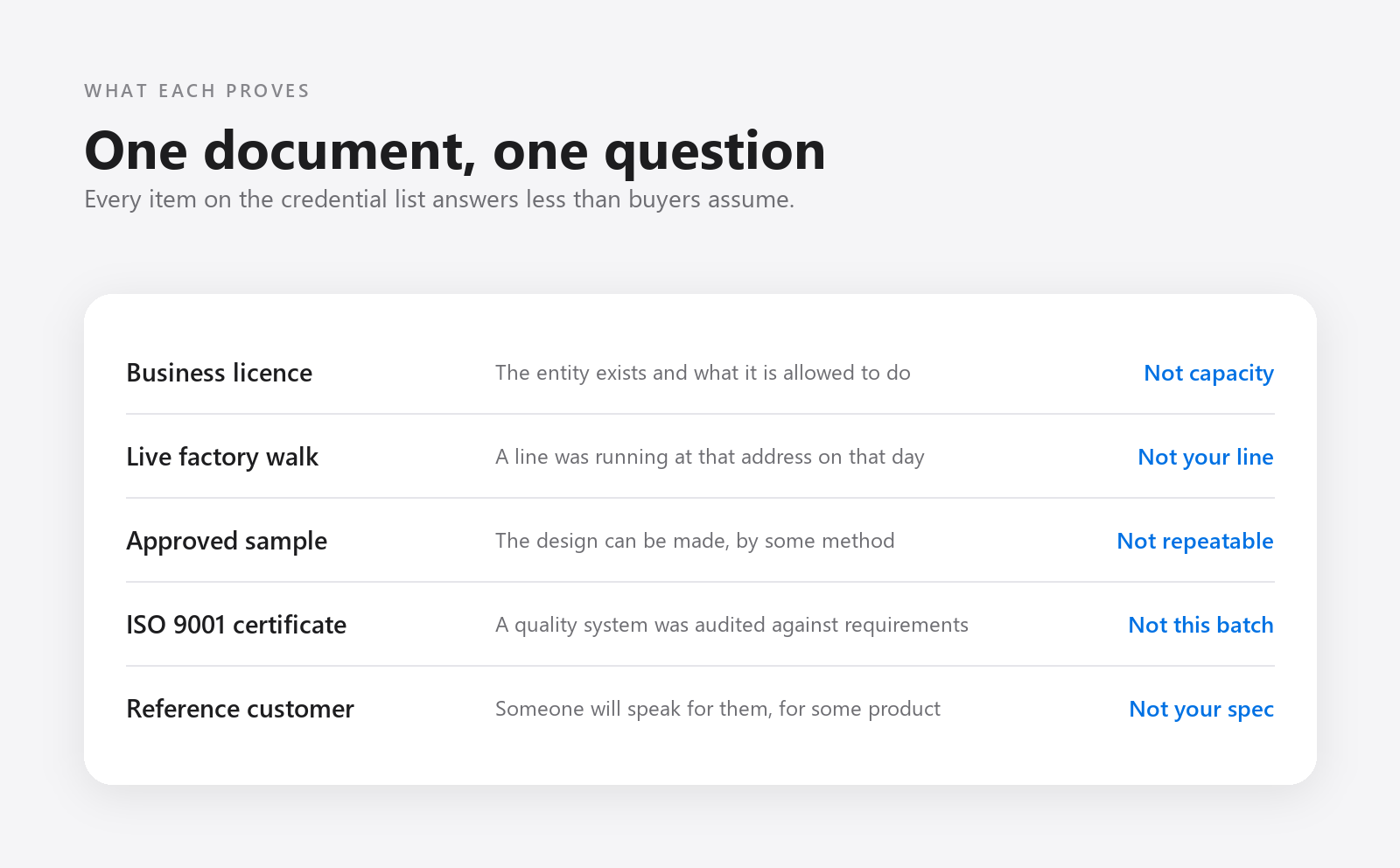
Each item on a supplier's credential list answers exactly one question. Treating a business licence as evidence of capacity is the most common first-order mistake, and an expensive one, because it feels like diligence. Certifications follow the same logic: ISO 9001 shows a system was audited against requirements, not that the 500th unit in your run is right. A filter, not a guarantee.
Six lines your quote has to carry
A quotation is the first draft of the contract; every line you omit becomes an argument later.
| Line | How it should read | What the omission costs |
|---|---|---|
| Tax Each Order Status | "USD 4.20 per unit, VAT excluded" or explicitly inclusive | A duty or VAT bill at the port that nobody agreed to |
| Trade term | "FOB Ningbo, Incoterms 2020", not just "FOB" | Disagreement over who pays what before the ship, and where risk passes |
| Tolerance | "Diameter 50 mm ±0.3 mm, caliper, three points per unit" | Goods that look fine and do not fit your packaging |
| Packaging | Unit pack, inner box, carton dimensions, marks, units per carton | Cartons over the carrier limit, or unreadable marks at the warehouse |
| Inspection standard | "AQL 2.5 major / 4.0 minor, general inspection level II, ISO 2859-1" | "Good quality" becomes an adjective instead of a test |
| Remedy | Defect threshold, who pays rework, reshipment and freight, and by when | No route to a fix except goodwill |
Tolerance is where "looks the same" dies: ±0.3 mm with a caliper at three points is enforceable, and the same figure without a method is not, because two people can measure it two ways and both be honest.
AQL is not a pass rate. The acceptance quality limit is the worst process average you will accept, expressed through a sampling plan. AQL 2.5, read through ISO 2859-1 at general inspection level II, tells the inspector how many units to pull from a lot and how many defects are allowed before rejection. It assumes random sampling from a uniform lot. If the factory stacks the good units on top, no sampling plan saves you.
Seal the approved sample, too: two copies, signed and dated, one held by each side. Without a sealed reference, "we approved the sample" has no force three months later.
Incoterms decide which door the risk walks through
EXW and FOB are not synonyms with different price tags. Under EXW the goods are yours at the factory gate, and export clearance, inland haulage and main carriage are your problem. Under FOB the seller's obligation ends when the goods are on board. One word moves the point where risk transfers, along with who buys insurance and who argues with the forwarder.
Incoterms 2020 contains 11 rules, and each lists its cost allocation in articles A9/B9. Reading that list against the quote takes ten minutes and settles most "who pays for this" questions before they exist. It also binds payment: a letter of credit usually wants an on-board bill of lading, which is why the 2020 revision adjusted FCA.
Move the second payment off the bill of lading
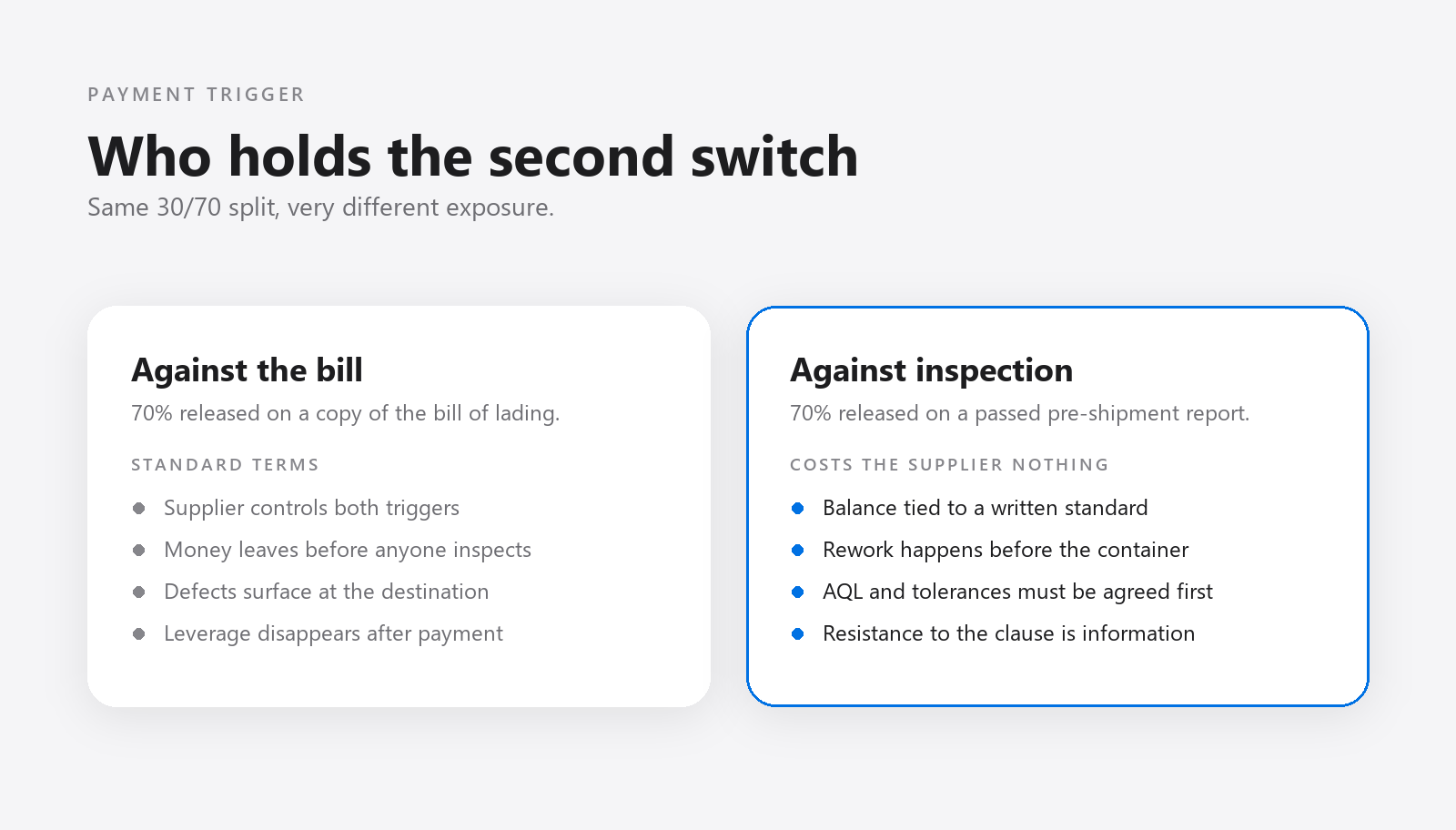
The standard first-order structure is 30% deposit, 70% against a copy of the bill of lading. The problem is not the split, but that both triggers sit with the supplier: they decide when production is done, and they hold the document that releases your money. You pay before anyone has looked at the goods.
Change one clause: 30% deposit, 70% against a passed pre-shipment inspection report. It costs a supplier with good goods nothing — if the product is right, the inspection is a formality. If it is not right, they find out before the container leaves, which is also better for them than a dispute at the destination. For you it is the only real lever in the transaction, and resistance to it is information.
| Structure | Deposit | Balance trigger | Main exposure |
|---|---|---|---|
| Full prepayment | 100% | None | Total loss, and you queue behind other creditors |
| Standard 30/70 | 30% | Bill of lading copy | Paying before anyone inspects |
| 30/70 against inspection | 30% | Passed inspection report | Standard must be written down, or the report is arguable |
| Deposit, inspection, retention | 30% | Inspection, plus 30 days after arrival | Suppliers may refuse; reasonable on a small first order |
Two rules that are not about percentages:
The bank account name must equal the contract entity. A request to pay a personal or third-party account, or a "new company account" mid-order, is a common way money disappears; the other is an intercepted invoice with substituted details. When details change, call a number you already had, not the one in the email.
Check whether they can still be there next quarter. A supplier can be technically excellent and financially fragile. In one case reported in the Chinese trade press, a forwarder with working routes ran out of cash after a loan was refused and the container yard began charging storage. More than a hundred downstream forwarders and several hundred sellers were caught; the resolution asked cargo owners to advance roughly 22 yuan per kilogram, later cut to 17, with a clause treating untransferred payments as abandonment of title. The operator's own line — the routes were fine, the money was not — is the lesson: operating capability and solvency are two checks.
Design the first order to fail small
A trial order is not "buy less". It is a controlled way to let problems surface while the loss is survivable. Too small and you learn nothing; small runs are often made on different equipment. Too large and it is not a trial. Ten to thirty per cent of the intended volume is a workable range. Inside it, test three things:
- Consistency. Pull 5% and measure the critical dimension. Unit one and unit 300 should be the same object.
- Packaging. Whether the carton survives your channel, and whether the unit pack can go on a shelf without repacking.
- Documents. Invoice, packing list, certificate of origin and any required test report, delivered on time rather than after three reminders.
If the product ships as a bundle, Kitting 038 Assembly is a separate line in the budget, priced per unit and per component.
Plan the timing honestly. Small batches can ship in 7 to 15 days; a bulk order needing scheduling, production, inspection and freight is usually 30 days before it leaves, plus transit. The volume break is real too: 500 units is a common minimum, and a factory that agrees to run 30 will often quote about 50% more per unit, because tooling, sampling and scheduling are fixed costs that do not shrink with the order. That premium is arithmetic, not rudeness — and it is why the rush order is always the expensive one.
Ten-minute compliance checks
Screen the entity. The U.S. Consolidated Screening List merges the restricted-party lists of Commerce, State and Treasury into one searchable tool, updated daily. It will not tell you whether a factory is competent, only whether you are about to contract with a party you should not.
Check who owns the barcode. If the supplier claims a brand, ask for the GTIN and check which company it is registered to. GS1 assigns GTINs to identify trade items, and different packaging configurations of the same product need different numbers — which explains why "just change the box" is never just a box.
Check the origin claim. An unqualified "Made in USA" claim requires final assembly and all significant processing in the U.S., with all or virtually all content domestic. That label on imported goods violates the labelling rule finalised in 2021 and carries civil penalties. Ask for the written basis of any origin claim rather than writing it yourself.
What due diligence cannot do
Four limits are worth accepting up front.
An audit is a date, not a period. You saw that line running on that day. You did not see next month's schedule, or which customer gets priority when the line is full.
A sample is not a production line. Handmade samples pass. Mass production drifts.
A certificate is not this batch. ISO 9001 says a system was audited. It does not say unit 500 matches unit 1.
Company-level export records are not to What Really available to buyers. Customs data sold by third parties varies in coverage and accuracy. What you can verify is entity consistency, restricted-party status, GTIN ownership and reference customers — not "how many containers they shipped last year".
Accept those four and the purpose of the exercise becomes clear. You are not eliminating risk. You are scheduling the discovery of it.
The short version
Match three names before you pay anyone. Walk the factory live, without cuts. Get a sample off the final tooling, and seal it. Put six lines in the quote — tax, trade term, tolerance, packaging, inspection standard, remedy — and move the balance from the bill of lading to the inspection report. Keep the first order at 10–30% of volume, and treat resistance to any of this as a finding rather than an obstacle.
If you have a category, a target quantity and a landing date, send them over. We will come back with a trial-order structure and a payment schedule before we discuss price.
References (Neutral Third-Party Sources)
Facts were checked against the following sources. No sourcing agent, inspection company or fulfilment provider is cited.
- International Chamber of Commerce — Incoterms 2020: the eleven rules, the consolidation of each rule's costs at articles A9/B9, and the FCA revision covering on-board bills of lading. https://iccwbo.org/business-solutions/incoterms-rules/incoterms-2020/
- ISO — ISO 9001:2015 Quality management systems — Requirements: what a certified quality management system covers, and therefore what a certificate can and cannot assert about a shipment. https://www.iso.org/standard/62085.html
- ISO — ISO 2859-1, Sampling procedures for inspection by attributes: acceptance sampling indexed by AQL, including normal, tightened and reduced inspection switching rules. https://www.iso.org/standard/2859-1
- GS1 — Global Trade Item Number (GTIN): how trade items are uniquely identified, and what a GTIN lookup can establish about the brand owner. https://www.gs1.org/standards/id-keys/gtin
- U.S. Federal Trade Commission — Complying with the Made in USA Standard: the "all or virtually all" test, the 2021 labelling rule, and civil penalties for unqualified claims. https://www.ftc.gov/business-guidance/resources/complying-made-usa-standard
- International Trade Administration, U.S. Department of Commerce — Consolidated Screening List: the merged Commerce, State and Treasury restricted-party lists, updated daily. https://www.trade.gov/consolidated-screening-list