
Automated Corporate Gifting: Send Gifts That Scale
The hard part of gifting a 500-person team is not picking the gift. It is keeping the list true — who still works here, what their address is, and who should not get a parcel this week. Automation mostly buys you one thing: the data handoff stops being a person re-typing a spreadsheet. The gift is the easy half.
This article walks through the rules engine, the data hygiene underneath it, the privacy line you have to respect, and the human checks you cannot safely automate away.
What automation actually automates
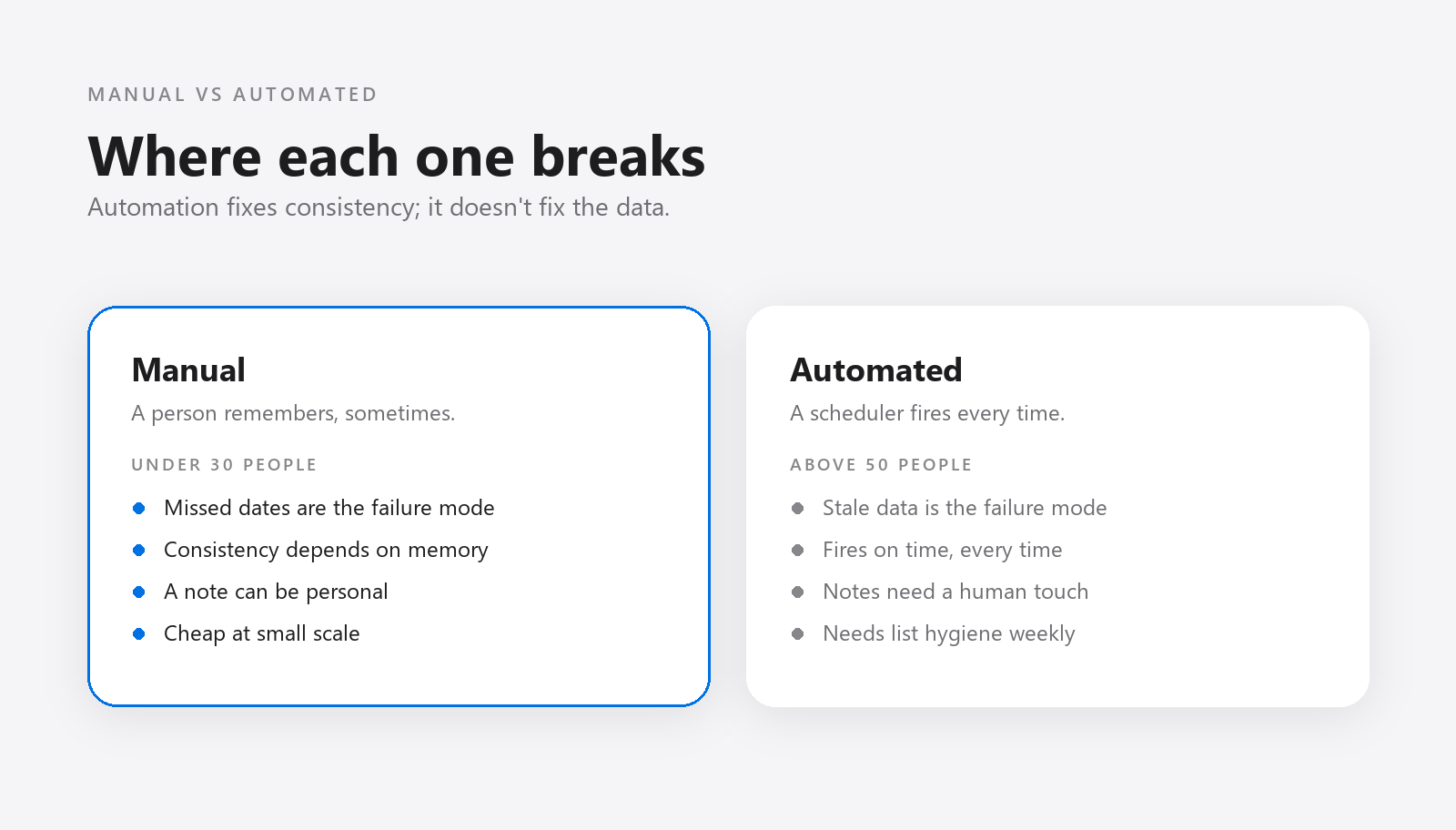
Strip the marketing out of "automated gifting" and what remains is a scheduler with a mailing list. The software watches a set of dates — hire date, birthday, work anniversary — and fires a gift when one arrives, instead of a person remembering to do it.
The value is consistency, not speed. A person who is supposed to send forty birthday gifts a year will send thirty-five, and the five missed will be the ones that matter. An automation sends all forty on time, every time. That is the whole argument, and it is a good one: Gallup's recognition research finds only about one in three U.S. workers strongly agree they received recognition in the past week, and employees who feel unrecognised are roughly twice as likely to say they will look for a new job within a year. Automation is how you keep the loop closed at scale without a calendar you will forget to check.
The triggers: build the rules engine first
Most teams start by picking a platform, then work out the rules. Do it the other way: write the rules in a spreadsheet, because the rules are where every later mistake lives.
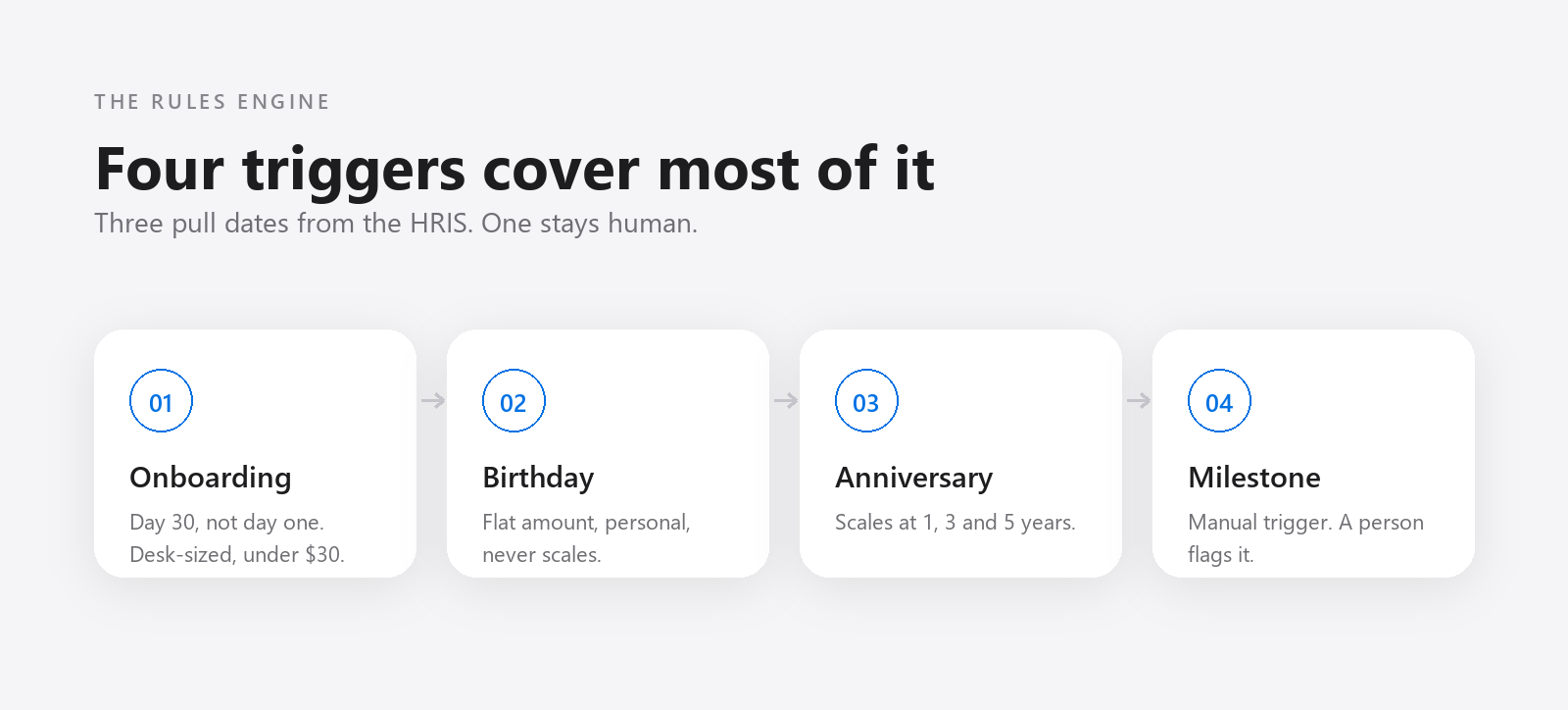
- Onboarding — day 30. Not day one. Day one is a welcome and the company is expected to do it; day 30 is the first time you can say "you stayed". A desk-sized item under $30.
- Birthday — flat amount. Personal, not a measure of service, so the amount does not scale.
- Work anniversary — scales with tenure. Rungs at one, three and five years, with a real jump between them.
- Milestone — manual trigger. First solo delivery, first client signed, first hire trained. These need a human to flag them, because no system knows they happened.
The dates for the first three should come from your HRIS, not from a spreadsheet someone owns. The milestone trigger stays human by design.
Your HRIS is the source of truth, or it should be
Every automated gifting programme lives or dies on the quality of the list it pulls from. The list that matters is not "who do we like" — it is the employee record in your HR system, because that is the one place hire dates, termination dates and job titles are kept current.
Two fields decide everything. Start date drives the anniversary ladder; birth date drives the birthday loop. If either is missing or wrong in the HRIS, the automation will fire on the wrong day and the mistake will repeat every year until someone fixes the record. Before you wire anything up, pull both fields for the whole population and audit them — a birthday entered as the default January 1 is a gift that fires for half the company on New Year's Day.
The second half of the pipeline is fulfilment, and it has its own accuracy number. A well-run warehouse keeps picking errors under about 0.3 percent, but that number only holds because every order passes a recheck before the shipping label goes on. When you automate the trigger, you have not automated away the recheck — you have just moved it downstream, which is why the pick-and-pack step still needs a human eye, and why assembled sets run through gift kitting rather than a single SKU.
Address hygiene: the list rots fast
A birthday list that sat untouched for a quarter is already wrong. People move, and the address on file is whatever they typed at onboarding two jobs ago.
The U.S. Postal Service keeps a national change-of-address dataset of roughly 160 million forwarding records, and its Move Update standard expects mailers to refresh address data within 95 days of a mailing. Delivery-point validation goes one step further and checks whether an address currently exists in the delivery file at all.
The operational version is three steps, and none of them are optional at scale: validate the file before dispatch, ask each person to confirm a delivery address rather than trusting the onboarding form, and set an address freeze a few days before the order goes out. A Friday-afternoon address change will not make a Monday pick list — treat anything after the freeze as the next batch.
Privacy: the consent trap
Automating Realtor Gifts means your gifting tool now holds employee names, home addresses, birthdays and hire dates. That is personal data, and it is exactly where people get sloppy.
Under the GDPR, two principles bite here. Data minimisation says you should collect only what is necessary and hold it no longer than needed — which means a gifting platform should not also be pulling salary bands or health fields just because the HRIS connector makes them available. And consent, in an employer-employee relationship, is mostly not a lawful basis you can lean on, because an employee cannot realistically refuse without fear of consequence. The safe posture is to rely on a lawful basis such as contract or legitimate interest, minimise what you sync, and tell people plainly what is collected and why.
For teams outside the EU, the rule of thumb is the same even where the law is looser: do not sync more than the gifting flow needs, and make opt-out easy. A "no gifts" preference is a legitimate data point, and honouring it is cheaper than the alternative.
The human checks automation cannot remove
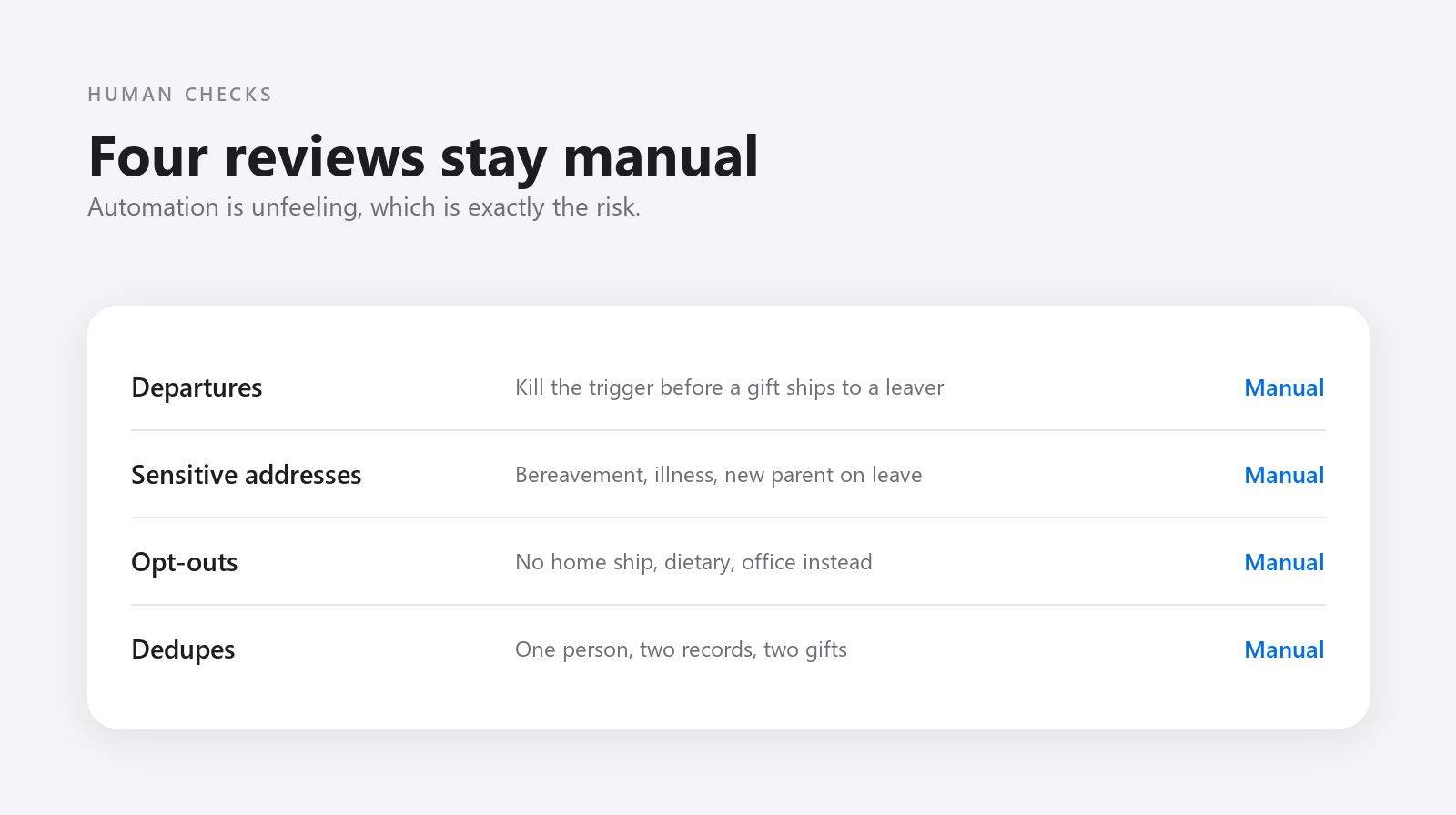
Automation is reliable and unfeeling, which is precisely why these four checks stay manual.
Departures. The single most embarrassing failure is a welcome gift arriving for someone who was terminated last week. Wire the offboarding date into the rules so the trigger dies before it fires, and still have a human skim the batch before release.
Sensitive addresses. Bereavement, a serious illness, a new parent on leave — a cheerful "happy birthday" parcel can land on the wrong doorstep at the wrong moment. A short human review of the release list catches what no rule will.
Opt-outs and preferences. Some people genuinely do not want a home shipment, or want it at the office, or have dietary restrictions on food gifts. Those flags live in the list, and the list only respects them if a person checks.
Dedupes. One person, two records — an old contractor entry and an employee entry — produces two gifts and two annoyed questions. A dedupe pass before release is a five-minute job that automation will never do for you.
A rules engine you can copy
| Trigger | Data source | Gift band | Manual review |
|---|---|---|---|
| Day-30 onboarding | HRIS start date | Under $30 | None |
| Birthday | HRIS birth date | Flat per head | Dietary and opt-out flags |
| 1-year anniversary | HRIS start date | $40 band | None |
| 3-year anniversary | HRIS start date | $80 band | None |
| 5-year anniversary | HRIS start date | $100+ band | Manager note |
| Milestone | Manual | Variable | Always |
Two columns deserve attention. The manual review column is what keeps the programme human, and the data source column is what keeps it true. If a trigger is pulling from a spreadsheet rather than the HRIS, mark it red until you fix the source.
On cost, keep the usual small-batch reality in mind for anything branded: a minimum order quantity and a sampling pass apply, and a 30-unit run can cost around 50 percent more per unit than a 500-unit run because tooling and sampling are fixed costs. For a programme firing a handful of gifts a week, that argues for keeping a small stock of unbranded, always-shipable items rather than ordering a fresh custom run every month.
The short version
Automated gifting is a scheduler attached to a mailing list, and its entire value is that it fires on time, every time, without a person remembering. The gift was never the hard part. Build the rules before the platform, pull dates from the HRIS not the spreadsheet, keep the address list fresh, minimise what you sync, and keep four reviews human — departures, sensitive addresses, opt-outs and dedupes. Get the data right and the gifts take care of themselves.
If you have a headcount list and a set of triggers but the list keeps going stale, send the current file over — we will show you where the data breaks before we talk about price.
References (Neutral Third-Party Sources)
Facts in this article were checked against the following public sources. No gifting platform or fulfilment provider is cited.
- Gallup — The Importance of Employee Recognition: Low Cost, High Impact: the one-in-three figure for weekly recognition and the doubled likelihood of job-seeking among those who feel unrecognised. https://www.gallup.com/workplace/236441/employee-engagement-drives-growth.aspx
- GDPR — Article 5, Principles relating to processing of personal data: the data-minimisation, storage-limitation and accuracy principles that apply when a gifting tool holds employee data. https://gdpr-info.eu/art-5-gdpr/
- United States Postal Service, PostalPro — Address Quality Solutions: the national change-of-address dataset, the 95-day Move Update window, and delivery-point validation for list hygiene. https://postalpro.usps.com/address-quality