
Company Gift Ideas for Clients and Customers
Most client gifts fail because the recipient has no reason to reach for them. A gift that isn't useful goes into a drawer, then a box, then the trash — usually within a year. The only test that matters is: would they use this if your logo weren't on it? If the answer is no, it's a branded donation, not a relationship asset.
Why most client gifts get binned in a week
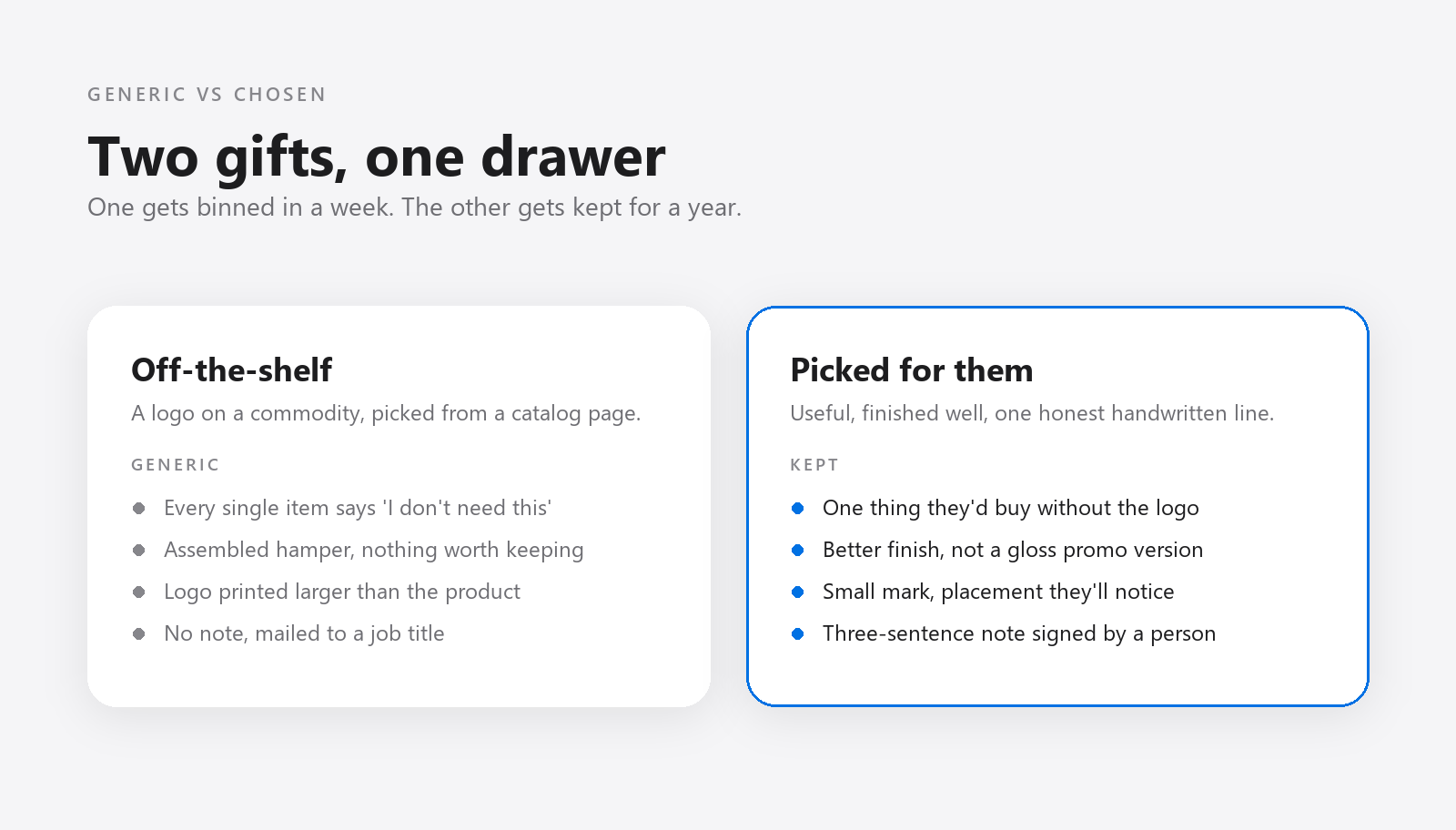
The first impression forms in about sixty seconds — how the packaging looks, whether the object has weight, whether the details were finished. That is not a made-up number; it is how Chinese corporate-gift sellers describe the moment a client tears the box open, and it matches what you already know from receiving gifts yourself. A gift that reads "quality" in that minute signals a company that is careful and professional. A gift that reads "clearance item" just fills a drawer.
The worst category is what one Chinese gift-picker writer calls "food without taste, abandoned but not thrown away" — a hamper of tiny items where every piece makes you think "I don't need this, but throwing it out feels wasteful." It sits on a shelf for months and does nothing. The gifts people keep are the quiet ones: reasonably priced, well made, comfortable to use, the kind of thing they'd hand to someone else if they didn't want it themselves.
The $25 tax wall you should know before you shop
Before you pick anything, understand the number the IRS sets. You can deduct no more than $25 per person per year for business gifts. That ceiling is why so many U.S. firms quietly keep the per-client gift under $25 — not because they're cheap, but because anything above it is partly after-tax money. There is a useful carve-out: an item costing $4 or less with your name clearly and permanently printed on it, distributed widely as one of many identical items, doesn't count toward the $25 limit at all. Pens, desk sets, and logo'd bags live in that space.
The anchor is a U.S. thing — Chinese buyers sort by scene instead: trend items for business, practical goods for perks.
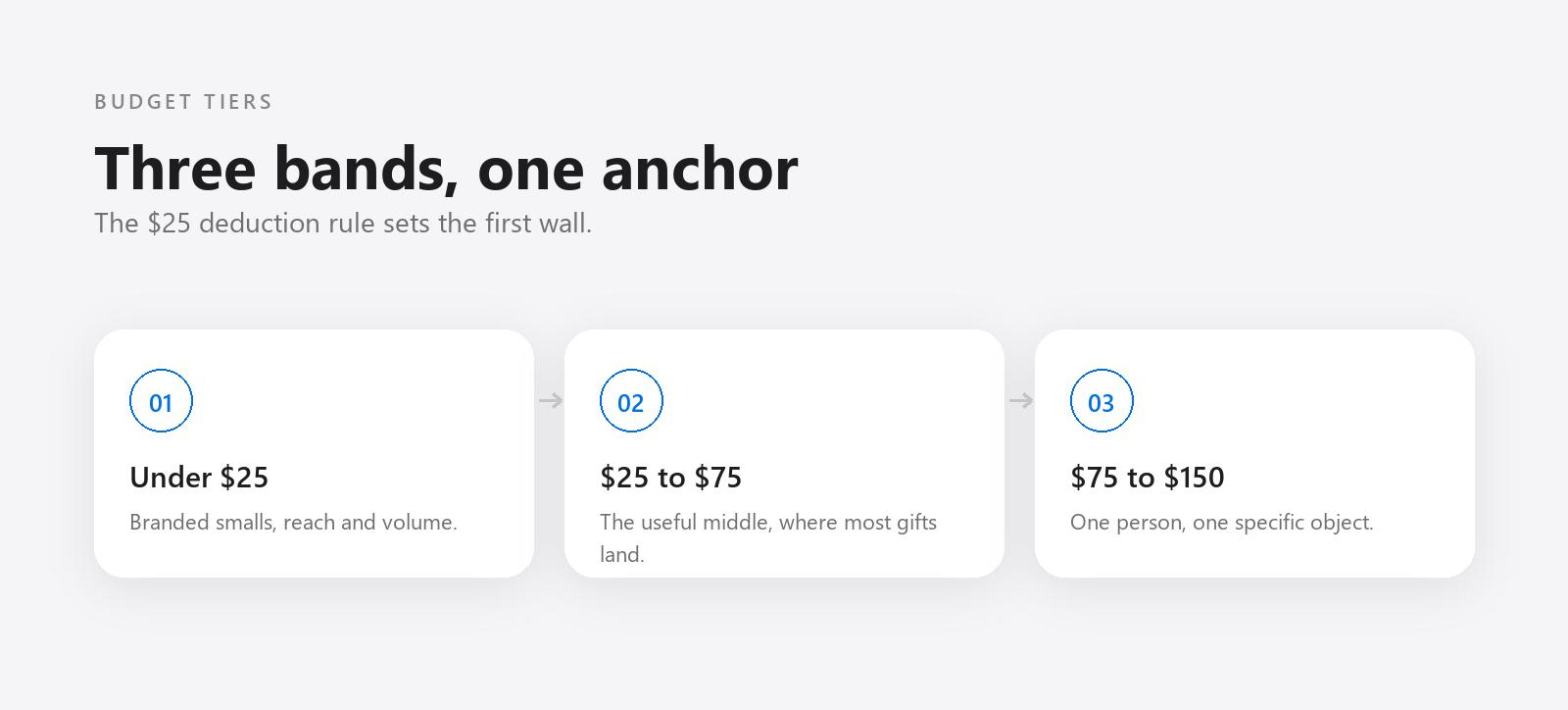
That single rule explains the tiers below. $25 is the anchor; above it you're spending real margin, so the object has to earn it.
Under $25: the branded smalls
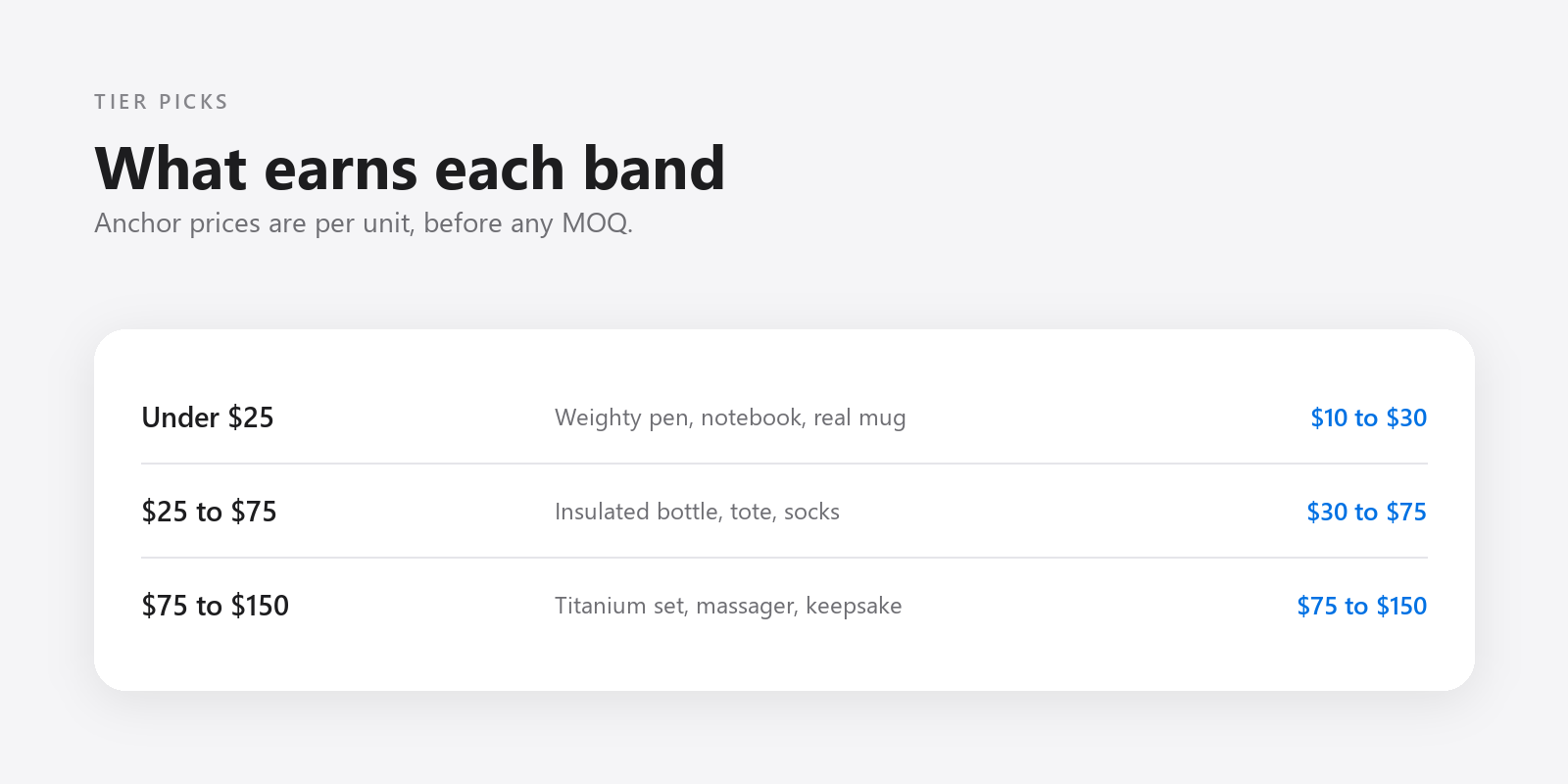
This is the "reach" tier — conference crowds, wide customer lists, holiday cards with a small physical add-on. The trap is buying the cheapest version of everything and ending up with a bag of plastic. Spend the whole budget on one good thing instead.
- A weighty pen that writes well (cheap pens get "lost on purpose")
- A soft-touch notebook with a debossed cover, not a printed one
- A quality ceramic mug in a shape someone would buy anyway
- A reusable bag with real handles, not the flimsy tote
The $4 rule does quiet work here. A $3.50 logo pen is not a gift, it's an exception to the gift rules — treat it as a give-away, not as the "client gift" line in your CRM.
$25 to $75: the useful middle
This is where most client gifts should land. It's the band where an object is nice enough to feel like a gift and cheap enough that you can send it to a long list without an approval chain.
The steady performers here, from what corporate-gift sellers in China keep restocking: an insulated travel tumbler, a notebook-and-pen set, a canvas tote that holds a laptop, a braided charging cable, good socks. The insulated bottle is the workhorse — used every day, visible on a desk or in a car, easy to put a small logo on without ruining it. One Chinese seller calls the thermos the "steady hot-seller" of the category because the same product fits meeting gifts, business gifts, and anniversary gifts.
What the useful middle buys you is repeated exposure. A client who uses your tumbler every morning sees your name five days a week for a year. That is the whole game, and it's why usefulness beats novelty.
$75 to $150: the relationship band
Above $75 you are no longer buying reach. You are buying one specific person, so the gift has to survive one person's scrutiny. This is the band for key accounts, deal-closers, and long-term partners.
The safe picks here are the "health and desk" category that Chinese vendors keep putting in year-end kits: a titanium travel cup in a gift box, a neck massager, a desk organizer, a Bluetooth speaker. For the very top of the band, precious-metal keepsakes — a small gold-foil plaque, a coin, a pair of cufflinks — carry a weight that a gadget can't, because they read as "commemorative" rather than "promotional."
A warning that gets skipped in the sales pitch: this band is where minimum order quantity bites. MOQ is the smallest run a supplier will take before charging a setup penalty — many factories will take thirty units only if you pay fifty percent more per piece, because the cost of the mold doesn't shrink. If you need four premium gifts, you are buying four items at a thirty-unit price.
The relationship ladder: new client, long-term client, key account
The same object changes meaning with the relationship. A $40 tumbler to a brand-new prospect says "thanks for the meeting." The same tumbler to a client you've billed for three years says "we forgot you exist." Bigger firms chase novelty and quality; smaller ones chase value and usefulness — which is why one list never fits. Tier the list before you buy anything.
| Relationship | What it should signal | Safe picks | Budget anchor |
|---|---|---|---|
| New prospect | We noticed you, low pressure | Notebook + pen, tote | $10–$30 |
| Long-term client | We remember you specifically | Insulated bottle, socks, small desk item | $30–$75 |
| Key account | You matter more than our logo | Titanium set, massager, keepsake | $75–$150+ |
The middle row is the hardest, and it's where most programs fall over. A long-term client has earned something personal, but you don't have the budget of a key account. The fix is to buy one useful item in a better finish rather than two cheap ones — the version of the tumbler with the matte powder coat, not the gloss promo finish.
Industry picks that actually land
Not every idea works in every room. Most of the industry still does shallow customization — slapping a logo on an off-the-shelf item and calling it done — which is why the three picks below stand out.
Financial and legal — these accounts live under gift-policy limits and audit trails. Keep the single item modest and keep the paper trail: recipient, amount, date, purpose. A notebook beats a bottle of whiskey here, because it never triggers a compliance conversation.
Technology — the client already owns better cables than you can buy. Skip the tech; go for what surrounds the desk — a notebook, a heavy pen, a felt laptop sleeve. The sleeve goes everywhere the laptop goes.
Real estate and design — these people hand things to others constantly. Give them something with a small, elegant mark they'd be proud to hand a client: a linen notebook, a machined pen, a candle. It reads as taste, not advertising.
The rule underneath all three: pick for the person's day, not for the brand's placement. We wrote the full logic for how a gift moves a sales decision in our guide to client gifts, and the moment-based version in client appreciation gifts.
The note does more persuading than the object
A gift with a card is a gesture. A gift without one is a package. The note is where you say why this person, why now — the two things the object can't say on its own. Keep it to three or four sentences, sign it with a real name, and never let it read like a mail merge.
The cheapest upgrade in the whole category is handwriting. A printed card says "you were on a list." A handwritten line says "a person did this." For a longer treatment of what to write and what to leave out, the thank-you gifts for clients guide covers the card in detail.
Five questions to ask before you order
Run every idea through these before you commit, because the fixes get expensive after the boxes arrive.
- Would the recipient use this if there were no logo on it?
- Is the per-unit cost inside the $25 anchor, or are we spending margin deliberately?
- Does this need an MOQ we can't meet without paying a setup penalty?
- Do I have the recipient's current address, or am I mailing to a title?
- Can I write one specific sentence about why this person got this gift?
If you can't answer number five, the gift is a broadcast, not a relationship move — and broadcasts don't survive the drawer.
The short version
Client gifting is not a selection problem, it's a filter problem. Apply the drawer test to every idea, anchor the tiers around the $25 deduction rule, and let the relationship — not the calendar — set the budget. A $40 tumbler to a new prospect and a $40 tumbler to a three-year client are two different gestures wearing the same price tag. Buy the useful version of the thing, write one honest line on the card, and the object does the rest for the next twelve months.
If you're ordering for a list and need the logistics handled — warehousing, kitting a multi-item box, and dispatching each parcel to a real person — get a quote and we'll map the run before you print anything.
References (Neutral Third-Party Sources)
- IRS — Publication 463, Travel, Gift, and Car Expenses: the $25 per-person, per-year deduction limit on business gifts, the $4 exception for imprinted items, and the incidental-cost rule. https://www.irs.gov/publications/p463
- IRS — Are business gifts deductible?: the same $25 limit and the record-keeping requirement (business purpose, description, amount, date). https://www.irs.gov/faqs/small-business-self-employed-other-business/income-expenses/income-expenses-8
- PPAI — 2021 Consumer Study: consumers' attitudes toward receiving promotional products, including the share who keep an item because it is useful. https://legacy.ppai.org/media/7062/21consstdy-info-ol.pdf
- Federal Trade Commission — FTC's Endorsement Guides: What People Are Asking: guidance on disclosure obligations when a gift or free product creates a material connection. https://www.ftc.gov/business-guidance/resources/ftcs-endorsement-guides-what-people-are-asking