
Influencer Gifting Note Examples That Get Responses
The note is what decides whether your box makes it into a video. A creator who receives several packages a week skims the card and, in about ten seconds, sorts your brand into "worth opening on camera" or "worth a courtesy thank-you." You can fix the note in an afternoon. What you can't fix with a good note is sending to the wrong person — so screen first, write second.
Here is the honest version of how this works, straight from sellers who have shipped hundreds of samples. Most creators who cold-approach a brand asking for free product never post anything. The ones who post after a screen are a different group, and they post at a much higher rate. The note is how you convert that second group.
Why the note decides the unboxing
In Amazon's creator program, the loop is: you send a free sample, the creator films a product video, uploads it to Amazon or social, and shares an affiliate link that pays commission on every sale. The commission is what keeps the creator motivated, but the sample is what starts the loop. No sample, no video, no link.
The problem is that the sample door swings both ways. Sellers in Chinese cross-border groups keep saying the same thing: "most of the ones who ask for samples are freeloaders," and "a lot of samples go out and you never hear back." The word they use for it is bai piao — free-riding, taking the sample with no intention of posting. If you send to everyone who asks, most of your budget walks out the door as unsolicited gifts.
There's a real number buried in one of those group chats. A seller who screens creators before sending says "eight or nine out of ten will upload a video." The same seller, unprompted, admits the flip side: the videos are often thin, and very few creators put real effort in. That is the honest trade — seeding buys you volume of real-person video, not guaranteed sales.
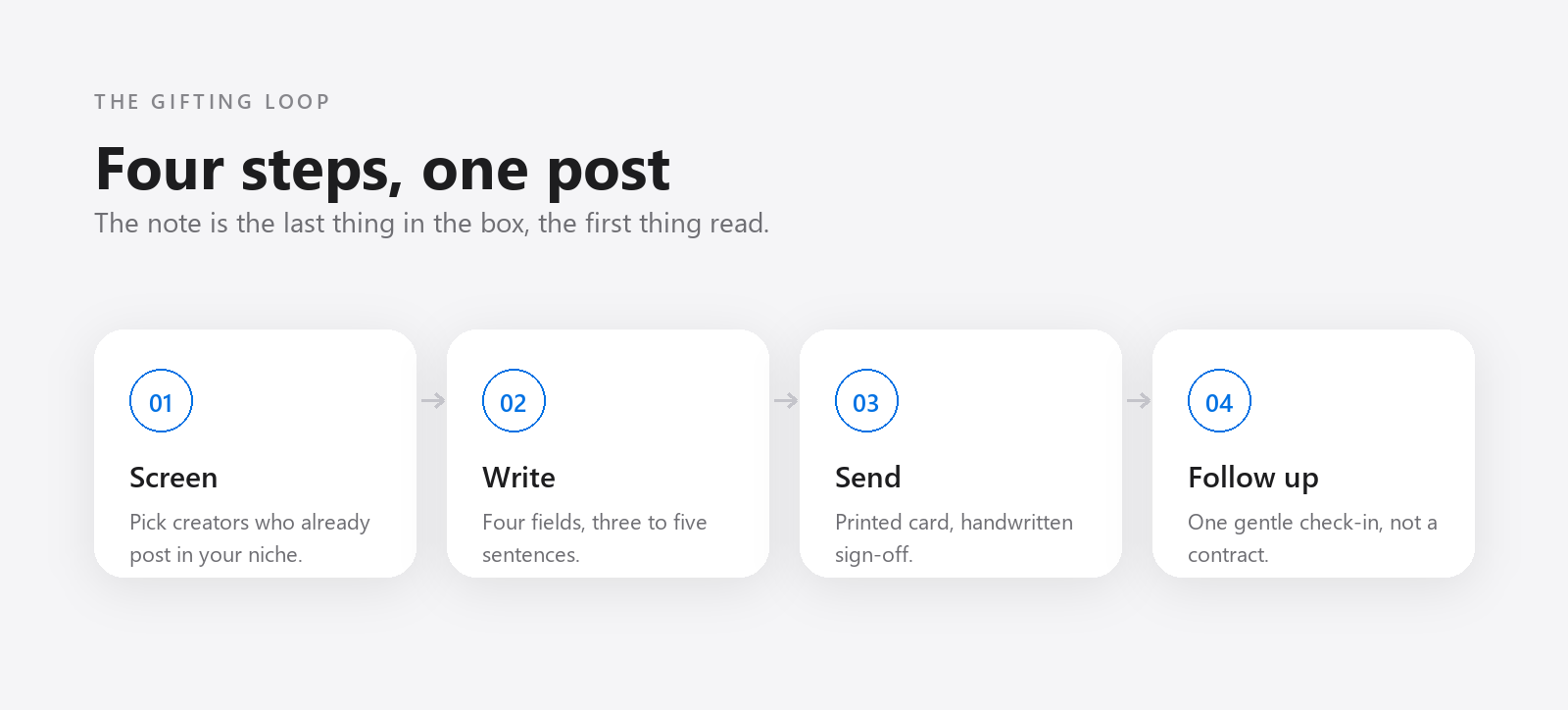
Screen first, then write the note
The note cannot save a bad list. If you write a beautiful card and ship it to someone who never had any intention of posting, you've just written a beautiful thank-you to a stranger. Screen on two things: does this creator already post consistently in your niche, and do they have an engaged (not necessarily large) audience you can actually reach?
One counter-strategy from the same sellers is worth stealing: set the commission high enough that creators buy the product themselves instead of asking for a free one. Someone who pays for the product is already past the free-riding filter. The ones who insist on a free sample despite a generous code are telling you something.
So the order is: screen, then write, then follow up. The rest of this guide assumes you've done step one.
The four fields every note needs
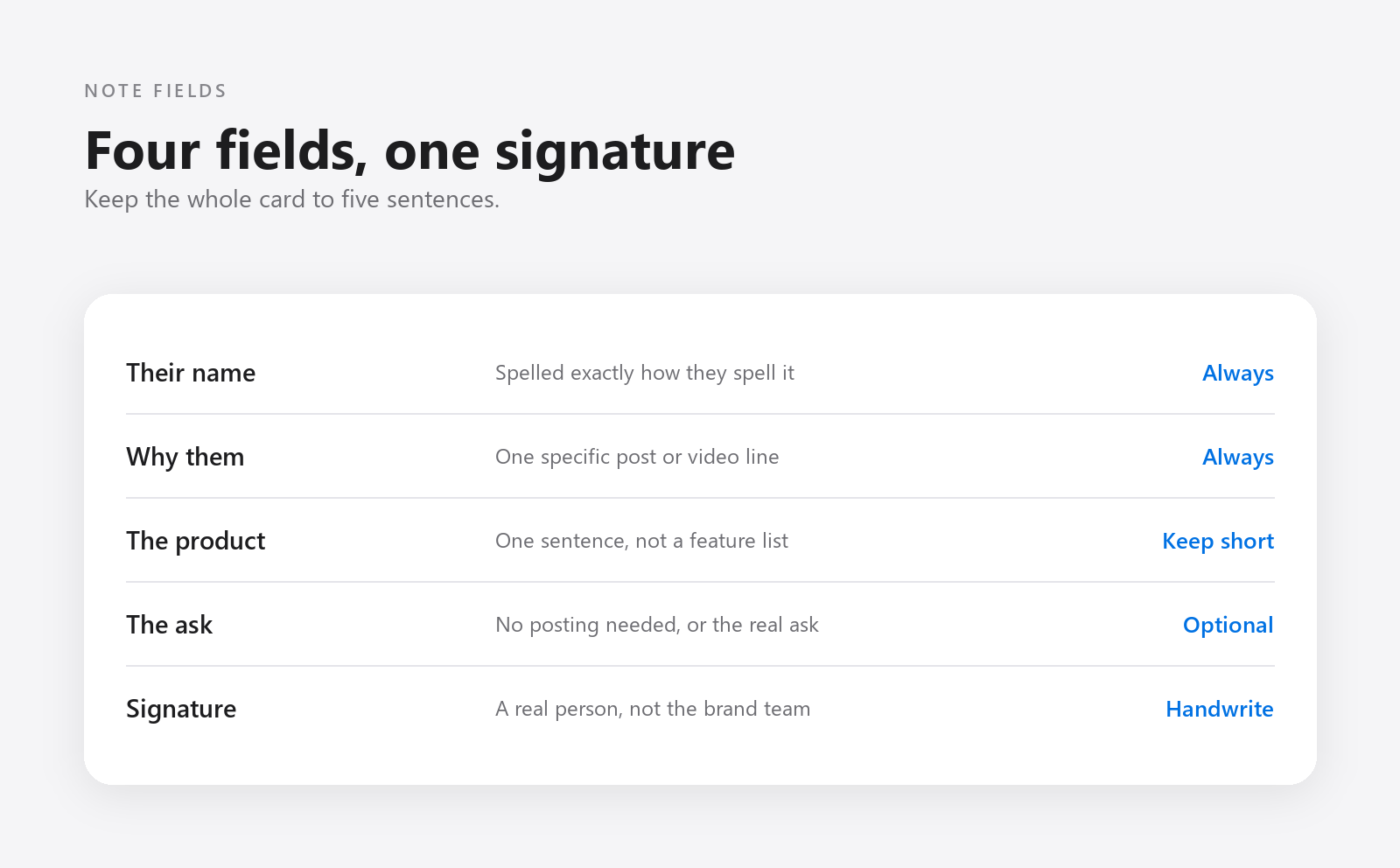
Strip the note down to four things and you can't go wrong. The whole card should be three to five sentences — it gets read on camera or not at all.
| Field | What to write | Required |
|---|---|---|
| Their name | Spelled the way they spell it, not "Hey there" | Yes |
| Why them | One specific post, video, or line they made | Yes |
| The product | One sentence on what it is or how to use it | Yes |
| The ask | "No posting needed" or the actual ask | Yes |
| Signature | A real name, not "The Brand Team" | Yes |
The "why them" line is the entire difference between a mass send and a personal one. One specific reference — "your video on winter running made half our team buy trail shoes" — beats three sentences of brand biography. If you can't write that line, you haven't screened enough.
Template 1: the no-strings send
Use this for pure seeding, where you want the creator to try the product and there is no posting requirement. It's the most credible kind of send, and it's what most creators are conditioned to ignore because it's so rare.
Hi Maya,
Your video on running in the rain is why half our team now owns trail shoes. We make [product], and we wanted you to have one. Nothing to post, nothing to fill in — just enjoy it.
— Sam, founder
The power is in what's absent. You didn't ask for a post, you didn't attach a deadline, you didn't drop a code. A creator who's been pitched all week notices.
Template 2: the early-look launch
Use this when the product is new and you want a launch-week wave of content. If you have an embargo date, put it on the card.
Hi Maya,
You're one of the first forty people to get this. [Product] goes on sale [date], and we wanted it in your hands first because your [topic] content felt like the right home for it. Tell us what you think, good or bad.
— Sam, [Brand]
Forty is not a random number — pick the real count so the line is true. Saying "one of the first five thousand" when you sent four boxes reads as fake the moment they compare notes with another creator.
Template 3: the problem-solver
Use this when the creator has mentioned a specific problem your product fixes. It's the highest-converting note because it's the hardest to fake — you have to actually watch their content.
Hi Maya,
You mentioned a few weeks ago that your running shoes give you blisters on long runs, and we couldn't stop thinking about it. [Product] was made for exactly that. Hope it helps.
— Sam, [Brand]
This one lands because it proves you watched. It's also the template most likely to get a reply, because you've handed the creator an obvious story to tell: "I said this thing, and a brand heard me."
Template 4: the code card
Use this when you've already agreed on a commission or a discount in your outreach. The card is the place to repeat it so the creator doesn't have to dig through their inbox.
Hi Maya,
In the box: [product] for you. For your followers: code [CODE] for [X]% off. For you, if they use it: [Y]% of every order. No pressure to post — if you do, it's all set up.
— Sam, [Brand]
This is where a note crosses from seeding into a commercial relationship, and it's the moment disclosure stops being optional. If there's a code, there's a material connection, and both you and the creator are responsible for making it visible.
What to leave out
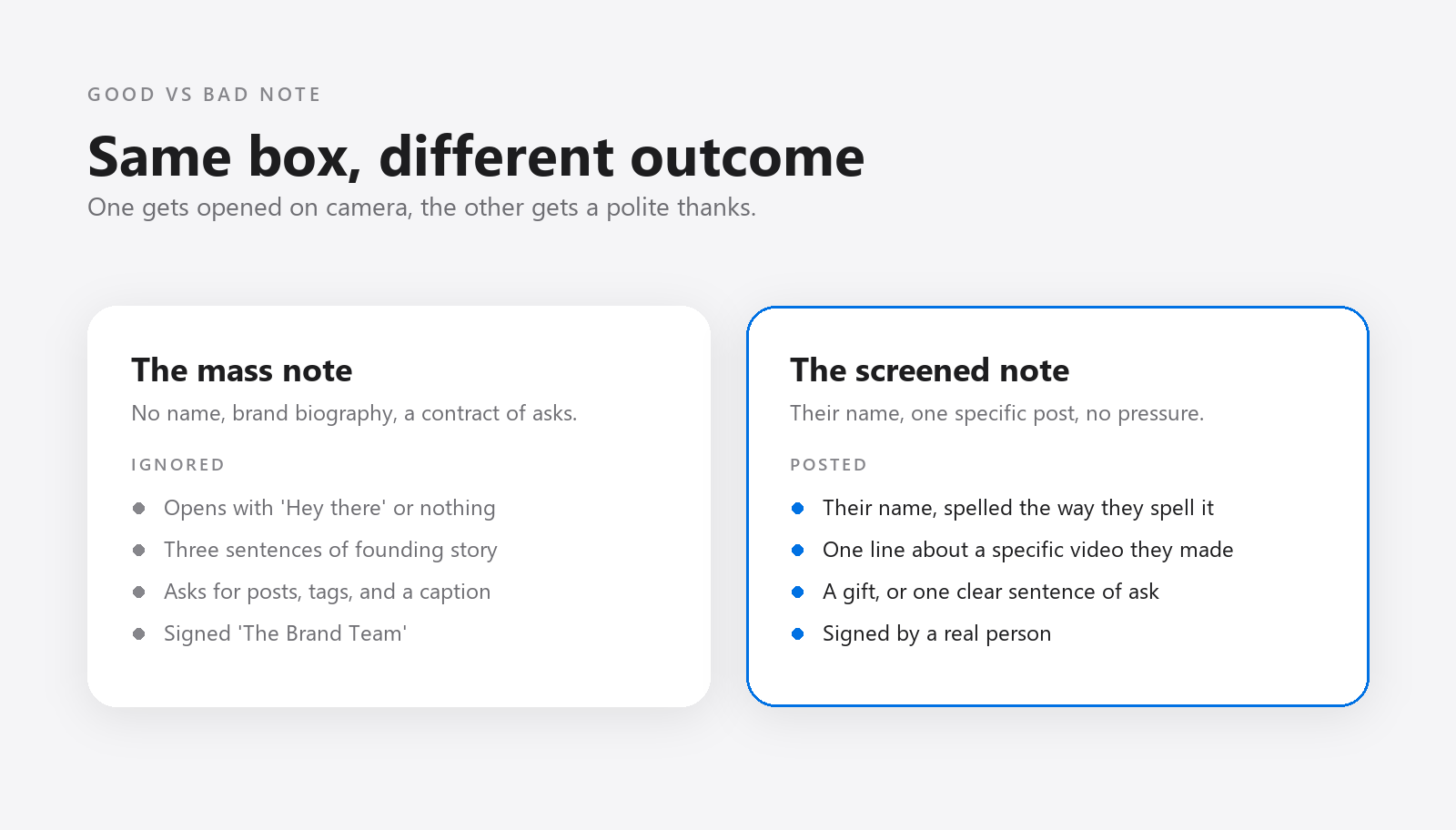
Three things kill a note faster than a typo. First, the brand biography — no one reads the paragraph about your founding story, they read the first line and decide. Second, legal-sounding conditions — "by opening this box you agree to…" is a fast way to get the box closed on camera with a confused look. Third, an over-specified ask — asking for a specific number of posts, specific hashtags, and a specific caption turns a gift into a contract and kills the goodwill you just bought.
Keep the ask either absent or one sentence. Everything else belongs in a separate brief or a DM, not on the card.
Handwritten or printed
Handwritten beats printed for genuine feel, but it doesn't scale — if you're sending a hundred boxes a month, you'll burn a day handwriting notes and the handwriting will get worse as your hand gives out. The practical middle is a printed card with a real handwritten sign-off: one line, your actual signature, done in seconds per box.
The full logistics of the send — one parcel per creator or per agency, declaring the sample as a sample, and collecting addresses through a form instead of a DM thread — are covered in our influencer seeding fulfillment guide. The note is the last thing in the box, but it's the first thing they read.
The disclosure line
If the creator posts, the post needs to disclose that the product was gifted. Under the FTC's endorsement rules, a free product is a material connection — a relationship that could affect how viewers weigh the recommendation — and it has to be disclosed clearly and conspicuously. "Gifted by [brand]" in the caption, or #ad, beats burying a hashtag at the end of a long caption.
Put a gentle reminder in the note or the follow-up, not a lecture. A single line — "if you share, a quick 'gifted by [brand]' keeps it all above board" — does the job without turning the card into a compliance document.
The short version
The note converts a screened creator into a post, and it does it in four fields and five sentences. Screen out the free-riders first, write one specific "why you" line, and keep the ask either absent or a single sentence. Handwrite the signature, not the whole card. And remember what the sellers who've shipped hundreds of samples will tell you: seeding buys you real-person video, not guaranteed sales — set your expectations there and the note will do its actual job.
References (Neutral Third-Party Sources)
- Federal Trade Commission — FTC's Endorsement Guides: What People Are Asking: a free product is a material connection that must be disclosed clearly and conspicuously. https://www.ftc.gov/business-guidance/resources/ftcs-endorsement-guides-what-people-are-asking
- Federal Trade Commission — Disclosures 101 for Social Media Influencers: when and how influencers must disclose a financial or material relationship with a brand. https://www.ftc.gov/business-guidance/resources/disclosures-101-social-media-influencers
- Federal Trade Commission — Native Advertising: A Guide for Businesses: the FTC's broader position that advertising must be identifiable as advertising, applied to sponsored or gifted content. https://www.ftc.gov/business-guidance/resources/native-advertising-guide-businesses