
Retail Fulfillment: Services, Costs, and How It Works
Retail fulfillment is the chain that moves a sold item from a shelf, a store back room, or a warehouse to the customer — and the hard part is not the last mile, it is deciding which of those three starting points each order should use. Most retailers don't run one fulfillment model. They run three at once and quietly lose money on the one they bolted on last.
This article is for anyone selling both online and in physical stores who is trying to figure out which orders should be picked in a store, which should ship from a warehouse, and what each choice actually costs.
The three models, and what each one is for
There are only three ways a retail order physically leaves the building.
| Model | Where it ships from | Speed | The catch |
|---|---|---|---|
| Warehouse / DC fulfillment | Central or regional warehouse | Standard to next day | Highest delivery distance |
| Ship-from-store | A physical store's back room | Same to next day | Store stock accuracy and labour |
| BOPIS (buy online, pick up in store) | A store, collected by the customer | Within hours | Pickup staging and no-shows |
A warehouse gives you cheap, accurate picking at scale and is the right home for steady national demand. Ship-from-store shortens the last mile — the final delivery leg to the door — but only works if the store's count of what's on the shelf is real. BOPIS, sometimes called click-and-collect, hands the final leg to the customer's own car, which removes the delivery cost entirely and adds a different problem: a picked order sitting on a shelf waiting for someone who may never arrive.
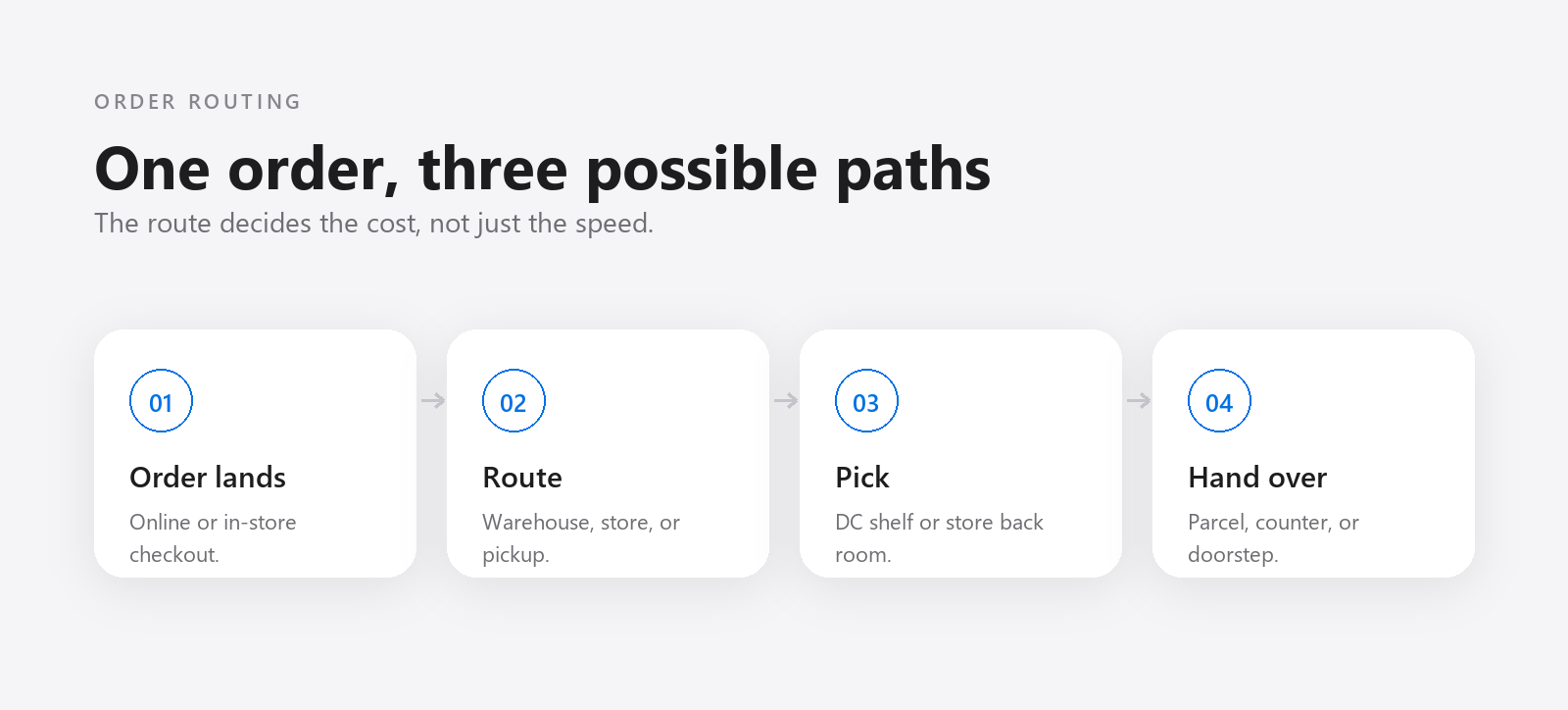
None of these is a technology purchase by itself. Each is a labour and inventory decision that happens to need software.
BOPIS is not free to run
BOPIS looks free to the customer and is not free to the store. Assembling one pickup order costs an estimated $2 to $6 in labour before you count the customer who never shows up, according to retail operations studies that measure the pick, the staging, and the handover at the counter. The saving is real — shipping a parcel from a warehouse runs $6 to $12 before last-mile — but the saving comes out of a store associate's shift, the same person who is supposed to be selling.
The number that decides whether BOPIS is worth it is the no-show rate. Industry discussions put unclaimed pickup orders at roughly 5 to 15 percent, varying by category and how long you hold the order. Every unclaimed order is a unit removed from the shelf and then put back by hand, so the labour happens twice and the revenue happens zero times. One Chinese warehouse-operations write-up puts the same logic in warehouse terms: a picked-but-uncollected order is the cheapest way to lose a unit twice, once in the pick and once in the restock.
The fix is a release window. Hold orders too long and the staging area fills with bags nobody wants; too short and customers abandon mid-process. Most operators land on windows measured in days, not hours.
Ship-from-store turns the shop floor into a pick face
Ship-from-store treats each store as a mini-fulfillment centre that ships to the customer closest to it. The appeal is speed and shorter delivery distance; the cost is that a store is staffed for selling, not picking, and nobody hired those people to walk a pick path.
The failure is rarely the first hundred orders. It is the two hundredth, on a Saturday, with a queue at the till. When an associate is pulled off the floor to pick an online order, the store trades a sale for a shipment, and the decision happens invisibly.
The deeper problem is accuracy. Store stock passes through more hands than warehouse stock — customers try things on, move them, and walk out with them — so a store's count drifts. A 3 to 5 percent discrepancy between what the system says and what's actually on the shelf is normal for a retailer that hasn't digitised, and at that error rate ship-from-store keeps cancelling orders it thought it could fill. A warehouse manager writing for a Chinese logistics magazine describes the standard defence: multiple checks — barcode, quantity, weight, and camera — layered on every pick and pack, which is a warehouse discipline a shop floor rarely has.
What a warehouse model actually costs
If you run a central warehouse, the cost is easiest to think about as fixed versus variable — a distinction a VP at a major Chinese food e-commerce retailer laid out in detail. Fixed costs (rent, equipment, most base wages) stay the same whether you ship ten thousand orders a day or one thousand. Variable costs (packaging, piece-rate labour, shipping) scale with every order.
His rule of thumb: warehouse cost and delivery cost usually run about 1:1, and the biggest fixed lines are rent and labour. The small variable line is the one worth watching, because it compounds. Cutting a carton from $1.50 to $1.20 saves $0.30 a box, which is nothing — until it's a hundred thousand boxes a day, at which point it's tens of millions a year.
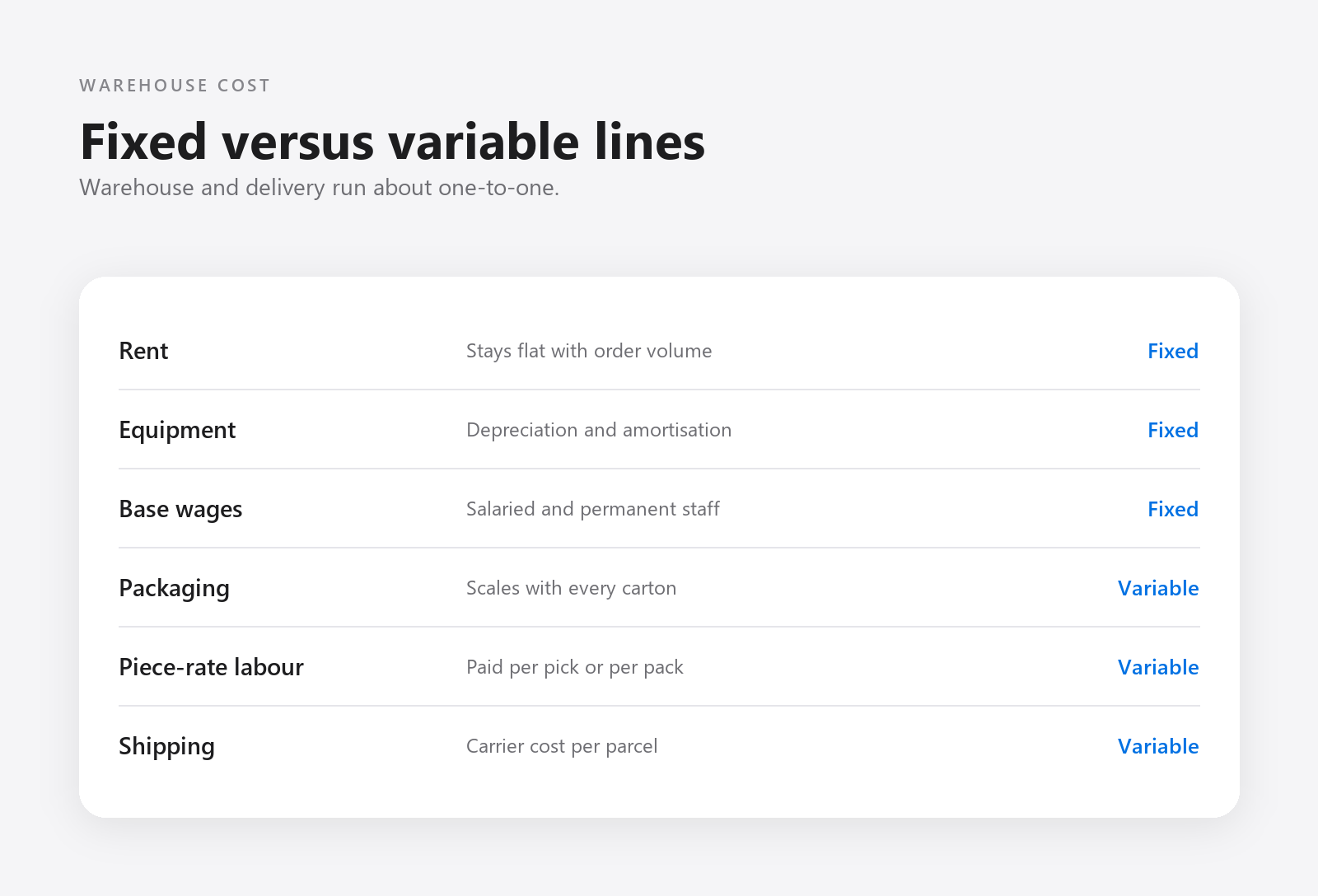
The same piece describes the honest answer to the build-versus-buy question: most retailers outsource transport and delivery but keep the warehouse in-house, and that split is usually backwards. Outsourcing the whole thing, when a competent partner exists, typically trims 10 to 20 percent of fulfillment cost.
The retail edge nobody in e-commerce sees
Selling to a big-box retailer is a different job from selling to a doorstep, and the difference is paperwork. Retailers order through EDI — electronic data interchange, the machine-to-machine order format that replaces email and spreadsheets — and they expect cartons on a 48 by 40 inch pallet, labels in the exact position their routing guide demands. A routing guide is the retailer's rulebook for how a shipment must be packed, labelled, and delivered.
Break those rules and the penalty is worse than a late parcel. One Chinese cross-border logistics provider writing about North American retail put it bluntly: a missed replenishment can get a supplier's Vendor ID — the number that lets you sell to that retailer at all — cancelled outright. On a marketplace a stockout costs you ranking; with a retailer it can cost you the account.
When to run it yourself, and when to outsource
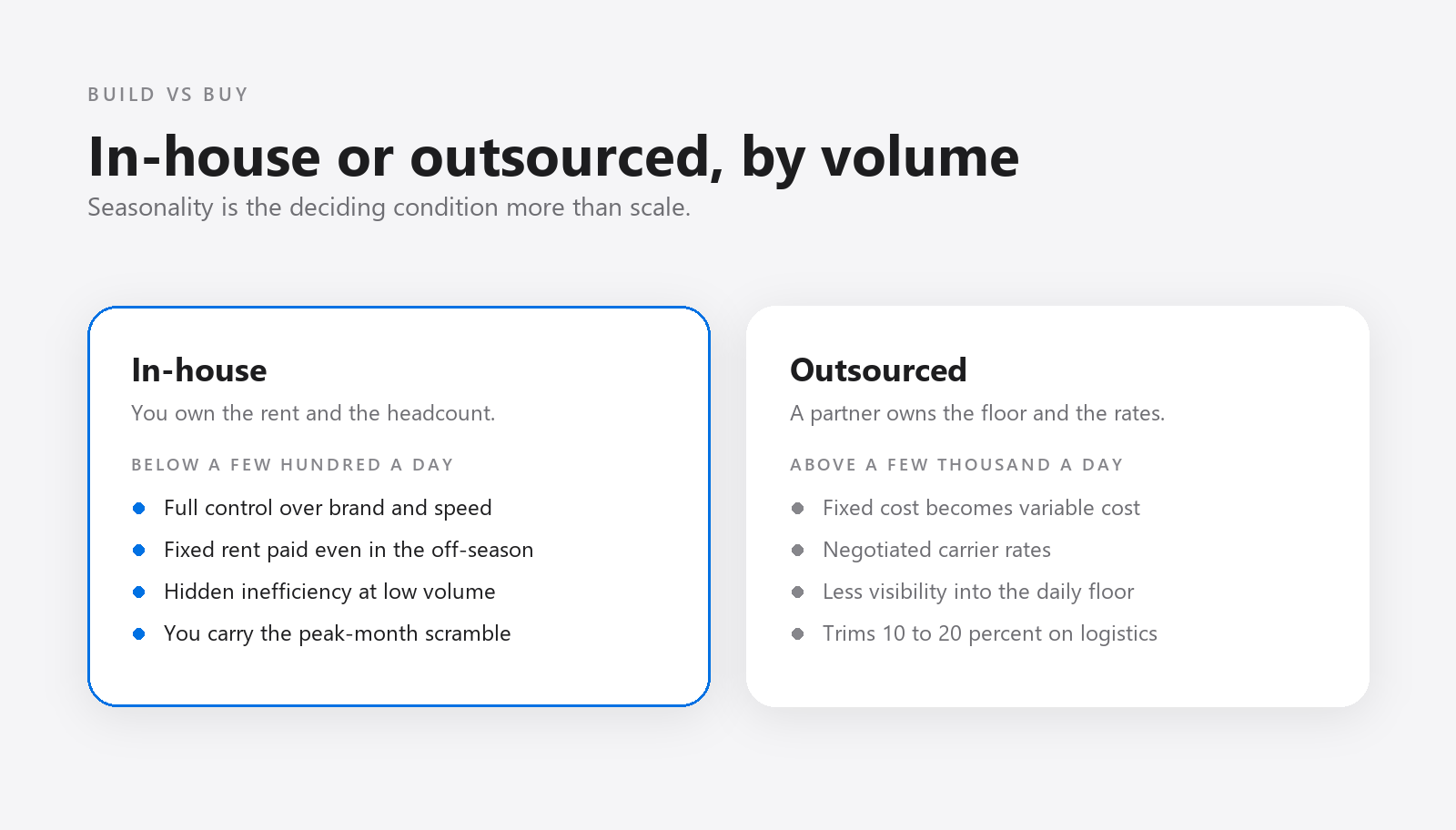
The scale question is the one most retailers answer by feel. A useful line: below a few hundred orders a day, in-house fulfilment keeps you flexible and hides its own inefficiency; above a few thousand, a warehouse's unit economics and a partner's negotiated carrier rates usually win. The uncomfortable middle — a few hundred to a few thousand orders a day — is where the decision is genuinely hard, and it is where most of the money gets quietly wasted.
The condition that tips it is seasonality. If your order volume swings hard and your fixed costs (rent, headcount) can't swing with it, you are paying for a full warehouse in the off-season. That is exactly when outsourcing converts a fixed cost into a variable one, which is the single most reliable cost lever in retail logistics.
Six questions before you add a model
- What is the store's actual stock accuracy, measured, not assumed?
- Who owns the release window for uncollected BOPIS orders?
- Does ship-from-store have a dedicated pick path, or does it borrow selling staff?
- Is the warehouse cost split into fixed and variable, and which side is growing?
- If you sell to retailers, do you meet their routing guide and EDI requirements in writing?
- What does an outsourced partner quote for the peak month, not the average month?
If you can't answer the first question with a number, the other five don't matter yet.
The short version
Retail fulfillment is not one system. It is three models sharing one set of customers, and the skill is matching each order to the model that serves it cheapest. Fix store accuracy before you ship from stores, set a release window before you launch BOPIS, and treat the warehouse as a fixed-versus-variable cost problem rather than a line item.
If you are about to add ship-from-store or hand retail orders to a 3PL, send us your order split and the stores you want to fulfil from for a quote — we will map which model each order should use before you change anything on the floor.
References (Neutral Third-Party Sources)
- U.S. Postal Service — Mail & Shipping Services: USPS service classes, dimensional-weight rules, and nonstandard-package fees that set the last-mile cost floor. https://www.usps.com/ship/mail-shipping-services.htm
- GS1 — Global Location Number (GLN): identifying stores and warehouses as routable locations in a retail network. https://www.gs1.org/standards/id-keys/gln
- Federal Trade Commission — Mail, Internet, or Telephone Order Merchandise Rule: ship within the stated time or 30 days, and obtain consent or refund if you cannot. https://www.ftc.gov/business-guidance/resources/business-guide-ftcs-mail-internet-or-telephone-order-merchandise-rule
- U.S. Bureau of Labor Statistics — Retail Sales Workers: the store labour model that ship-from-store and BOPIS have to borrow from. https://www.bls.gov/ooh/sales/retail-sales-workers.htm
- U.S. Bureau of Labor Statistics — Transportation and Material Moving Occupations: the warehouse and material-handling labour behind each node. https://www.bls.gov/ooh/transportation-and-material-moving/