
Birthday & Work Anniversary Gifts for Employees: 15 Ideas
A birthday and a work anniversary are not the same gift wearing different wrapping. A birthday is about the person; an anniversary is about what they have done for you. Spend the same money on both and you flatten the two moments into one generic gesture, which is how recognition programmes become background noise.
This guide separates the two, tiers the budget by tenure instead of by title, and gives you fifteen concrete Appreciation Gifts Ideas across three price bands so you stop guessing and start shipping.
The two Realtor Gifts do different jobs
The cleanest way to see the difference is to ask what the gift is meant to say.
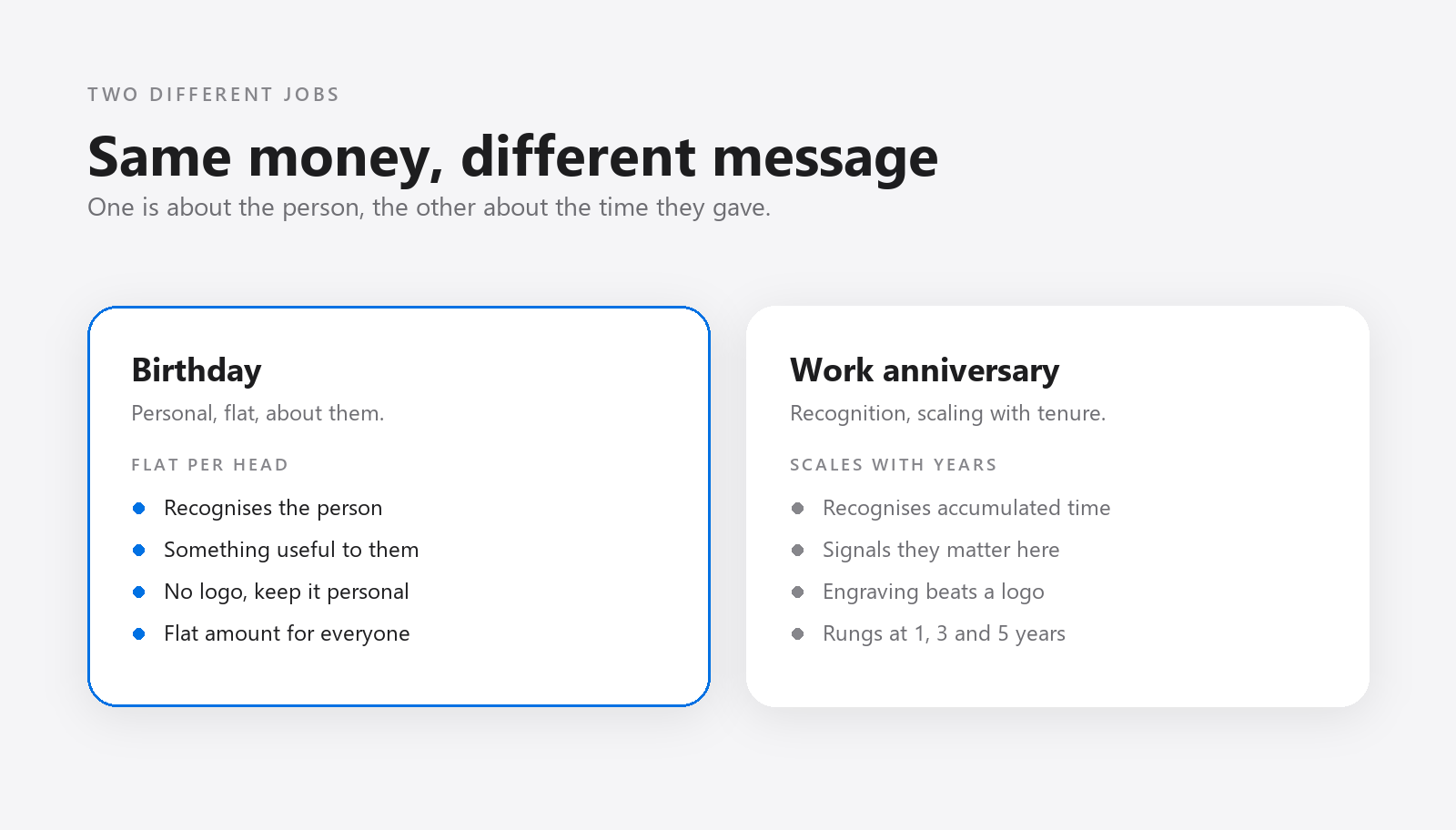
| Question | Birthday | Work anniversary |
|---|---|---|
| What it recognises | The person, full stop | Accumulated time and contribution |
| Who it is personal to | The individual's taste | The role and the tenure |
| Best value | Something genuinely useful to them | Something that signals they matter here |
| Right amount | A flat per-head amount | Scales with years of service |
| Mistake to avoid | A logo-covered item they'd never buy | A gift that ignores how long they've been there |
A birthday gift that is just company swag says "we had a budget line item". An anniversary gift that is the same $25 mug you give every new hire says "your five years weigh the same as day one". People can read both.
Tier the money by tenure, or don't bother
The single most common failure is a one-size budget. The fix is a ladder, and the first rung has to be reachable.
Set anniversary rungs at one year, three years, and five years, with a real jump between each. A one-year rung matters more than most teams think: if the first milestone is five years out, most people never reach it, and the programme becomes a trophy for veterans instead of a recognition loop for everyone.
Birthdays run on a separate, flat amount, because a birthday is not a measure of service. Keep the two ladders separate and write them down. A discretionary budget — whatever the nearest manager approves — reliably produces better gifts for whoever sits closest to HR, and everyone notices.
Fifteen ideas across three price bands
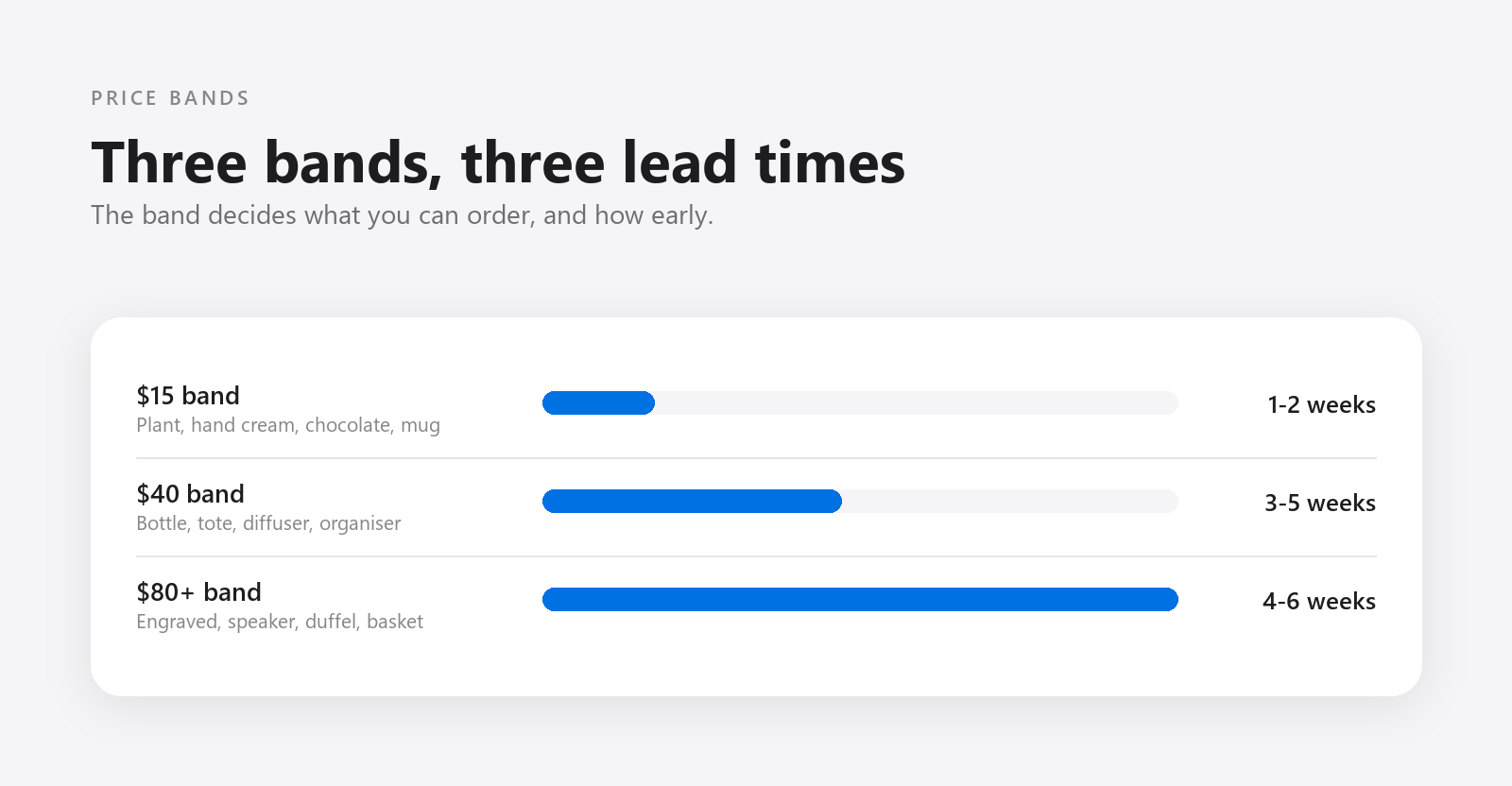
| Idea | Band | Why it works |
|---|---|---|
| Desk plant or succulent | $15 | Lives on the desk, visible to everyone |
| Good hand cream in a box | $15 | Useful, consumable, reads as a gift not filler |
| Small-batch chocolate box | $15 | A print-finished box can feel three times its price |
| Artisan mug with a card | $15 | Under $30, but the note carries the weight |
| Wooden desk toy or fidget | $15 | Stress relief people actually keep |
| Insulated bottle | $40 | Daily use, plain enough for anyone |
| Commuter tote or pack | $40 | Solves a real, repeated problem |
| Aromatherapy diffuser | $40 | Warm, personal, hard to get wrong |
| Desk organiser in wood | $40 | Useful and quietly premium |
| Scented candle or diffuser set | $40 | Curated feel without size risk |
| Engraved pen or notebook | $80+ | Engraving turns an object into a keepsake |
| Smart speaker | $80+ | A real thing they wanted, not a logo |
| Weekend duffel bag | $80+ | Travel-sized, lasts, no fit problem |
| Curated gift basket | $80+ | Assorted, feels chosen, easy to home-ship |
| Experience voucher | $80+ | Memory over object, but check redemption |
Three notes sit under that table. Sizes only matter in the two apparel-adjacent rows — the rest avoid the fit problem entirely, which is half the reason they work for a group. Engraving is the cheapest way to move an item from $40 to "$80 of thought", and it is not the same thing as a logo: a name or a start date says "for you", a large logo says "for us".
What the $15 band is really for
This band is a frequency tool, not a value statement. It should fire often — birthdays, day-30 welcomes, small thank-yous — and it fails only when someone tries to stretch it into the only gift of the year.
The traps are two. A low unit price invites padding: a box of five things nobody needs reads as clutter, and it ends up unsold on a marketplace a month later. And the card matters more here than anywhere else. A $15 plant with a handwritten name on the card is "the company noticed me"; the same plant in a poly bag is "the company ordered 200 units".
What the $40 band buys
This is the workhorse band for birthdays and three-year anniversaries, and it is where the "would they buy this for themselves" test first becomes a real bar. An insulated bottle or a commuter bag clears that bar because it solves a repeated, concrete problem — which is exactly what makes it feel like a gift rather than a tchotchke. For anything assembled from several items, price the gift kitting separately from the contents.
Custom runs live here and carry real lead time. Anything branded needs a minimum order quantity and a sampling pass before production. A factory that happily runs 500 units will often price a 30-unit order about 50% higher per unit, because tooling, sampling and scheduling are fixed costs that do not halve with the order. Small runs often finish in 7 to 15 days; a full bulk order with production, inspection and freight is closer to 30 days before it ships.
What the $80+ band is for
Reserve this band for five-year and ten-year milestones, and for retention cases. At this level the gift is no longer about utility; it is about the company signalling that a specific amount of accumulated time is worth a specific kind of object.
The failure mode here is treating price as thoughtfulness. An $80 item with no card, no name and no reason attached lands exactly like a $15 item — it just costs more. The two highest-leverage moves are engraving and a note from a manager or founder. Gallup's recognition research is blunt about this: recognition that is specific and personal is what people remember, and it is cheap relative to the alternative, since employees who feel unrecognised are about twice as likely to say they will look for a new job within a year.
The catalog: choice without chaos
Once a team passes roughly 50 people, or spans very different ages and jobs, the right model is usually not "pick one gift" but "let them pick from a short list". The catch is that the list must be curated.
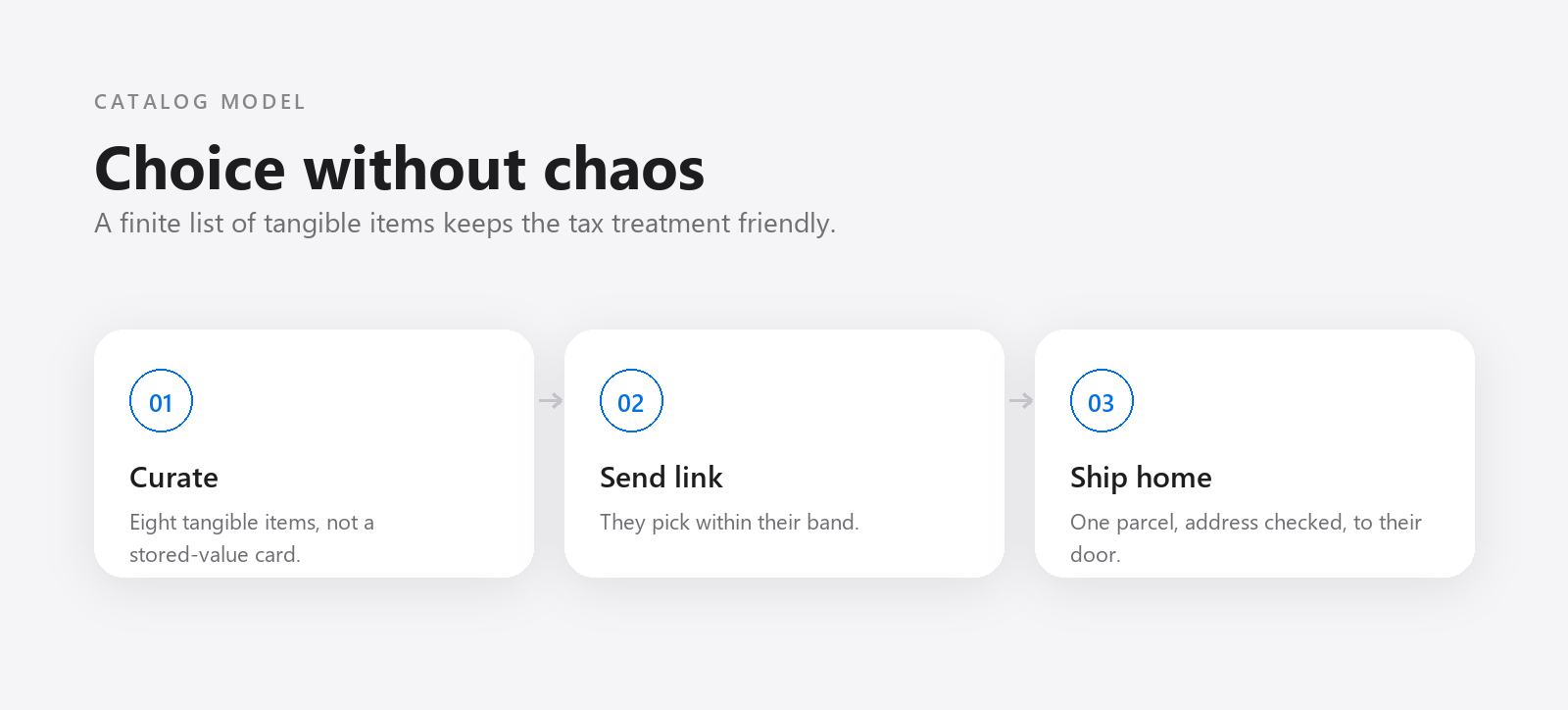
An open gift card changes the tax treatment — a card is wages, a chosen tangible object usually is not — so the catalogue has to be a finite assortment of tangible items, not a stored-value voucher. A short list of eight objects is a different instrument from a card, and it keeps the recognition tax-friendly.
The costs are real. Per-unit cost runs 10 to 20 percent above a single bulk buy, because you carry scattered inventory and ship individual parcels instead of one drop — a home-shipping job that is best quoted as one pick-and-pack with address validation attached. And you now own redemption: a redemption rate of 50 to 60 percent is common, and a low rate almost always means the list was wrong, not that people were ungrateful.
The short version
Split the two moments before you spend anything: birthdays run flat and personal, anniversaries scale with tenure on a one-three-five ladder. Keep the budget bands at roughly $15, $40 and $80+, and let the band tell you what kind of object to buy. Above 50 people, move to a curated catalogue so taste stops being your problem — and remember the line that separates a catalogue from a card: a chosen tangible item can stay recognition, a stored-value card becomes wages.
If you have a headcount, a tenure split and a per-head budget, send them over and we will return a tier plan and a shipping schedule before we discuss price.
References (Neutral Third-Party Sources)
Facts in this article were checked against the following public sources. No gift supplier or fulfilment provider is cited.
- Gallup — The Importance of Employee Recognition: Low Cost, High Impact: the one-in-three figure for weekly recognition and the doubled likelihood of job-seeking among those who feel unrecognised, plus the finding that personalised recognition is what employees remember. https://www.gallup.com/workplace/236441/employee-engagement-drives-growth.aspx
- Internal Revenue Service — Publication 15-B, Employer's Tax Guide to Fringe Process 038 Benefits: low-value non-cash birthday gifts can qualify as de minimis benefits, while gift cards and cash equivalents are always taxable wages. https://www.irs.gov/publications/p15b
- United States Postal Service, PostalPro — Address Quality Solutions: the change-of-address dataset and delivery-point validation used to keep a home-shipped gift list current. https://postalpro.usps.com/address-quality