
17 Cool Gifts for Employees That Actually Get Used
A "cool" gift is not the one that looks best in the box. It is the one that is still on someone's desk, in someone's bag, or inside a daily routine three months later. The distance between those two things is the entire job of a gift programme, and most programmes get it backwards: they buy the object they want to be seen giving, then wonder why it ended up in a drawer.
This guide treats "cool" as a test, not a style. A gift passes when it gets used, seen, or thanked — ideally two of the three. The seventeen ideas below are arranged by moment, each with the reason it survives and a price anchor.
What "cool" actually means in a gift
Strip the word down and it stops meaning "trendy". A cool employee gift is one that survives contact with real life: it solves a small problem the person actually has, sits somewhere colleagues can see it, or gets consumed quickly enough that nobody has to pretend to like it.
The single most reliable test is embarrassingly simple — "would this person buy this for themselves?" If the answer is no, a logo will not change it. If the answer is yes, the logo barely matters. Everything below is picked to pass that test, not to look good in a catalogue photo.
The 17 ideas, at a glance
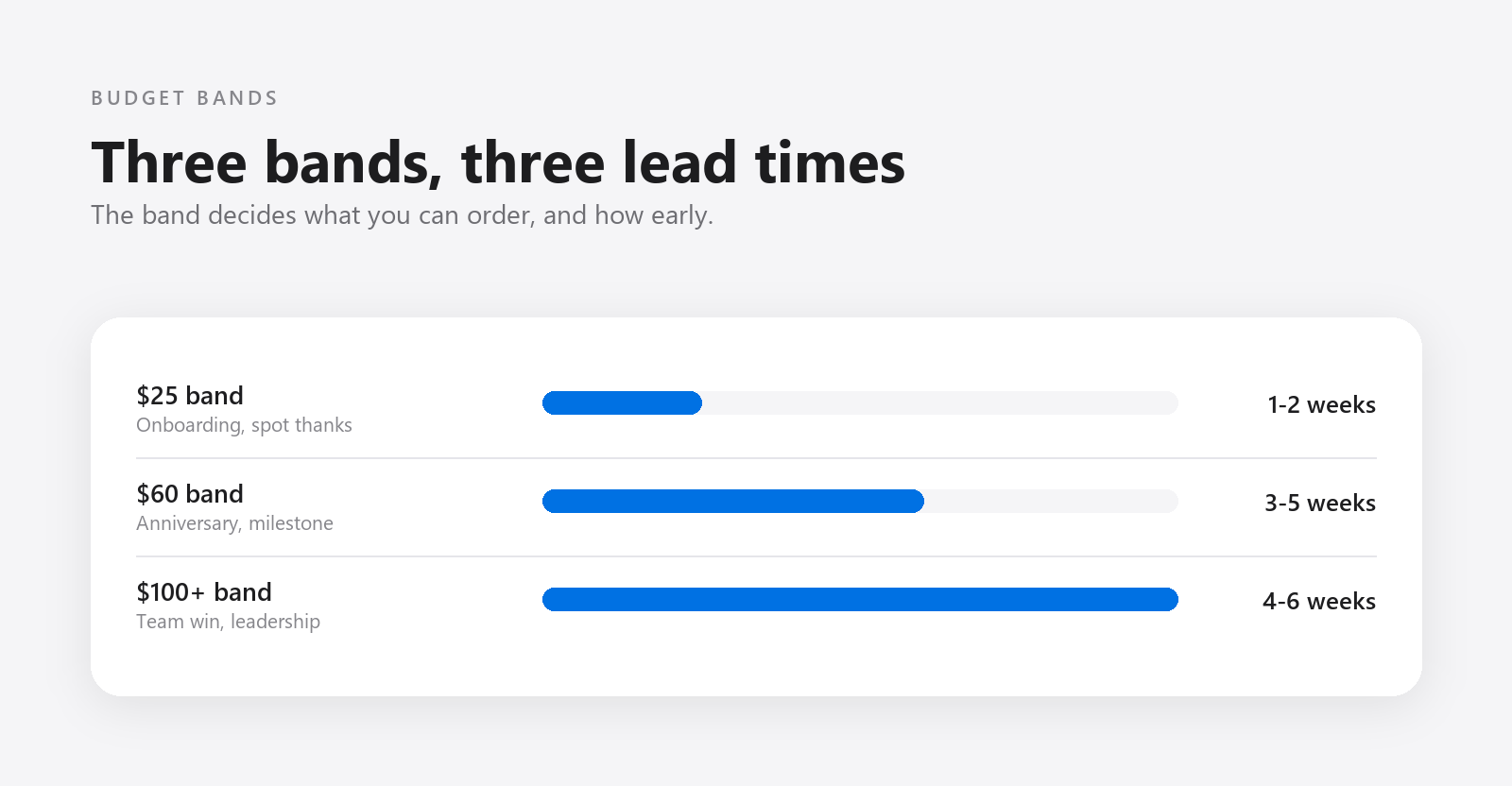
| Idea | Band | Fits | Why it actually gets used |
|---|---|---|---|
| Desk plant or succulent | $25 | Onboarding, spot thanks | Lives on the desk, seen by everyone |
| Good hand cream in a box | $25 | Onboarding, birthday | Consumable, reads as a gift not filler |
| Small-batch chocolate box | $25 | Spot thanks, team win | Gets eaten within the week |
| Artisan mug + handwritten card | $25 | Onboarding, day 30 | Used daily; the note carries the weight |
| Wooden desk toy or fidget | $25 | Onboarding | Stress relief people keep on the desk |
| Magnetic power bank | $25 | Any moment | Used the same day it arrives |
| Cable organizer or desk tray kit | $25 | Onboarding | Solves daily clutter, near-zero taste risk |
| Premium insulated tumbler | $60 | Anniversary, milestone | Daily commute use, no sizing risk |
| Commuter tote or backpack | $60 | Anniversary | Solves a repeated, concrete problem |
| Laptop sleeve | $60 | Milestone, hybrid teams | Protects gear, near-zero fit risk |
| Aromatherapy diffuser or candle set | $60 | Anniversary | Warm, personal, hard to get wrong |
| Notebook + quality pen set | $60 | Onboarding, conference | Used in meetings, offsites, client calls |
| Blue-light glasses or laptop stand | $60 | Screen-heavy teams | Ergonomic fix for a daily discomfort |
| Wireless earbuds or headphones | $100+ | Team win, leadership | Used daily, universally wanted |
| Smart speaker or desk lamp | $100+ | Leadership, business owner | Joins the home, seen every day |
| Weekend duffel or cabin bag | $100+ | Five years, retention | Travel-sized, no fit problem |
| Experience voucher | $100+ | Team win, milestone | A memory that outlasts an object |
The bands are anchors, not rules. A tumbler in a neutral color beats a branded one the person would never carry; a power bank they use the day it arrives beats a desk toy handed out at an all-hands.
The $25 band is about frequency, not value
This band fails only when someone stretches it into the only gift of the year. Its real job is to fire often — onboarding, day-30 welcomes, spot thank-yous — and to cost little enough that nobody has to approve it twice.
The trap is padding. A low unit price invites a box of five things nobody needs, which reads as clutter and ends up unsold on a marketplace a month later. One good thing in a box beats five fillers. A $10 hand cream in a box with a ribbon reads as a gift; a $5 chocolate box with a decent print finish can feel like three times its price. The sixty-second first impression after the box opens is decided by packaging, not by the item inside.
The $60 band is where the "would you buy it" test starts to bite
This is the workhorse band for anniversaries and project milestones, and the first band where the recipient's taste genuinely matters. A tumbler or a tote clears the bar because it solves a repeated problem — which is exactly what makes it feel like a gift rather than corporate swag. Anything assembled from several items, like a tumbler plus a notebook plus a note, is a kitting job (assembling several pieces into one finished gift set) and should be priced separately from the contents.
Custom runs live in this band and carry real lead time. Anything branded has a minimum order quantity (MOQ) — the smallest run a factory will accept — and a sampling pass before production. A factory that happily runs 500 units will often price a 30-unit order about 50% higher per unit, because tooling, sampling (the pre-production sample you approve before the full run) and scheduling are fixed costs that do not halve with the order. Small runs often finish in 7 to 15 days; a bulk order with production, inspection and freight is closer to 30 days before it ships.
The $100+ band is for moments with a name on them
Reserve this band for team wins, retention cases, and the people who lead them — which is also where searches for "gifts for business owners" and "leadership gifts" land. At this level the gift is no longer about utility; it is about signalling that a specific amount of accumulated effort is worth a specific kind of object.
The failure mode here is treating price as thoughtfulness. An $80 pair of earbuds with no card and no reason attached lands exactly like a $15 item — it just costs more. The two highest-leverage moves are engraving and a note from a manager or founder. A name or a start date says "for you"; a large logo says "for us". Gallup's recognition research is blunt about this: recognition that is specific and personal is what people remember, and it is cheap relative to the alternative, since employees who feel unrecognised are about twice as likely to say they will look for a new job within a year.
The desk effect: why visibility beats utility
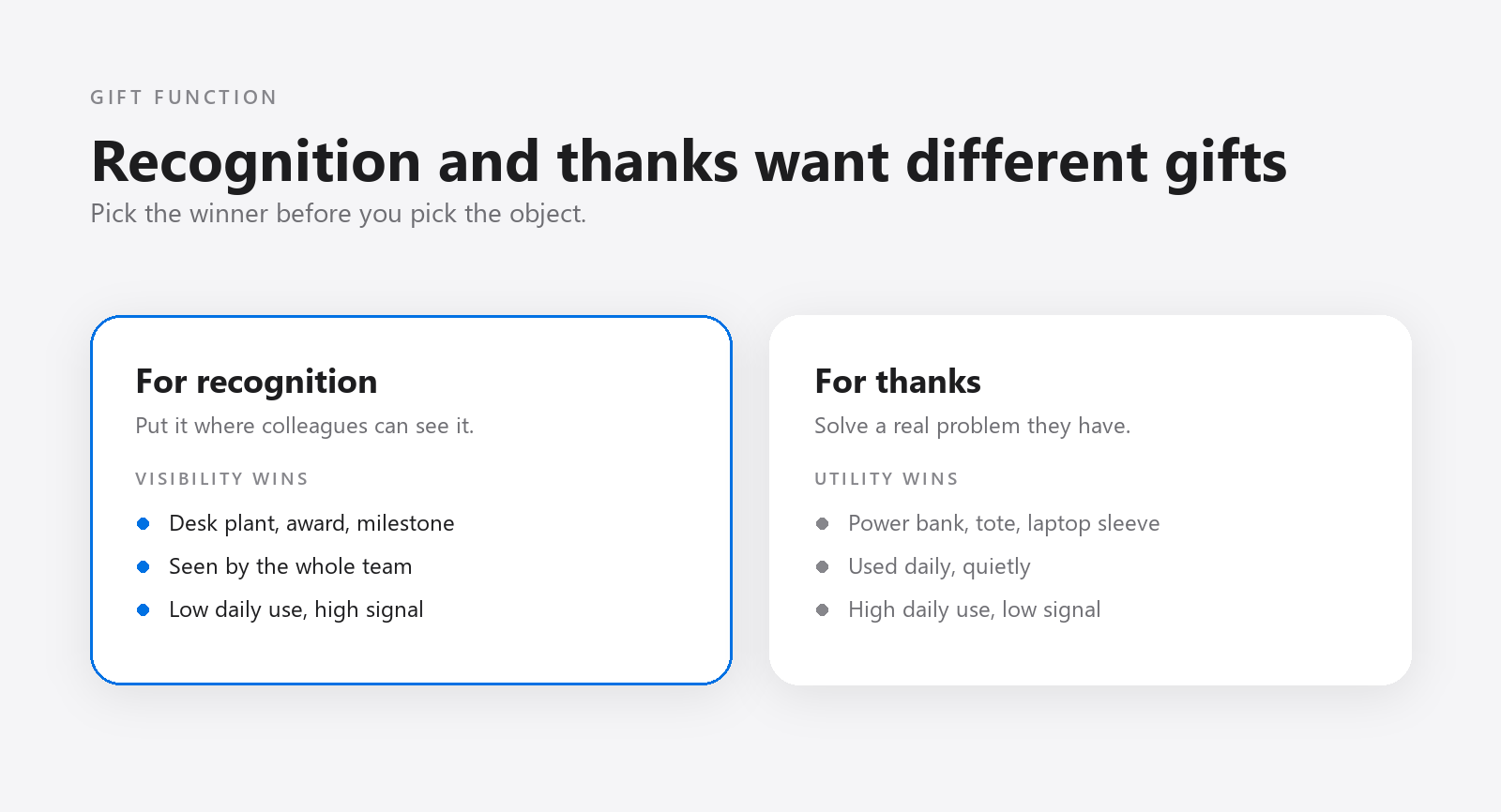
A gift the person can put on a desk where colleagues see it does double duty. It rewards the recipient, and it quietly tells the rest of the team what success looks like — the same mechanism that makes client appreciation gifts work on the client's desk instead of the employee's.
This is the one place where "cool" and "useful" genuinely diverge. A desk plant is less useful than a power bank, but it is seen by more people. When the function of the gift is recognition, visibility wins. When the function is thanks, utility wins. Pick the winner before you pick the object.
The tax line between a card and an object
Almost no gift guide mentions this, and it decides whether a self-serve catalogue is even possible.
Under U.S. federal fringe-benefit rules, a low-value holiday or birthday gift can qualify as a de minimis benefit — too small to account for — provided it is not cash. Cash equivalents are excluded entirely: gift cards, gift certificates and gift coupons are taxable wages however small the amount. So a $25 coffee card is payroll; a $25 mug probably is not. The recipient experience is nearly identical. The accounting is not.
A curated list of eight tangible objects is a different instrument from a stored-value card, and it keeps recognition tax-friendly. Outside the U.S., assume nothing — have local finance confirm the position in writing before you design a programme around it.
Shipping 17 gifts to 17 homes
The hidden half of a cool-gift programme is the last mile — the final leg of delivery to each recipient. One bulk delivery to one office is simple; forty parcels to forty home addresses is a pick-and-pack job (picking individual orders and packing them for home delivery) with address validation attached, and should be quoted as one.
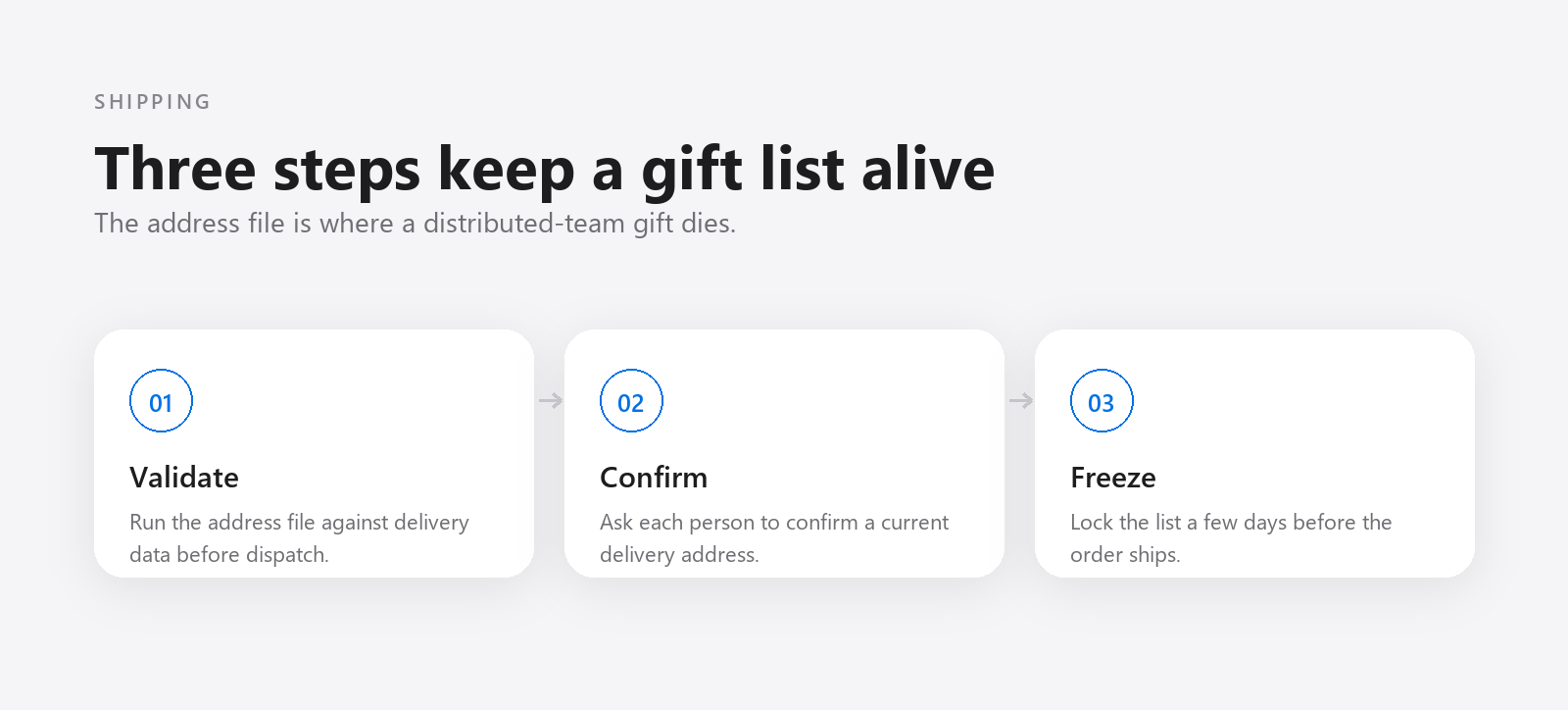
For a distributed team, the address list is where gifts die. The U.S. Postal Service's change-of-address dataset holds roughly 160 million permanent forwarding records, and its Move Update standard asks mailers to refresh address data within 95 days of a mailing. A list that sat untouched for a quarter already contains dead addresses. Three steps: validate the file before dispatch, ask each person to confirm a delivery address, and set an address freeze a few days before the order goes out — a Friday-afternoon change will not make a Monday pick list.
The short version
Cool is a test, not a style: the gift has to get used, seen, or thanked. Run the $25 band often, keep the $60 band for milestones, and save the $100+ band for moments with a name on them. Remember the two lines that decide everything — a gift card is wages while a chosen object usually is not, and a logo across the front demotes a gift to swag. Then put the address freeze on the same calendar as the ship date.
If you have a headcount, a budget per head and a rough split of the moments, send them over and we will return a tier plan and a schedule before we talk about price.
References (Neutral Third-Party Sources)
Facts were checked against the following public sources. No gift supplier or fulfilment provider is cited.
- Internal Revenue Service — Publication 15-B, Employer's Tax Guide to Fringe Benefits: defines de minimis benefits, excludes gift cards and gift certificates from that treatment, and sets the $400 / $1,600 achievement-award limits with the limited-assortment exception. https://www.irs.gov/publications/p15b
- Gallup — The Importance of Employee Recognition: Low Cost, High Impact: the one-in-three figure for weekly recognition, the doubled likelihood of job-seeking among those who feel unrecognised, the seven-day recommendation, and the finding that personal, specific recognition is most memorable. https://www.gallup.com/workplace/236441/employee-engagement-drives-growth.aspx
- United States Postal Service, PostalPro — Address Quality Solutions: the national change-of-address dataset, the 95-day Move Update window, and delivery-point validation used to keep a home-shipped gift list current. https://postalpro.usps.com/address-quality