
Gifts for Remote Employees: Ideas That Bridge the Distance
The hard part of a remote gift is not finding something to send. It is that there is no office, so there is no shared room where a gift lands in front of colleagues, no desk to leave it on, and no one down the hall to ask for the address. A gift to a remote employee has to do all of its work alone, in a box, on a doorstep that may be in another time zone or another country.
This guide covers what actually changes when the recipient is remote: the choice between digital and physical, the customs and logistics of crossing a border, the address problem, and how to make the arrival feel like a moment instead of a delivery.
The missing room is the real problem
Roughly a third of U.S. employed people do at least some of their work from home, and for them the recognition math is different. In an office, a gift has an audience: it sits on a desk where colleagues see it, and the visibility is part of the point. For a remote worker, the only audience is the person opening the box — so the gift cannot rely on being seen to mean something. It has to land as a genuinely useful or genuinely personal object, or it reads as "the company shipped a thing".
That single shift changes the whole brief. Utility and personal feel go from nice-to-have to the whole job, because there is no surrounding room to supply meaning.
Physical or digital: what survives the distance
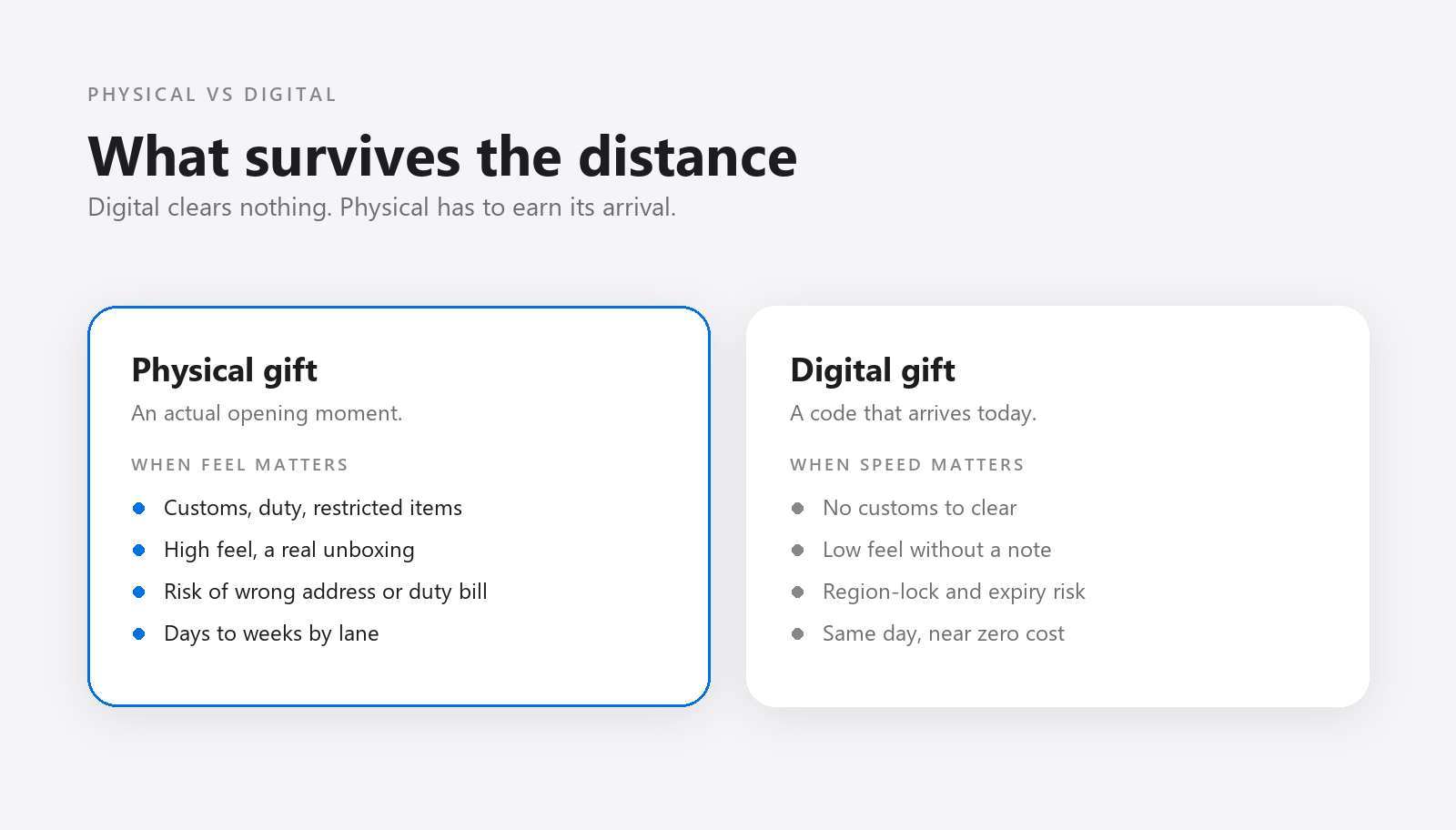
| Question | Physical gift | Digital gift |
|---|---|---|
| Crossing a border | Customs, duty, restricted-item rules | Nothing physical to clear |
| Feel | High, an actual opening moment | Low on its own, needs a note |
| Risk | Lost in transit, wrong address, duty bill | Region-locked, expired, feels like a rebate |
| Speed | Days to weeks, depends on the lane | Same day |
| Cost to send | Last-mile shipping to every home | Near zero |
A digital gift — a gift card, a subscription, a course — wins on speed and never has to clear customs. Its weakness is emotional: a code in an inbox reads as transactional unless a person attaches a sentence to it. A physical gift wins on feel and loses on logistics. The practical answer for a distributed team is usually both: a small physical object that arrives, plus a digital extra or a manager's note that arrives the same day.
Crossing a border is where gifts get expensive
The moment a gift leaves the country, three costs and three rules appear, and they are where budgets quietly blow up.
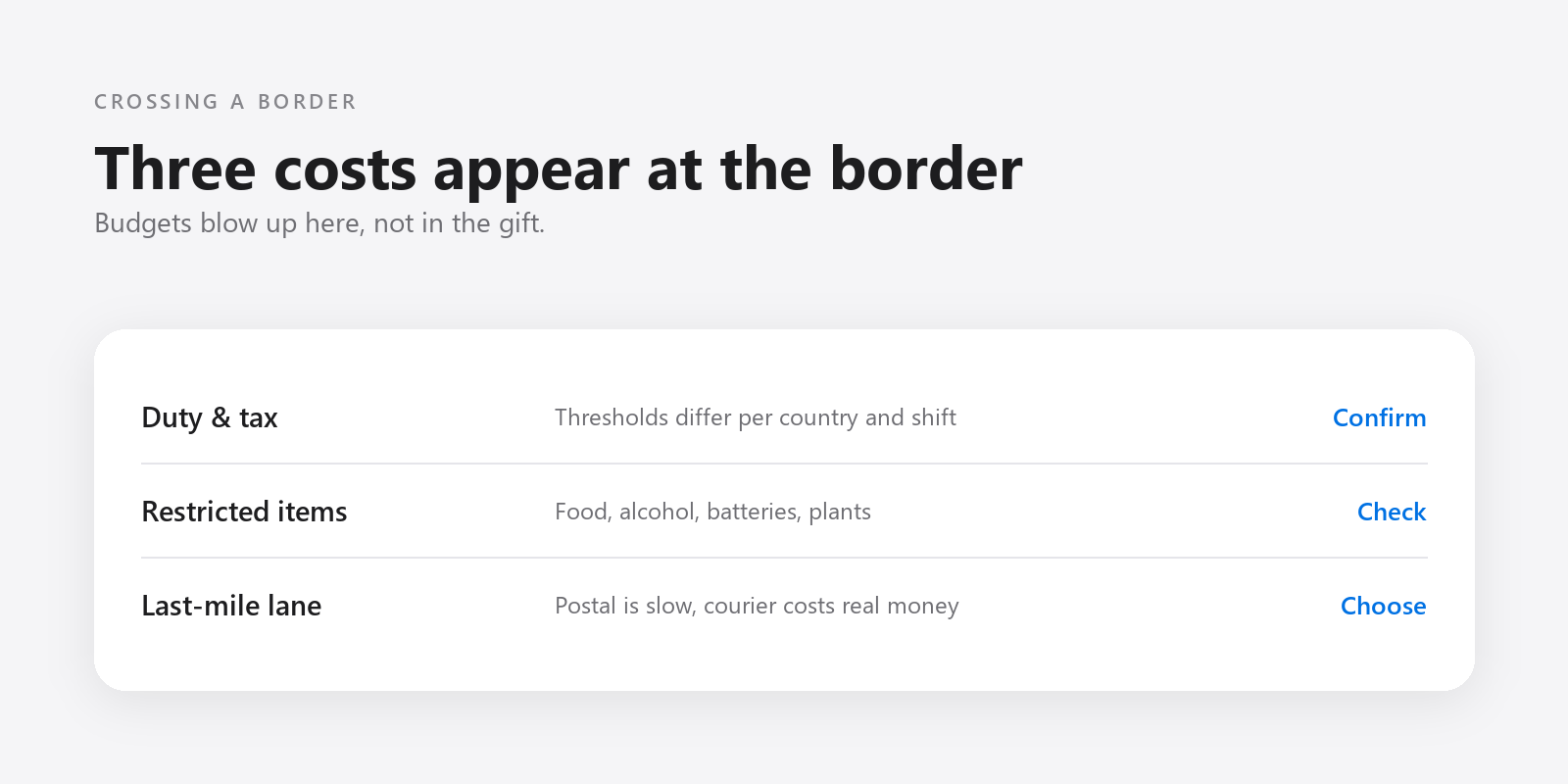
First, duty and tax. Every country sets its own threshold below which a low-value parcel enters duty-free, and those thresholds have been changing fast in recent years — what cleared free last year may not this year. Confirm the current treatment for each destination before you promise a budget, and decide who pays the duty: a recipient who gets a "you owe customs" notice has effectively been billed for their own gift.
Second, restricted items. Food, alcohol, batteries, liquids and plant material are the common ones, and they behave differently in every country. A candle is fine; a candle with a lithium battery in the base is not. If you are unsure, the safe rule is to ship items that are inert and clearly described, because a vague customs declaration is how a parcel sits in clearance for a week.
Third, the last-mile lane. International postal services reach nearly everywhere but can be slow and untracked in the final stretch; a commercial courier is faster and tracked but costs real money per parcel. For a global team, the difference between "arrived in two days" and "arrived in two weeks" is usually which lane you bought, not how far the box travelled.
Getting the address right without a desk to ask at
There is no receptionist to walk over to, so the address has to be collected and verified before anything ships — and the address you already have is probably wrong, because it was typed at onboarding and never touched since.
The U.S. Postal Service keeps a national change-of-address dataset of roughly 160 million forwarding records, and delivery-point validation confirms whether an address currently exists at all. The operational version is to validate the file, then ask each person to confirm a current delivery address rather than trusting the one on file, then freeze the list a few days before dispatch. At any scale this is a pick-and-pack job with address validation attached, and it should be quoted as one rather than patched together per country.
Collecting that address is also a privacy matter, not just a logistics one. A home address tied to an employee record is personal data, and under the GDPR the principle of data minimisation applies: collect only what the shipment needs, hold it no longer than necessary, and give people an easy opt-out or an office alternative. For a distributed team this is not a footnote — it is the difference between a gift programme and a data-liability programme.
Sync the arrival, not just the send
The most underrated failure with a remote team is timing. If gifts ship when your office clocks out and land scattered across a week, there is no shared moment at all.
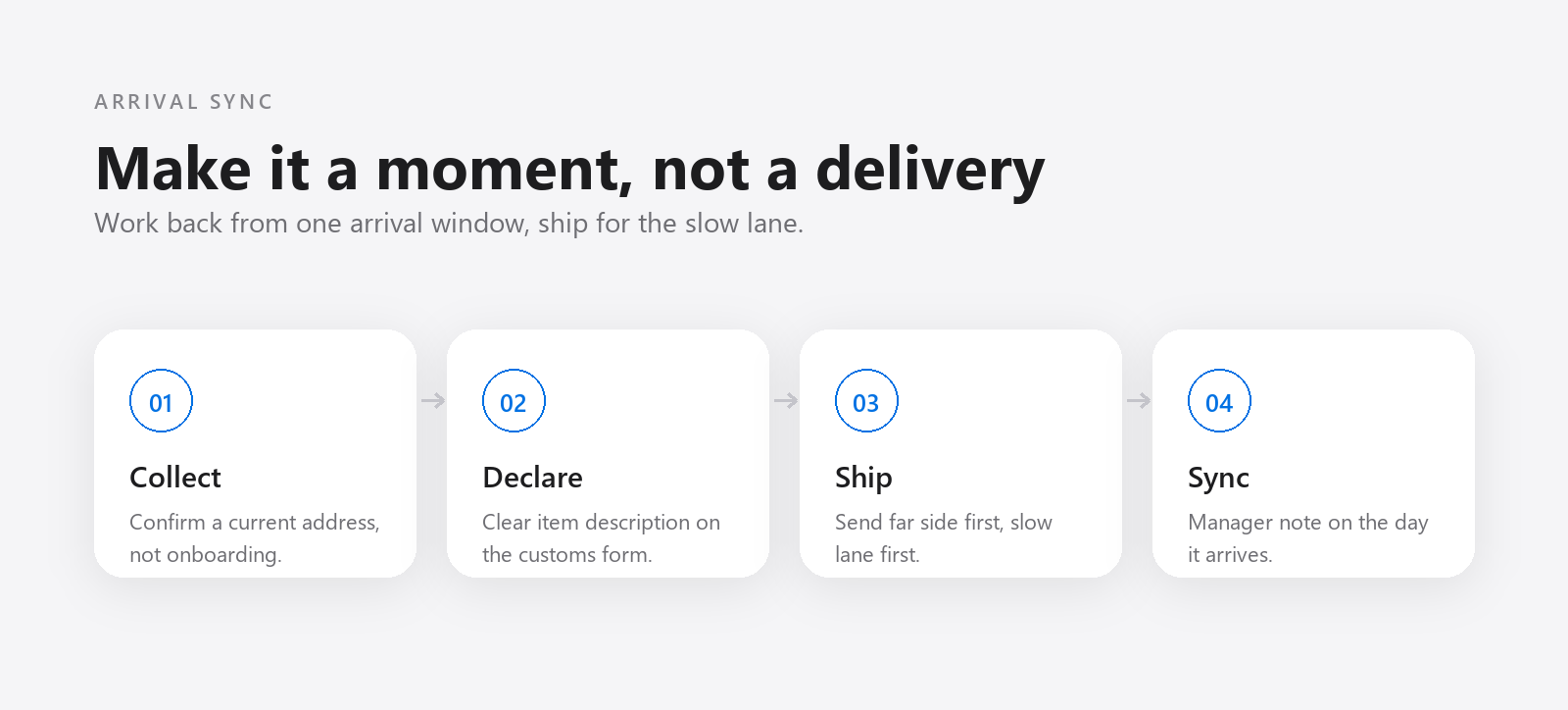
The fix is to work backwards from a single "arrival window" rather than a single "send date". Pick the week you want everyone to have it, subtract the slowest lane's transit time, and ship early enough that the far side of the world arrives first, not last. Then coordinate the note: a short message from a manager on the day it arrives does more than the gift itself, because it supplies the moment the box cannot.
One caveat worth writing down: a parcel to a remote employee in the same country can arrive in two to five days; the identical parcel to an employee on another continent can take two weeks or more and sit in customs on top of that. Do not promise everyone the same arrival date unless you have actually planned for the slow lane.
Gifts that travel well
| Gift | Why it travels | Watch out |
|---|---|---|
| Desk plant | Flat, light, survives a long lane | Some countries restrict live plants |
| Insulated bottle | Inert, useful, no fit issue | Fine almost everywhere |
| Notebook and pen | Paper goods clear easily | Nothing |
| Chocolate or coffee | Small, consumable, personal | Food rules vary by country |
| Scented candle | Light, no battery | Avoid "candle with battery" combos |
| Digital gift card | No customs at all | Region-lock the card to their market |
The short version of that table: pick items that are inert, light, and clearly describable on a customs form, and treat anything with food, batteries or plant material as a country-by-country question rather than a default. If you bundle several small items into one box, assemble them through gift kitting so the customs declaration matches what is actually inside.
The short version
A remote gift has no room around it to supply meaning, so it has to be useful or personal on its own, and it has to arrive as a moment you planned. Choose digital when speed and simplicity matter and pair it with a note; choose physical when you want an opening and accept the customs and duty work. Verify the address, respect the privacy of holding it, ship for the slowest lane, and sync the note to the arrival. Get those four right and a parcel on a far doorstep reads like a gift, not like logistics.
If you have a remote headcount and a country list, send them over — we will come back with a lane plan and an arrival window before we talk about price.
References (Neutral Third-Party Sources)
Facts in this article were checked against the following public sources. No gift supplier or fulfilment provider is cited.
- U.S. Bureau of Labor Statistics — American Time Use Survey, 2024 Results: the share of employed people who did some or all of their work at home on days worked (33 percent in 2024). https://www.bls.gov/news.release/archives/atus_06262025.htm
- United States Postal Service — International Shipping & Mailing: customs form requirements, restricted-item guidance, and prepaying import duties for international parcels. https://www.usps.com/international/
- United States Postal Service, PostalPro — Address Quality Ecommerce Fulfillment Solutions: the national change-of-address dataset, the 95-day Move Update window, and delivery-point validation. https://postalpro.usps.com/address-quality
- GDPR — Article 5, Principles relating to processing of personal data: the data-minimisation and storage-limitation principles that apply to holding employee home addresses. https://gdpr-info.eu/art-5-gdpr/