
Outsourcing Fulfillment: 7 Signs It's Time to Stop Shipping In-House
Outsourcing fulfillment usually starts to win somewhere between 2,000 and 8,000 orders a month — not because a 3PL picks faster, but because rent, base payroll and your own hours stop scaling with volume while a per-order invoice does. Below that band the honest answer is often "not yet." Brands that move too early pay a premium for a service they could still run themselves; brands that move too late spend a peak season discovering it.
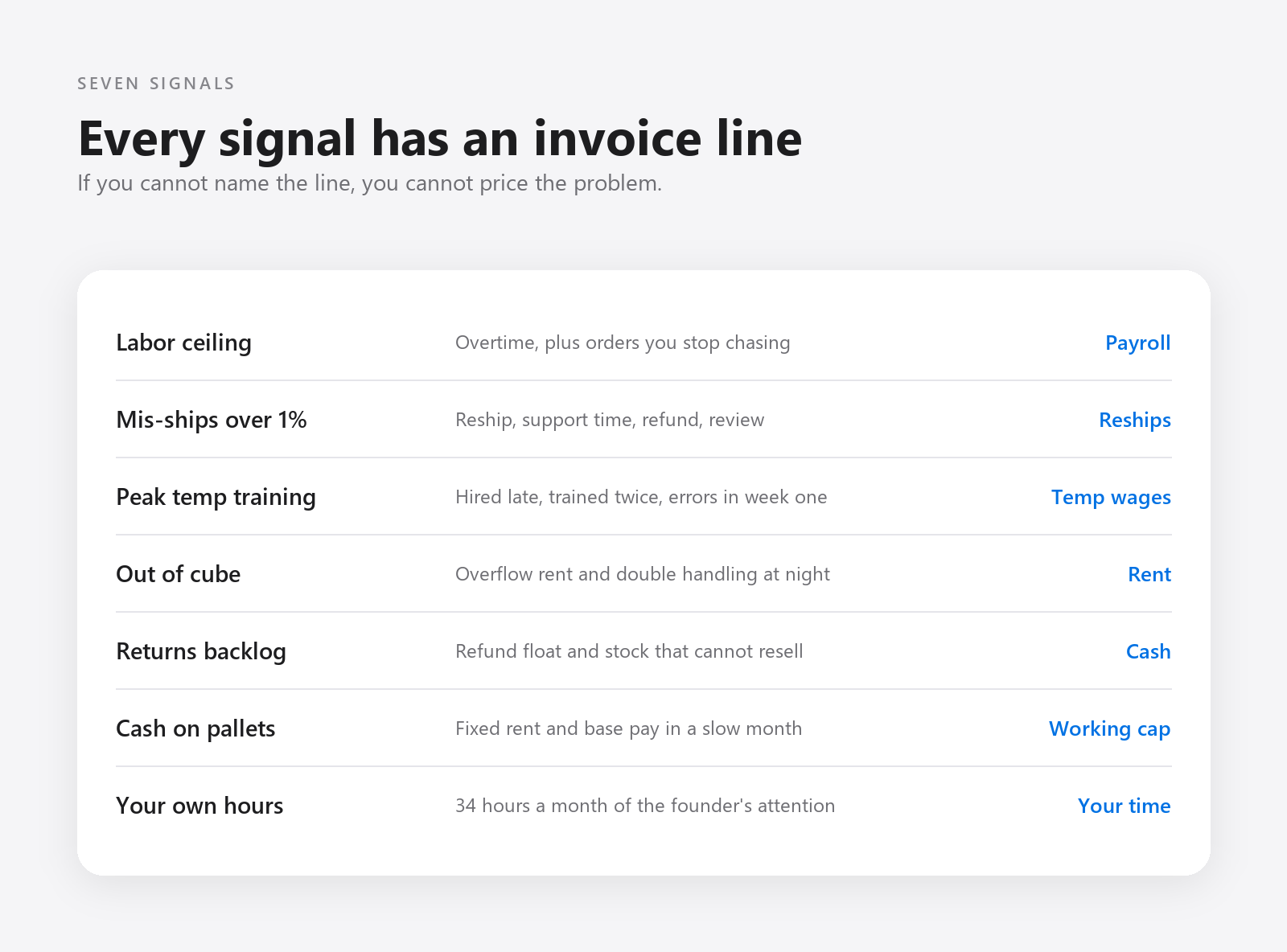
The seven signals below are the ones that show up before the invoice does. Each is translated into the money it is already costing you, because "we're getting busy" is not a budget line and "¥2.05 a parcel in labor" is.
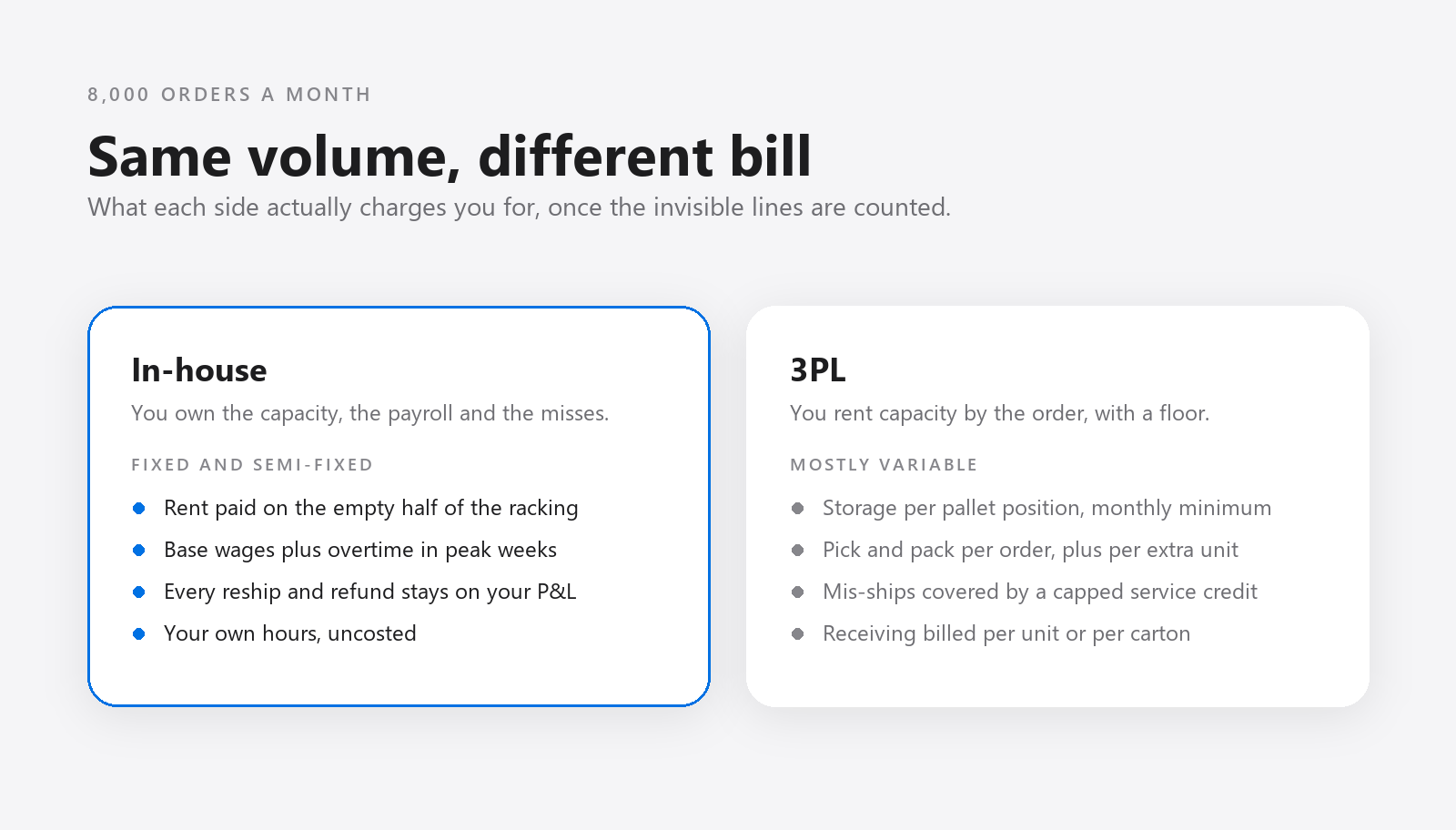
Most in-house cost models have four lines and only two of them filled in. Rent and wages are visible. The cost of a wrong parcel and the market value of your own hours are not. Add those and divide by parcels shipped, and the comparison stops being philosophical.
Sign 1: every order is waiting on a person
Watch the ratio, not the headcount. If a normal Tuesday runs at 85–90% of your ceiling, you have no room for a promotion, a restock or a sick day — and you are paying overtime to stay at that level.
The tell is specific: work queues at the pack bench instead of staff queueing at the pick list. Once the backlog is measured in hours rather than orders, an extra pair of hands buys you a week.
What it costs: overtime premium on every shift, plus the orders you quietly stop chasing because you can't promise a ship date. That second number never reaches a statement, and it's usually larger.
Sign 2: the mis-ship rate passes 1%
At 6,000 orders a month, 1% is 60 wrong parcels. Each carries four costs: the reship, the support conversation, the refund offered to end it, and the review that follows. Run your own figures — $9 to reship, 20 minutes of support, a third of cases ending in a refund — and the bill lands in the low thousands at a volume most brands call small.
Good looks like this: pick accuracy under 0.3% is achievable with barcode scanning at the pick face, and the best-run sites push mis-ships toward one in twenty thousand. Three controls get you there. Scan-to-confirm on every pick. A weight gate that alarms when a finished parcel is more than 5 grams off its expected weight. A second scan matching label to order before the label prints. Install all three and the error rate falls faster than any hiring plan will fix it.
One correction before you outsource. If your error rate is high at 500 orders a month, a 3PL inherits the problem rather than solving it — wrong picks usually start in a bad pick list, not a careless picker.
Sign 3: peak season means training temps twice
Every operation hires temporary labor before the holidays. The difference is when. Warehouses that hold accuracy book temps seven days early, put them on the two or three stations that don't affect accuracy, and keep a fixed core of experienced staff on picking and checking. Warehouses that hire during the surge pay for training twice: once in wages, once in the error spike that lands in the highest-traffic week of the year.
The money isn't the temp payroll. It's the four weeks of supervisory attention spent on people who leave in January, plus peak surcharges on carrier invoices for parcels that go out late and get re-run.
Sign 4: you are out of cube, not square feet
A 40,000 m² building doesn't help if your twenty best sellers sit 40 meters from the pack bench. The fix is to forecast slots per SKU per week, not square meters: fast movers into a fast-pick zone beside packing, slow stock out to holding before it takes a prime position.
Two habits make it hold. A seven-day volume forecast that starts from the marketing calendar rather than last month's sales, and a refresh of sold units, remaining stock and carrier pickup capacity every two hours during a peak. Good sites also set a turnover target: fast-pick slots turning at least three times a day, slow movers flagged after seven days without movement.
Above roughly 85% utilization, receiving slows first. Replenishment gets pushed to nights, inbound becomes the bottleneck, and you rent overflow space you never budgeted because the alternative is refusing a container.
Sign 5: returns sit longer than a week
Returns are the first process to be deprioritized because nothing about them ships. A parcel that arrived damaged on the 3rd gets opened on the 14th, refunded on the 15th and resold in September — or never, if the packaging is dated.
Outbound has a clock: many warehouses promise that anything ordered before 10pm leaves the same day, and publish the first carrier scan rate to prove it. Inbound returns usually have no clock at all. That asymmetry is the cost: refund float, dead stock, and a customer waiting past the 48 hours you promised.
It gets worse for kit-based catalogs, because a returned box has to be broken back into components before any of it can be resold. If your return rate is above 5% and the team is under five people, the de-kitting and re-kitting work alone runs a week late every month.
Sign 6: your cash is sitting on a pallet
The fixed-versus-variable argument is real but oversold. Rent is fixed whether you ship 10,000 orders or 100,000. Base wages are fixed; only the piece-rate part moves. Packaging is genuinely variable — one seller cut carton cost from ¥1.50 to ¥1.20 and, at 100,000 orders a day, saved about ¥30,000 a day, which is over ¥10 million a year.
Outsourcing converts most of that fixed block into a per-order invoice, and operators who switch commonly report 10–20% off total logistics cost. But "100% variable" is a sales line. Storage minimums, monthly minimum spends and per-unit inbound fees make the contract semi-variable. Ask for the minimum in writing before you model savings: the minimum is what you pay in a bad month.
Sign 7: you are the constraint
Count the hours. Eight a week on packing, labels or carrier issues is 34 hours a month of the only person who can change the product, the price or the channel.
The test isn't whether you can still pack a box. It's whether you can absorb a day that arrives at three times normal volume without touching the operation. If not, fulfillment is setting your marketing budget — and it will keep doing that at every volume level, because the constraint moves with you.
Where the line actually sits
No universal crossover exists. What changes is which cost dominates at each band.
| Orders per month | What breaks first | Where the money goes | What to do |
|---|---|---|---|
| Under 1,500 | Nothing, if the process is clean | Your hours, and full retail carrier rates | Stay in-house; fix the pick list, buy postage at commercial rates |
| 1,500–3,500 | Storage, and one person's holiday | Overtime, then a shift you can't fill | Add a part-time picker; move only if accuracy is already under 0.5% |
| 3,500–8,000 | Peak weeks, and returns | Temp training, reships, overflow rent | Get two quotes; compare landed cost per order, not the pick fee |
| Above 8,000 | The building, then the payroll | All of the above, plus your own time | Outsource picking and packing; keep forecasting and packaging spec |
What stays with you, and what to ask before you sign
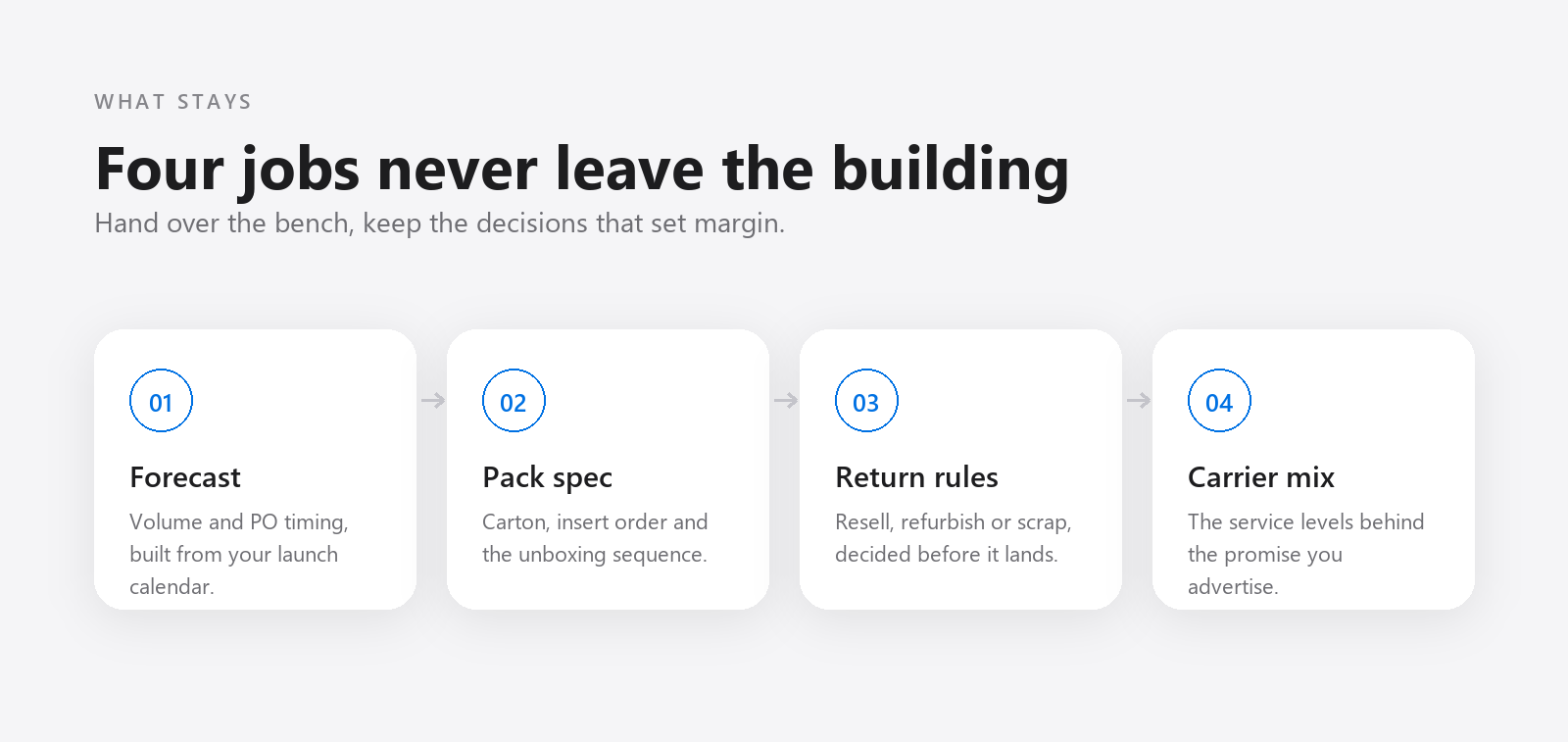
Four things should not move, even after the contract is signed. Demand forecasting and purchase-order timing, because a partner sees your orders and not your launch calendar. Packaging spec and the unboxing sequence, because that is brand, not logistics. Returns disposition rules, because "resell, refurbish or scrap" is a margin decision. And the carrier mix behind your delivery promise, because a partner that quietly downgrades service to protect its margin changes what you can advertise.
Everything else — receiving, put-away, picking, packing, labeling, handover, and the daily reconciliation that keeps them honest — is a candidate. A competent pick and pack operation can usually take all of it inside a month.
Then ask six questions. What is the minimum monthly spend, and what happens in a month below it? Is inbound receiving billed per unit, carton or hour? Is storage billed per pallet position, cubic foot or bin, and is there a floor? What is the service credit for a mis-ship, and is it capped at the pick fee? Who owns the inventory data, in what format, on termination? And if the contract ends badly, what does it cost to get the stock back, and how many days does it take?
That last one isn't hypothetical. Two forwarder collapses in 2021 and 2022 left Chinese cross-border sellers with containers stuck at port; in one case 56 containers and more than 300 sellers were frozen, and customers were asked to advance about ¥22 per kilo to have their own goods released. Ask what insurance covers your stock inside someone else's building, and put in writing that the goods remain yours.
The short version
Count orders per labor hour, count the cost of a wrong parcel, count your own hours, then compare that with a landed cost per order — pick fee plus receiving, storage, packaging, postage and minimums. Under about 2,000 orders a month the honest answer is usually to stay and fix the process. Above 8,000 the math rarely favors keeping it. In between it depends on SKU count and return rate, and no benchmark will settle it for you.
If you want a second opinion on where your line sits, send the monthly order count, the SKU count and the peak-week multiplier. We'll model the landed cost both ways before we talk about price — start here.
References (Neutral Third-Party Sources)
- Harvard Business Review — The Core Competence of the Corporation (Prahalad & Hamel, 1990): the argument for keeping competence-defining work in-house and buying the rest. https://hbr.org/1990/05/the-core-competence-of-the-corporation
- USPS — Mailing & Shipping Prices: retail and commercial prices for the same services differ, which is why postage bought at low volume is not a benchmark. https://www.usps.com/business/prices.htm
- USPS Domestic Mail Manual 253 — Parcel Select Prices and Eligibility: how billing weight is set, including dimensional weight over 1,728 cubic inches, the 70-pound ceiling and the combined length-plus-girth limit that triggers oversize pricing. https://pe.usps.com/text/dmm300/253.htm
- USPS Domestic Mail Manual 507 — Mailer Services: Address Correction Service and the per-notice fee a mailer pays when a parcel cannot be delivered as addressed. https://pe.usps.com/text/dmm300/507.htm
- GS1 US — What is a GTIN?: why each product variation needs its own identifier, and how that differs from an internal SKU. https://www.gs1us.org/upcs-barcodes-prefixes/what-is-a-gtin
- NIST — Handbook 44: Specifications, Tolerances and Other Technical Requirements for Weighing and Measuring Devices: scales used in commerce are covered by accuracy tolerances, which is the basis for weight-gate checks. https://www.nist.gov/pml/weights-and-measures/publications/nist-handbooks/handbook-44