
Reshipment & Failed Deliveries: Fix Them Without Losing Customers
A reshipment is a second order that you pay for twice. The first parcel already took the goods, the label, the pick, the pack and the support time. The second takes all of it again, usually on a faster service, because by then the customer has been waiting three weeks.
Treat that as a customer-service cost and it grows quietly until it eats a month of margin. Treat it as a fulfilment cost with its own line in the P&L and it becomes manageable, because failed deliveries are not random. They cluster around one address type, one carrier lane, one product that keeps arriving in pieces.
Six failures, six different owners
The first job is not to apologise. It is to put the failure in the right bucket, because the bucket decides who pays and what you are allowed to promise.
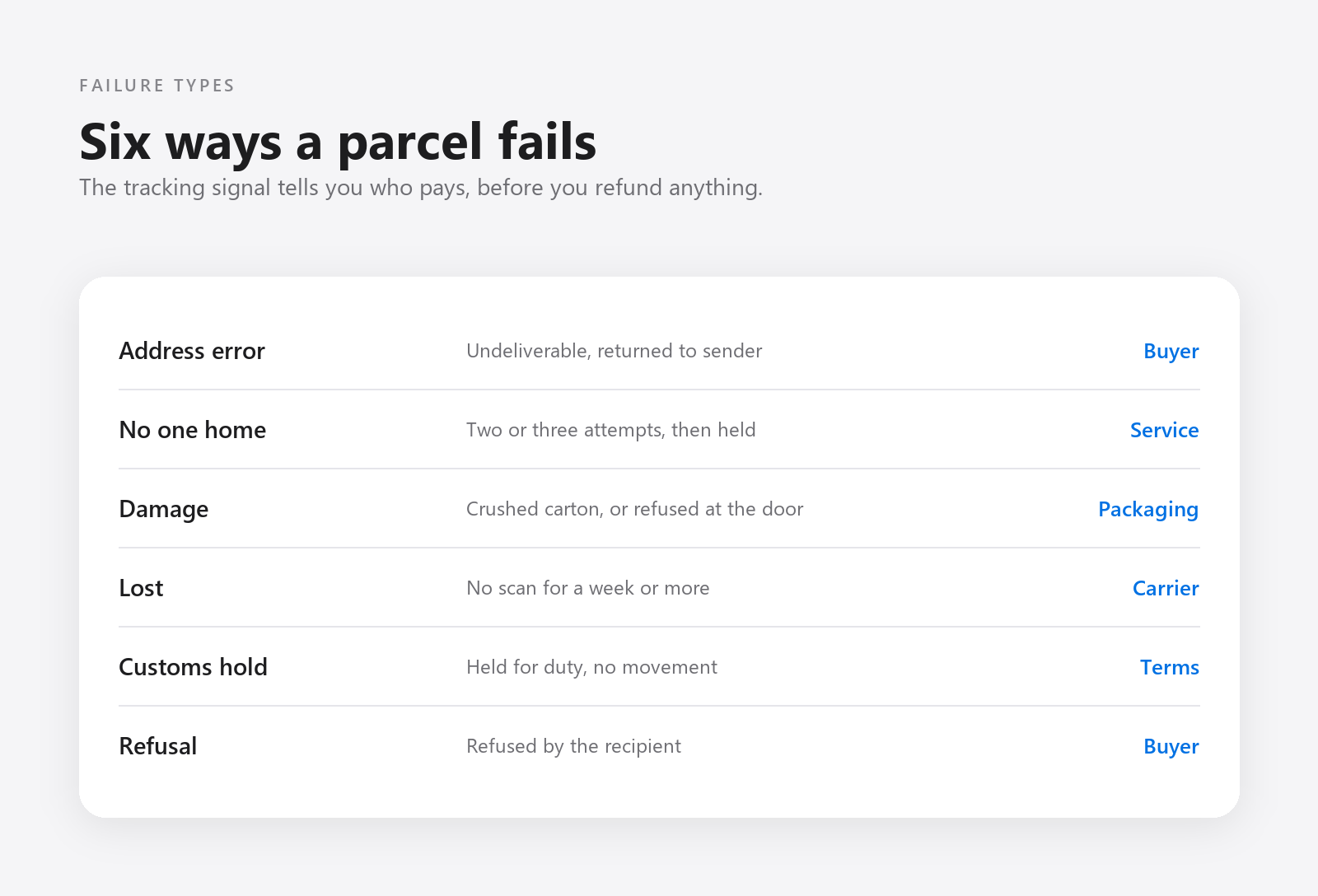
| Failure | What tracking shows | Who usually owns it | First move |
|---|---|---|---|
| Address error | Undeliverable as addressed, returned to sender | Buyer, most of the time | Get a corrected address before a second label exists |
| No one home | Two or three attempts, then held at a depot | Depends on the service you bought | Reattempt, or redirect to a pickup point |
| Damage | Delivered with a crushed carton, or refused at the door | Packaging, or the carrier | Photos before the customer bins the box |
| Loss | No scan for a week or more | Carrier, inside a liability cap | Reship, then claim |
| Customs hold | Held in customs, duty unpaid, no movement | Whoever owns duty under your terms | Send the invoice and the classification |
| Refusal | Refused by recipient | Buyer, with exceptions | Ask why before you send it again |
The mix matters more than the number. A brand whose exceptions are 70% address errors needs checkout work; one at 70% damage needs a packaging engineer, not a better carrier. You do not have to invent the categories either: USPS stamps a reason on every parcel it returns — Insufficient Address, No Such Number, Moved Left No Address, Refused, Unclaimed — and those endorsements are a failure taxonomy you get for free.
Among warehouse operators who publish their own figures, a line that scans the SKU at pick and re-scans the carton at pack tends to sit under 0.3% mis-ships, and the tightest claim a tenth of that. The gap between 0.3% and 3% is rarely skill. It is whether the second scan exists.
Who pays is decided before the parcel moves
By the time a parcel fails, most of your options are gone. Three decisions made at dispatch set the ceiling on what you can recover.
Delivered duty paid or duty unpaid. On a DAP shipment a customs hold is the buyer's problem in law and yours in practice, because the buyer will not see it that way. Say which one you sold, in one line, on the product page and again in the order confirmation.
Signature or release. A signature costs money and creates failed attempts; release saves both and creates a dispute instead, because tracking says delivered and the customer says it never arrived. UPS states plainly that packages released at the shipper's request are not eligible for lost-package claims.
Declared value or default liability. Carriers do not pay what the parcel was worth to you, but what you can prove, up to the coverage bought. USPS pays no more than the article's actual value and nothing for loss after a signature.
Refund, reship, or credit
Once you know the bucket, the choice is arithmetic plus one judgement about the customer.
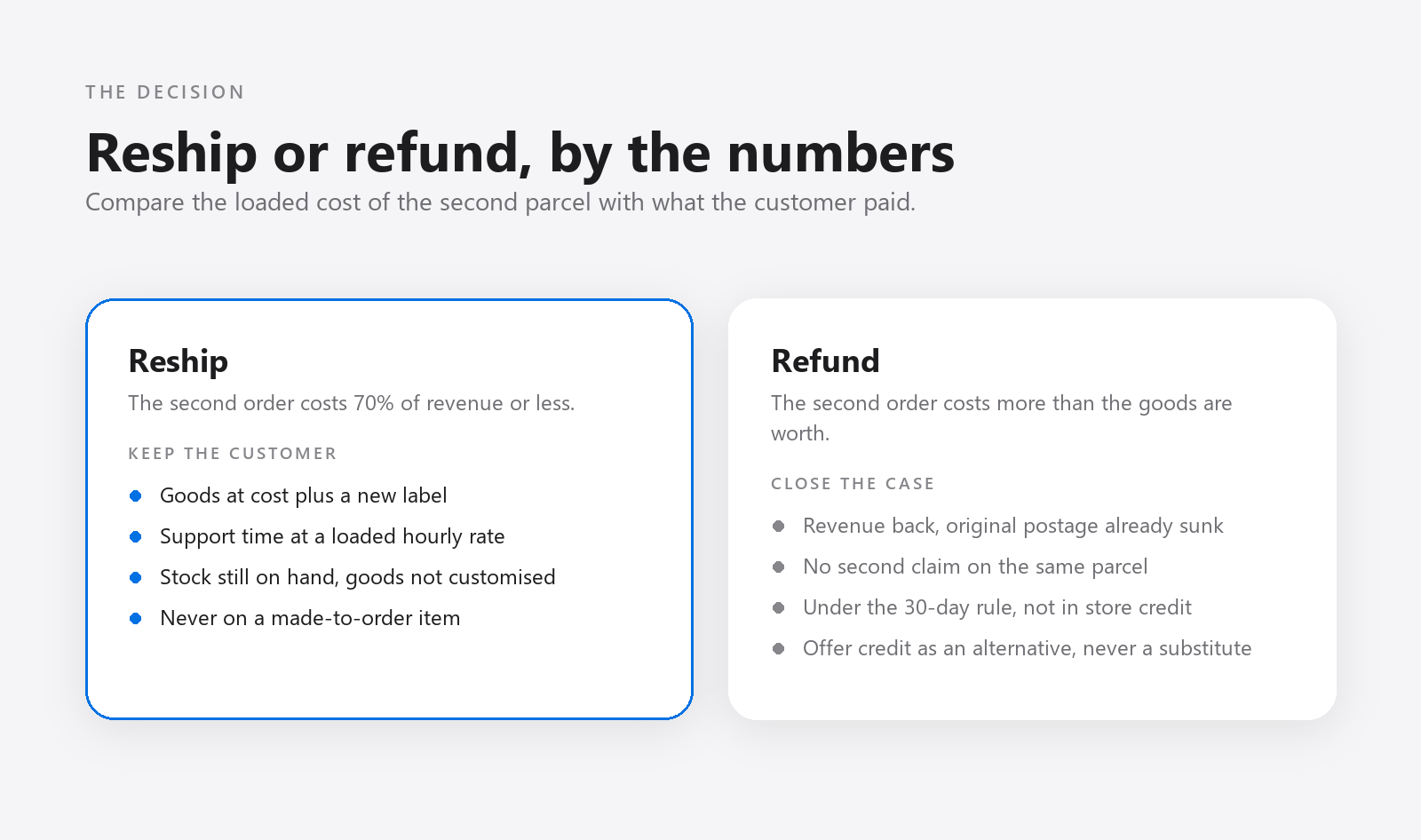
| Route | Use it when | What it to What Really costs | What it risks |
|---|---|---|---|
| Reship the same SKU | Stock on hand, order still wanted, goods not customised | Goods at cost, label, pick and pack, support time | The second parcel fails the same way |
| Reship an upgrade | Original is out of stock or end-of-line | Higher goods cost, higher postage | Customer reads it as a favour you owed |
| Full refund, no return | Low value, high recovery cost, or the customer is done | Full revenue plus sunk postage | A small number of repeat claimants |
| Partial refund, keep it | Damage is cosmetic and the product still works | Discount, and no goods back | Sets a price for damage |
| Store credit | The customer will buy again and said so | Deferred revenue, not saved revenue | Reads as a refund substitute |
Store credit sits at the bottom for a reason. Under the FTC's Mail, Internet, or Telephone Order Merchandise Rule, a merchant who cannot ship within the promised window and cannot get the customer's consent has to refund — promptly, and not in vouchers. Credit is a loyalty tool you offer instead of a refund, never a refund you talk someone into.
The line where a refund beats a reship
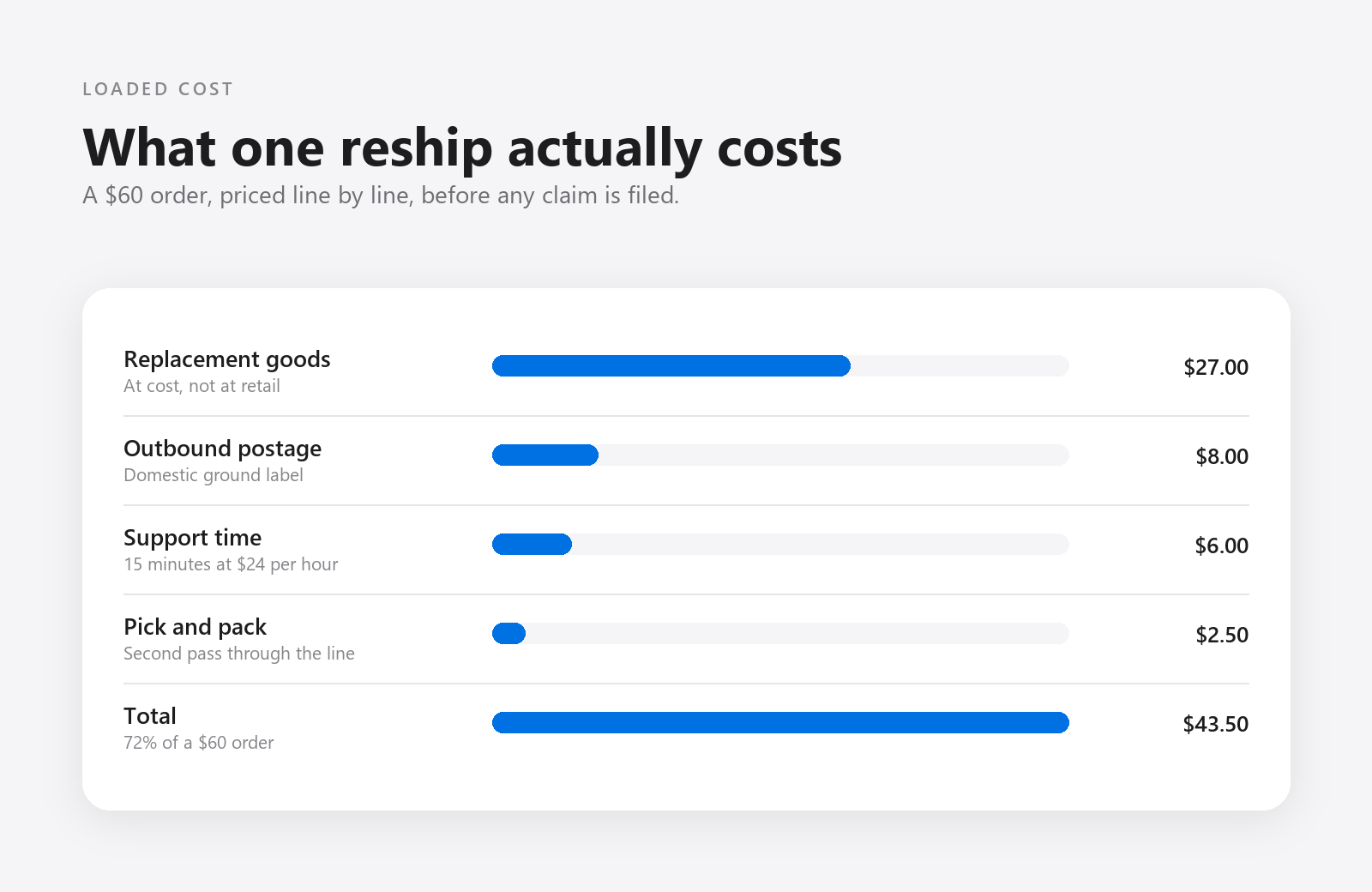
Work out the fully loaded cost of the second parcel, then compare it with what the customer paid. Our working line sits at about 70%: past seven-tenths of the order value, refund.
A $60 order: goods at $27 cost, an $8 domestic label, $2.50 pick and pack, and fifteen minutes of support at a $24/hour loaded rate, which is $6. The reship lands at $43.50, or 72% of revenue — just over the line, so it depends on the customer. Drop the order to $45 and the same reship is 97%: refund, and do it today rather than after two more emails.
Two overrides are legitimate: a customer with three orders in twelve months is worth more than the parcel, and a personalised item cannot be resold, so "refund and keep the stock" does not exist. The illegitimate override is habit — reshipping by default because it feels kinder.
The claim runs on its own clock
A carrier claim is a recovery, not a remedy. The customer does not care that UPS has eight to ten business days to review a case. Reship or refund on your own timeline, then chase the money separately.
The clocks differ, and this is where small teams get caught:
- USPS — for a lost package the window opens 15 days after mailing for Ground Advantage, Priority Mail, insured mail and COD, and closes at 60 days; Priority Mail Express opens at 7 days. Damage can be filed immediately but not after 60 days. Expect a decision in 5–10 days, with 30 days to appeal.
- UPS — start within 60 days of the scheduled delivery date; most cases resolve in 8–10 business days.
- FedEx — 60 calendar days from the shipment date for damage on U.S. packages, 21 days for international, and up to nine months for a lost or undelivered shipment.
Keep the box. Every one of those processes assumes you still have the packaging, the label and the contents, and USPS asks you not to bin damaged items even after photographing them. A support agent who tells the customer to throw the carton away has cost you the claim and the reship.
Address, signature, release
Address capture. A single address line will always lose apartment numbers. Require the secondary line, validate the postal code against city and state, and flag the types that fail most: hotels, university halls, new-build estates, business parks where the suite number does the routing. None of that catches the customer who moved last month, which is why the confirmation email should ask once, plainly, whether the address is still right.
Interception. Caught before delivery, a redirect beats a reship on price: USPS Package Intercept is $19.45 plus applicable postage, refundable if the intercept fails. Against a $43 reship the maths is not close.
Signature policy by value, not by feel. Set a threshold — many merchants use $150 — above which a signature is mandatory, below which the customer chooses at checkout. Two published policies beat one applied differently by whoever is on shift.
Packaging that survives a denial
Bad packaging does not just cause damage; it cancels the claim. USPS lists damage by abrasion or scraping to articles not properly wrapped as non-payable, along with fragile articles whose nature prevented safe carriage regardless of packaging. The carrier is not being clever. It is telling you the box was the failure.
So test the box before the customer does. A waist-height corner drop, three times on the same corner, then the opposite one, tells you more than a spec sheet. Photograph the packed carton before sealing — three photos, one per side — because the claim form will ask and the warehouse will have moved on.
The other half is catching the wrong parcel before it leaves. A weight check at the bench, with each SKU and bundle loaded into the system, flags a missing insert or a swapped item at a tolerance of a few grams. That one gate removes two of the six failure types from your exceptions report before the label is paid for.
A log with five fields
You cannot cut a rate you do not measure, and most merchants record reshipment as a dollar total, which explains nothing. Five fields are enough: order number, failure code, last carrier scan, loaded cost, and who closed it.
Read it weekly while the volume is small enough to read. Our rule: if one code is more than a quarter of the month's exceptions, the fix is a process change, not a customer conversation. Address errors past that line mean checkout. Damage past that line means packaging. Loss past that line means the lane, or the service level you buy on it.
The short version
Name the failure, decide who owns it, then do the arithmetic: reship when the second parcel costs under about 70% of the order, refund when it costs more, and never let a carrier claim decide how long a customer waits. Fix the address field, the signature threshold and the carton, in that order — all three are cheaper than the parcel you send twice.
If the reship rate is climbing and the log says the cause sits on your side of the handoff, that is a pick and pack problem rather than a carrier problem. Send us the exception counts by code and we will tell you which checkpoint is missing.
References (Neutral Third-Party Sources)
- USPS — File a Claim: Domestic: filing windows by mail class, required documents, 5–10 day decisions, 30-day appeals. https://www.usps.com/help/claims.htm
- USPS — Domestic Mail Manual 609: Filing Indemnity Claims for Loss or Damage: the non-payable list, including damage from improper wrapping and loss after a signature. https://pe.usps.com/text/dmm300/609.htm
- USPS — Request a USPS Refund: Domestic: package intercept fee and the money-back guarantee window for Priority Mail Express. https://www.usps.com/help/refunds.htm
- UPS — File a UPS Claim: 60-day filing window from scheduled delivery, released packages excluded from lost claims, 8–10 business day resolutions. https://www.ups.com/us/en/help-center/claims-support.page
- FedEx — File a Claim: 60-day domestic and 21-day international windows for damage, nine months for loss, and the documents required. https://www.fedex.com/en-us/customer-support/claims.html
- Federal Trade Commission — Business Guide to the FTC's Mail, Internet, or Telephone Order Merchandise Rule: the 30-day shipping rule, delay notices, and the requirement to refund rather than issue credit. https://www.ftc.gov/business-guidance/resources/business-guide-ftcs-mail-internet-or-telephone-order-merchandise-rule