
Omnichannel Fulfillment Services: One Inventory, Every Channel
Omnichannel fulfillment services mean one thing operationally: every channel you sell on — your store, Amazon, retail, wholesale — draws from a single pool of stock through one available-to-sell number, and a single team picks, packs, and ships every order to that channel's own rules. The service is not the warehouse. It is the decision that one number owns the truth, and everything else obeys it.
This article is about what you are actually buying when you buy "omnichannel fulfillment services," and how to tell a real one from a multichannel operation wearing the label.
The service, item by item
Strip the branding and the service is a fixed set of jobs. Each one matters, but most of them are commodities.
| Service | What it is | Why it matters |
|---|---|---|
| Receiving | Check in inbound stock, verify counts, put away | Inventory truth starts at the dock |
| Storage | Hold stock in racking, tracked by SKU | The fixed cost of the whole model |
| Pick and pack | Pull each order and pack it | The billed heartbeat of the contract |
| Shipping | Label and hand to the carrier | Carrier choice sets the promise |
| Returns | Log, inspect, and restock | Feeds the count back into the pool |
The five lines are the same for a single-channel warehouse. What makes it omnichannel is the sixth, invisible one: one stock record that every channel reads and writes to, updated the moment a unit is received, sold, returned, or damaged. The mechanics of how that sync is built are a separate question — the omnichannel inventory models matter less here than the fact that a provider commits to one.
One number owns the truth
The number is called available-to-sell — ATS for short, the quantity your channels are allowed to promise right now. In a single-channel warehouse ATS is a trivial calculation. Across channels it is the whole game, because a website order, an Amazon shipment, and a store restock can all want the same carton on the same afternoon.
If each channel keeps its own count, one sale on your storefront doesn't reduce the number Amazon sees, and both sell the last unit. If one number owns the truth and updates on every transaction, the race disappears. The distinction is not how many places you sell. It is whether those places draw from the same count.
A Chinese overseas-warehouse operator describes the cheapest version of this control without any jargon: set a stock threshold per SKU, and let the system warn and pause a listing before the count reaches zero. It is a floor, not a technology, and it stops the listing from selling a shelf that is already empty.
Overselling is a race, not a bug
Overselling gets blamed on slow sync, but the arithmetic is a race between two channels that both read "one available" in the same instant. The fix is reservation: the channel asks permission before it sells, instead of reporting afterwards.
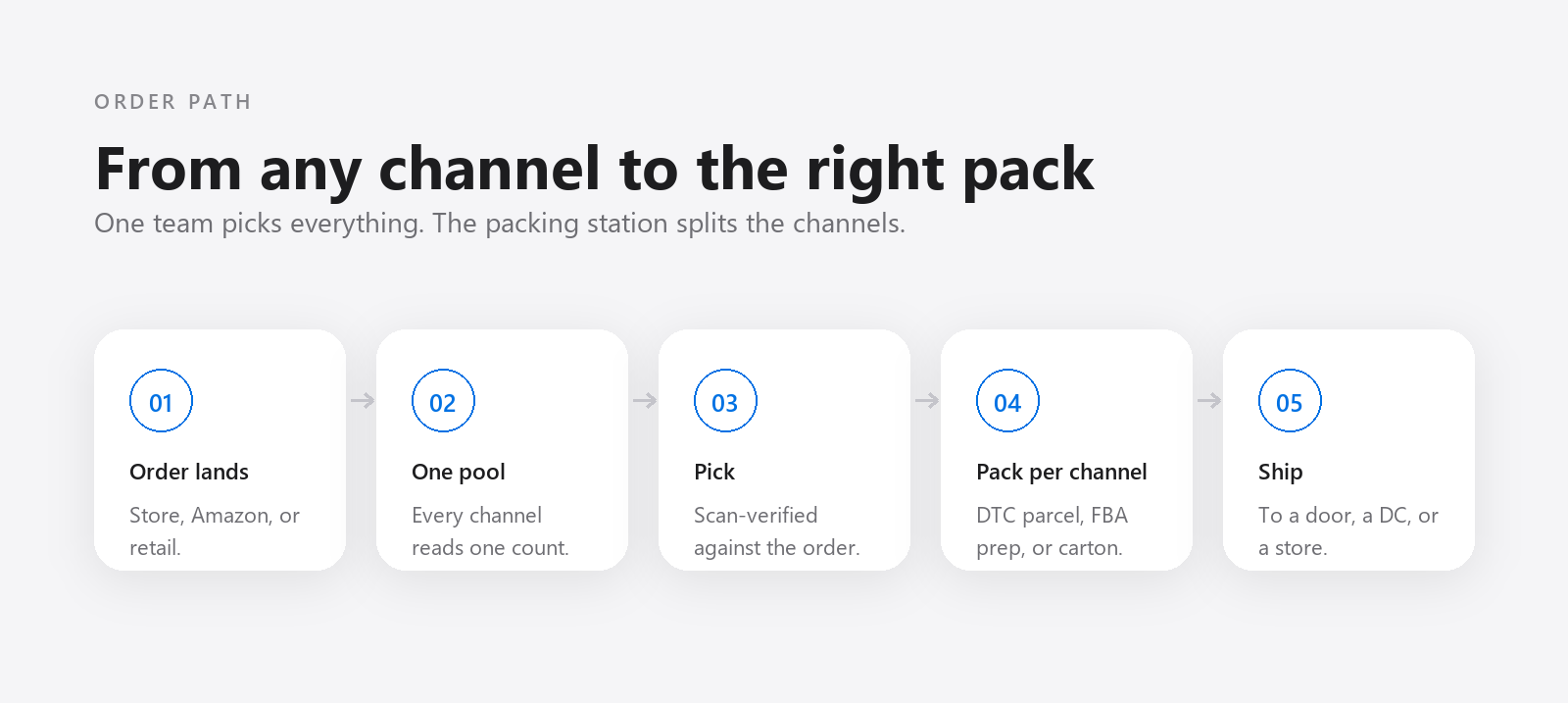
The detail most service-level discussions skip is pick accuracy. A warehouse that runs even a 0.3% pick error — which a well-run Chinese fulfilment operation reports as the bar — still drifts, because every mis-pick is a unit the system thinks it has and does not. No sync cadence fixes that. Only scan-verified picking, with every unit matched to the order, keeps the count honest — the same discipline behind a well-run pick and pack station.
Every channel packs differently
The part that breaks a generalist warehouse is not the picking. It is the packing, because each channel demands a different box.
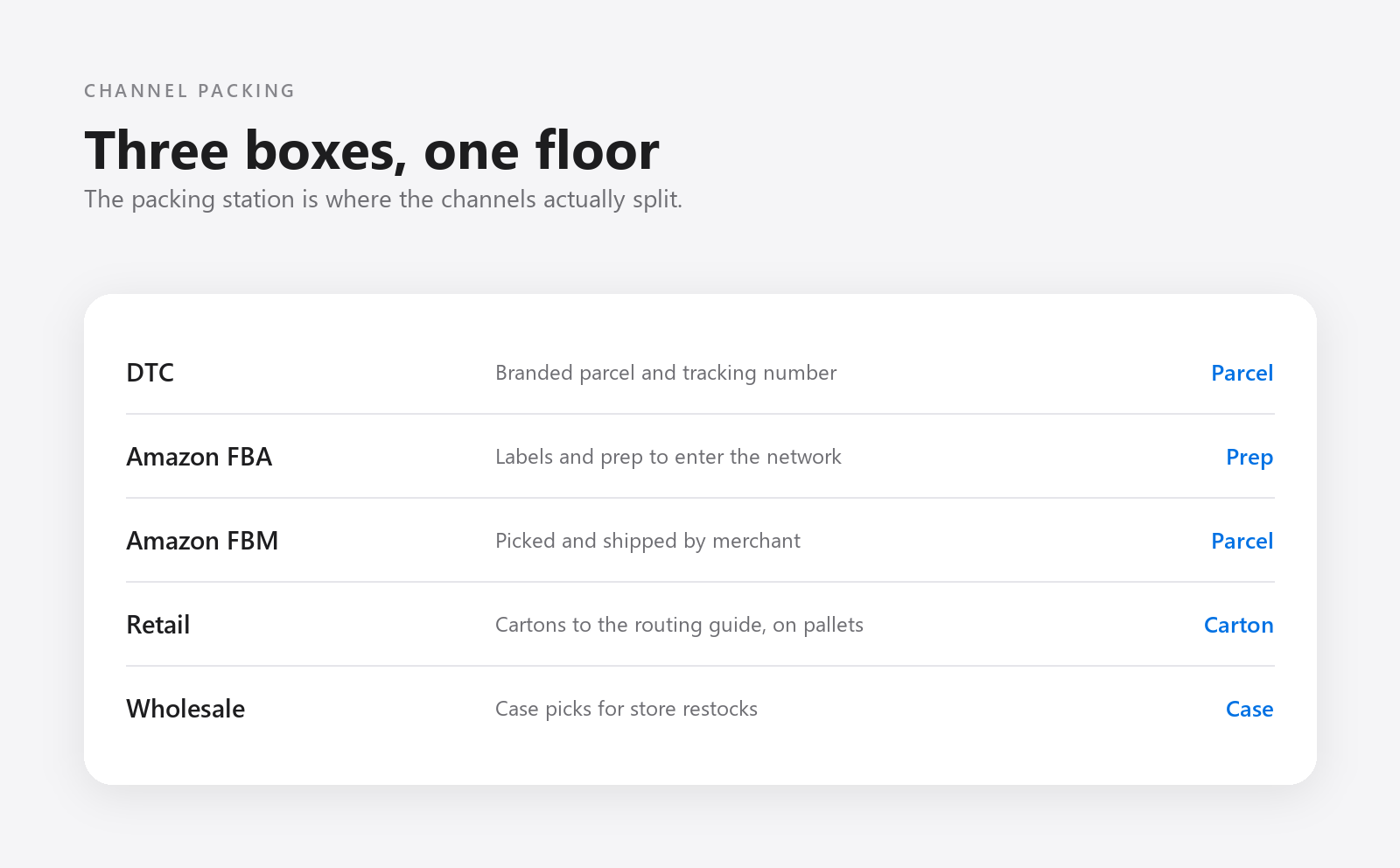
A DTC order gets a branded parcel and a tracking number. An Amazon order either gets FBA prep — the labelling and prep work that lets a unit enter Amazon's own network — or it gets picked and shipped as a merchant-fulfilled order. A retail order gets cartons built to a routing guide, the retailer's rulebook for how a shipment is labelled, palletized, and delivered.
One team picks everything; the packing station is where the channels split. That split is the difference between this and a multi-channel setup that keeps a separate pool per channel.
A warehouse that has only ever packed DTC parcels will fail the retail carton on its first big-box order, and the penalty is a chargeback — a fee the retailer deducts for a non-compliant shipment — not a grumpy email. The packing station is also where a generalist quietly loses money: it quotes one pick fee and then discovers the retail carton needs a routing-guide audit, pallet wrap, and a different label set, none of which were in the rate.
Retail is the lane that tests the label
Selling into a big-box retailer is where "omnichannel" stops being a marketing word. Retailers order through EDI — electronic data interchange, the machine-to-machine format that replaces email — and expect cartons on a 48 by 40 inch pallet, labels in the exact spot the routing guide says.
The cost of getting it wrong is higher than most brands expect. A Chinese cross-border logistics provider writing about North American retail is blunt: miss a replenishment and a supplier's Vendor ID — the number that lets you sell to that retailer at all — can be cancelled outright. A marketplace stockout costs you ranking. A retail short-ship can cost you the account.
That is the real test of an omnichannel service provider: not whether they can ship a parcel, but whether they can ship a retail carton to spec and a DTC parcel from the same floor without pulling from the wrong pool.
Eight questions to ask before you hand over every channel
- Do all my channels read from one ATS number, or do you split inventory into per-channel pools?
- When does received stock start counting as sellable — at the dock, or after put-away?
- Can you pick retail cases and single DTC units from the same stock without double-counting?
- Who reads my retailers' routing guide, and who owns it if a carton gets rejected?
- What is your pick error rate, measured, and how do you scan-verify each order?
- How does a return get graded and fed back into the sellable count?
- What happens to an order that lands with a bad address or an invalid SKU — who owns the exception?
- What does your quote look like for my peak month, not my average month?
If the answer to the first question is anything other than "one number," the rest of the conversation is about how much of the count you will reconcile by hand.
When one pool actually pays
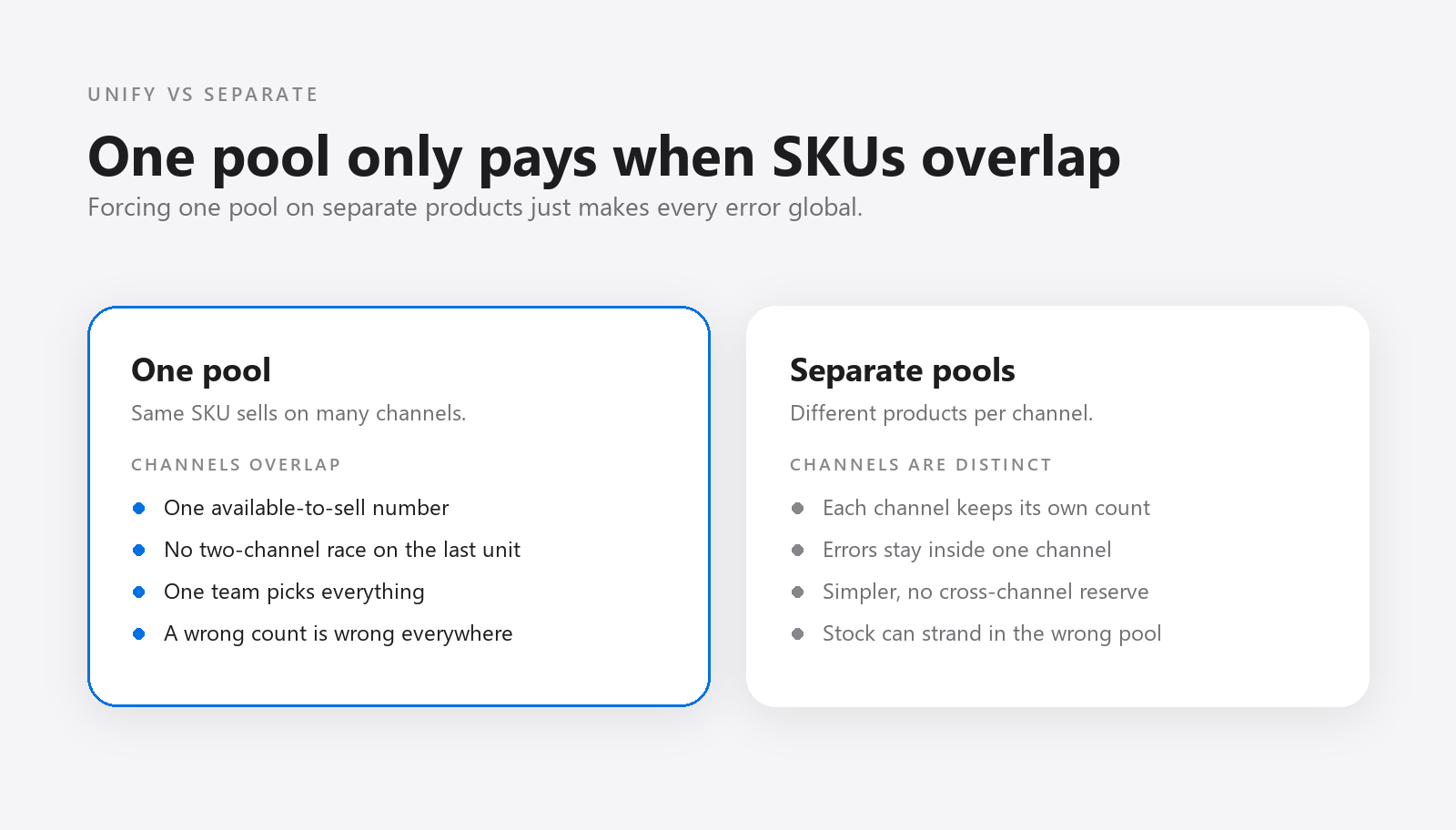
Unifying inventory is not free — it concentrates risk in one system and one team. It pays when the same SKU genuinely sells across more than one channel. If your Amazon stock and your DTC stock are different products, you are multichannel and that is fine; forcing one pool just makes every error global.
The cleanest signal is oversell frequency. If you have cancelled an order in the last quarter because two channels sold the same unit, you have already paid for the unification in lost trust — the question is only whether you fix it now or after the next peak.
The short version
Omnichannel fulfillment services are one inventory decision wearing a logistics uniform: one ATS number owns the truth, one team picks everything, and the packing station splits the channels. Share the pool only when the SKUs actually overlap, verify every pick, and judge a provider by whether it can ship a retail carton to spec — not by whether it can ship a parcel.
If you are about to add a marketplace or a retail account, send us your channel list and order split for a quote — we will map whether one pool is worth it before you switch anything on.
References (Neutral Third-Party Sources)
- GS1 — Global Trade Item Number (GTIN): the identifier that gives each sellable variant one machine-readable record across channels. https://www.gs1.org/standards/id-keys/gtin
- GS1 — Global Location Number (GLN): identifying the stores, warehouses, and functions an order router directs work toward. https://www.gs1.org/standards/id-keys/gln
- Amazon Selling Partner API — searchOrders: the order states a marketplace uses across seller systems, from pending to shipped. https://developer-docs.amazon.com/sp-api/reference/searchorders
- Shopify Help Center — Fulfilling orders: what the fulfillment action covers, from picking and packing to handing parcels to a carrier. https://help.shopify.com/en/manual/fulfillment/fulfilling-orders
- Federal Trade Commission — Mail, Internet, or Telephone Order Merchandise Rule: ship within the stated time or 30 days, and obtain consent or refund if you cannot. https://www.ftc.gov/business-guidance/resources/business-guide-ftcs-mail-internet-or-telephone-order-merchandise-rule