
Book Fulfillment Services for Authors and Publishers
Book fulfillment is storing your printed titles and then picking, packing, and shipping every order — a single paperback to a reader, or a pallet of cartons to a retailer — plus taking the returns back. The core loop is the same as any warehouse. The edges are where books punish a generalist: paper has corners, dust jackets crease, and a signed copy cannot be reprinted when it gets damaged.
This article is for independent authors and small publishers who have printed a run and are deciding whether to pack boxes in the garage or hand the work to someone who does it every day.
Why books are a different product
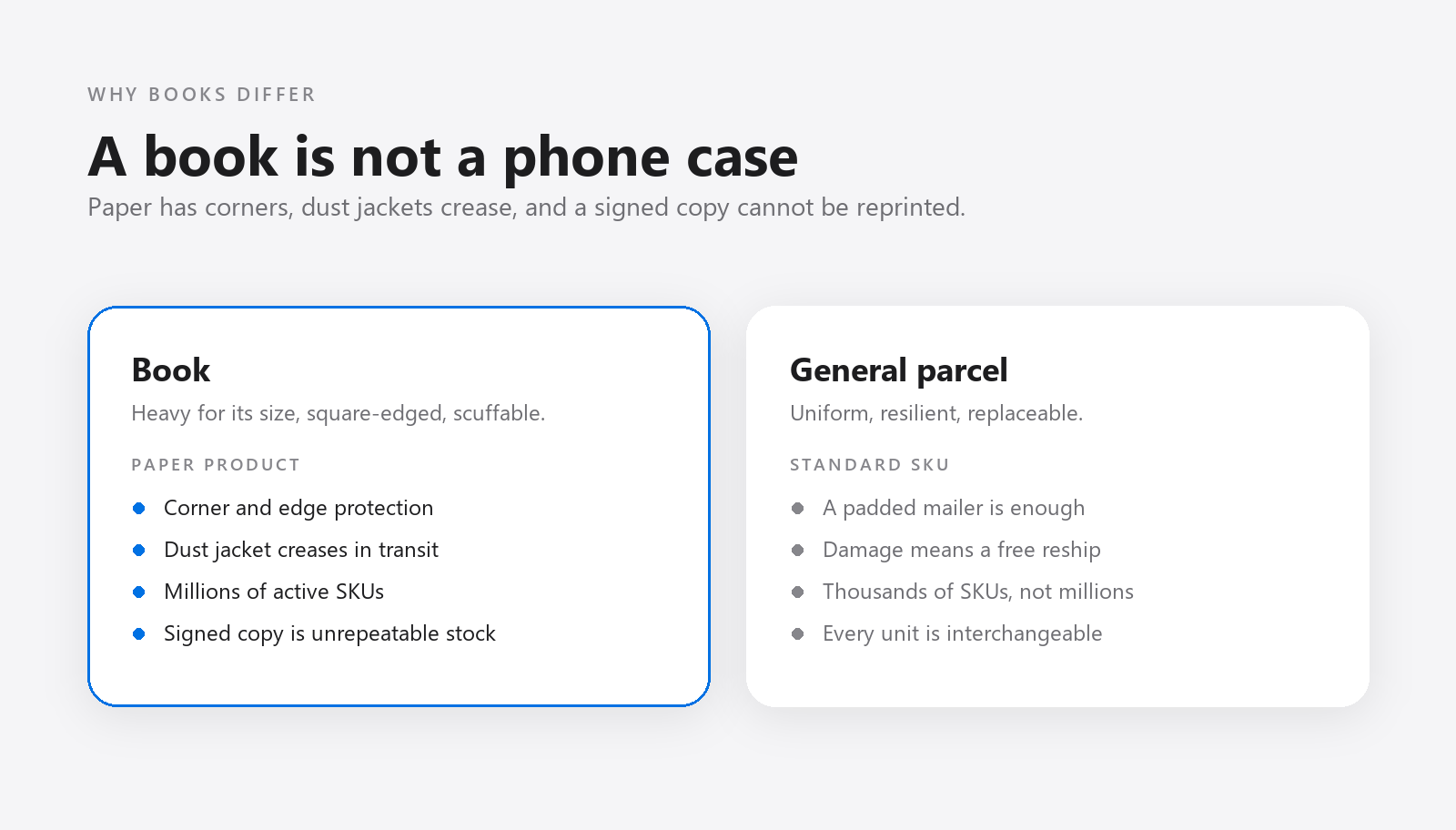
A book is heavy for its size, square-edged, and easy to scuff. A paperback survives a padded mailer; a hardback with a dust jacket does not — one author in a self-publishing forum put the complaint plainly: it was not the price, it was a dust jacket creased in transit. A hardback is heavier and squarer than a paperback, and it needs a written packing standard, not a promise to be careful.
The second difference is the catalogue. Books have millions of active SKUs, not thousands — a Chinese book-trade publication describes the scale when it notes that a single title can sit in a warehouse for months waiting for one order, then move a hundred copies in a day when a review lands. A generalist warehouse that also ships phone cases will not understand ISBN matching, which is the barcode discipline that keeps each edition separate, or the damage claims that come with paper.
Three models, and they are not the same thing
Authors routinely conflate three services, and confusing them is how they pay twice.
| Model | What it does | Who it suits |
|---|---|---|
| Print-on-demand | Print one copy when an order lands, ship straight to the buyer | Long tail, no inventory, no storage |
| Warehouse fulfillment | Store a printed run, pick and pack per order, take returns | A real run with real unit economics |
| Distribution | Sell into bookstores and libraries, absorb returns, pay you | When a retailer actually asks |
Print-on-demand means nothing sits on a shelf, but every copy carries print cost and you never get the economics of a real run. Warehouse fulfillment is the opposite: per-unit cost falls hard at volume, but you now own unsold paper — and the storage bill that goes with it. Distribution adds a sales channel on top, but traditional distribution contracts are hard to get and hard to leave.
Most self-publishers land in the middle: a short run for author copies and events, print-on-demand for the long tail, and a distributor only when a retailer actually asks. The warehouse option is the only one that runs a pick and pack line on every single order.
Packaging is the whole game
A book arrives damaged because it was packed like a phone case. Paper products need packaging chosen for their shape and edges: a rigid or padded mailer for a single paperback, corner and edge protection for a hardback, and a right-sized box for multi-book orders so the titles don't shift and crush their own corners.
A Chinese book-trade write-up on cross-publisher bundling makes the same point from the other direction: when you ship a set of several titles in one box, the box has to be built so the spines don't fold — the reason retailers ask for cover-up display and shrink-wrap on the receiving end. The test is not a spec sheet. It is shipping five real copies to five real addresses before you commit a run, because the first copy a reader opens should look like it came off the press.
Media Mail changes the arithmetic
For US authors, the single most important cost fact is Media Mail — the USPS service class reserved for books and eligible media. It starts around $4.39 at the Post Office, runs 2 to 8 days, and accepts packages up to 70 pounds, far cheaper than Priority Mail for a heavy hardback. The catch is the eligibility: it covers books of at least eight pages and a narrow list of media, and every package is subject to opening and inspection by the Postal Service.
That last clause is the one authors forget. If you slip a bookmark, a thank-you note, or any non-media item into a Media Mail parcel and it gets inspected, you and the buyer pay the higher rate. A fulfilment provider that knows books ships the book under Media Mail and the marketing insert under a different class, or leaves the insert out.
Signed editions need a hand, not a machine
A signed edition is where cheap fulfillment shows itself. Signing means opening sealed stock, having the author sign or a signed tip-in page inserted, and resealing — a manual, low-volume step that a generalist warehouse either refuses or charges for as a custom job.
This is exactly the kind of work that belongs in a kitting and assembly flow. The author signs a batch of tip-in sheets in advance; the warehouse inserts one per book, then reseals to the original standard. If the provider cannot describe this process in writing, treat every signed copy as at risk, because a signed book that ships damaged is unrepeatable inventory — you cannot reprint an autograph.
Pre-orders and wave shipping
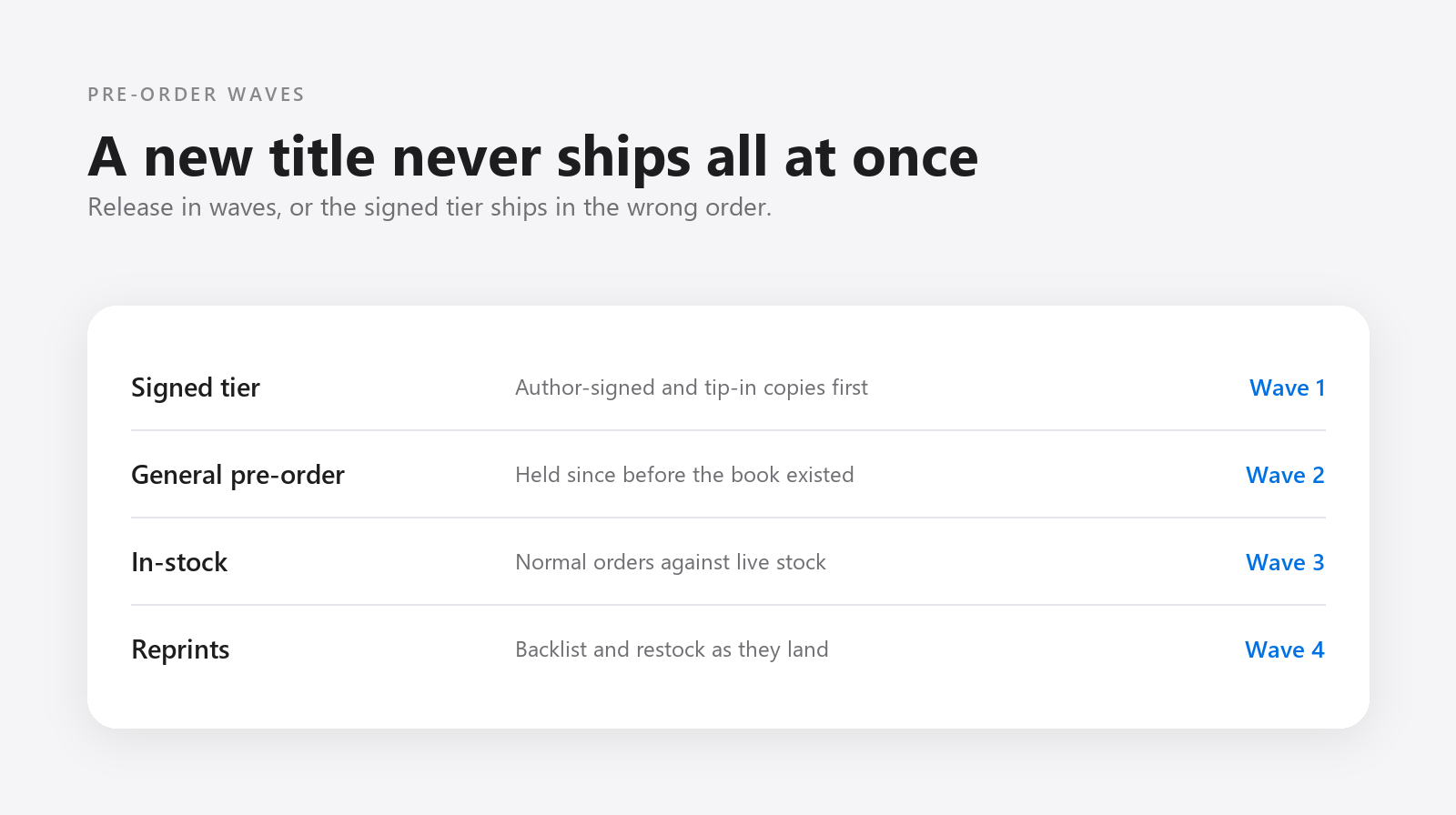
A new title does not ship all at once. Pre-orders arrive before the book exists, and the fulfilment job is to hold them, then release them in waves — the signed-edition tier first, then general pre-orders, then reprints. The mistake is treating pre-orders and in-stock orders as one queue.
A Chinese book-trade publication describing how publishers prepare for the big November shopping season makes the timeline concrete: a publisher stocking up for the peak starts procuring in July so everything is in the warehouse by the end of September, then adjusts warehouse binning and staffing in October to handle the surge. The discipline is the same at any scale — you cannot fix a pre-order wave the week it releases.
Bundles and sets are kitting, not shipping
When you sell a boxed set or a multi-title bundle, you are kitting, not just shipping. A Chinese trade account of cross-publisher bundling explains the hidden cost: a "virtual bundle" — several single titles grouped in the system — can't run promotions like a real SKU; a "physical bundle" can, but then returns have to be unpacked and split back to the original titles, and the money has to be re-allocated to each supplier.
For a self-publisher, the same logic shows up as the set that arrives with one volume dented: the whole set is unsellable until the damaged volume is swapped, which is a kitting-and-assembly job, not a return. Bundle only when the warehouse can describe how a set is assembled, and how it is unassembled when one volume comes back.
Returns are the part nobody prices
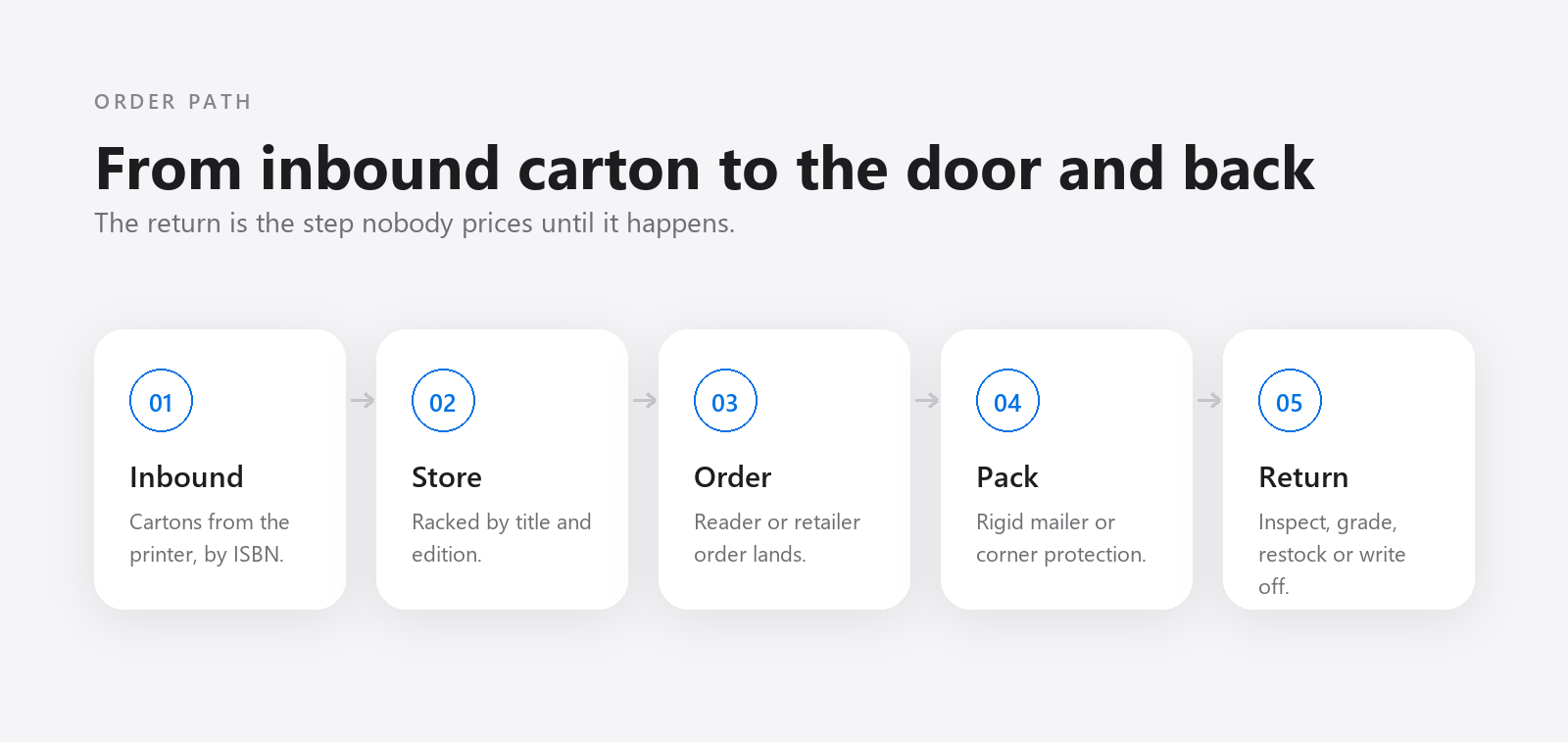
Returns come back to the warehouse, not to your garage — that is half the point of the service. The other half is what happens to them. A returned book needs inspection: a creased spine is unsellable, a bent corner on a trade paperback might be salvageable, and a boxed set with one damaged volume needs the swap described above.
The cost is not the inspection. It is the decision. A book returned in saleable condition goes back into the pool; a book returned damaged is written off. A provider that logs the return and updates the count by title, not just by "returns," is the one that keeps your inventory honest — and keeps you from selling a copy you no longer physically have.
What to ask a book fulfillment provider
- What share of your volume is books, and can I see your packing standard in writing?
- Do you match ISBNs per edition, or do you treat a title as one number?
- Can you ship Media Mail and flag the inserts that don't qualify?
- How do you handle signed editions and tip-ins — as a standard flow or a custom job?
- How do you release a pre-order in waves, and where does the signed tier sit?
- When a boxed set comes back with one damaged volume, how do you split and restock it?
If the answer to the first question is "we ship everything," the rest of the conversation is about how much of the packing you will redo yourself.
The short version
Book fulfillment is a warehouse job with sharp corners. Match the ISBN, pack for paper, use Media Mail where it qualifies, treat signed editions and pre-order waves as kitting work rather than shipping, and judge a provider by whether it can describe how a damaged set gets split back into sellable copies.
If you are holding a print run and not sure how to split author copies, pre-orders, and long tail, send us the title count and the run size for a quote — we will map the packaging and the wave plan before we talk pricing.
References (Neutral Third-Party Sources)
- U.S. Postal Service — Mail & Shipping Services: the Media Mail service class for eligible books and media, its price, speed, weight limit, and inspection rule. https://www.usps.com/ship/mail-shipping-services.htm
- GS1 — Global Trade Item Number (GTIN): the identifier family that includes the ISBN, giving each edition one machine-readable record. https://www.gs1.org/standards/id-keys/gtin
- Federal Trade Commission — Mail, Internet, or Telephone Order Merchandise Rule: ship within the stated time or 30 days, and obtain consent or refund if you cannot — the baseline for pre-order promises. https://www.ftc.gov/business-guidance/resources/business-guide-ftcs-mail-internet-or-telephone-order-merchandise-rule
- U.S. Bureau of Labor Statistics — Transportation and Material Moving Occupations: the warehouse labour behind receiving, picking, packing, and returns. https://www.bls.gov/ooh/transportation-and-material-moving/