
Kitting Fulfillment: What It Is and How to Pick a Partner
Kitting fulfillment is not an add-on service on a fulfillment contract. It is two decisions: where your inventory stops — components only, or finished kits as well — and who owns the build. Those two answers set the quote structure, the lead time, and whether the operation survives a peak week.
Most partner comparisons fail because they compare adjectives. Everyone claims accuracy, flexibility and scalability; none of that can be checked in a meeting. Five things can: scan a component, weigh a finished kit, print a label against a mismatched order, release a work order, and name the carriers they can label. If a provider cannot show you all four, the rest is marketing.
What kitting fulfillment actually means
Three models, and the difference is not craft. It is where the inventory sits.
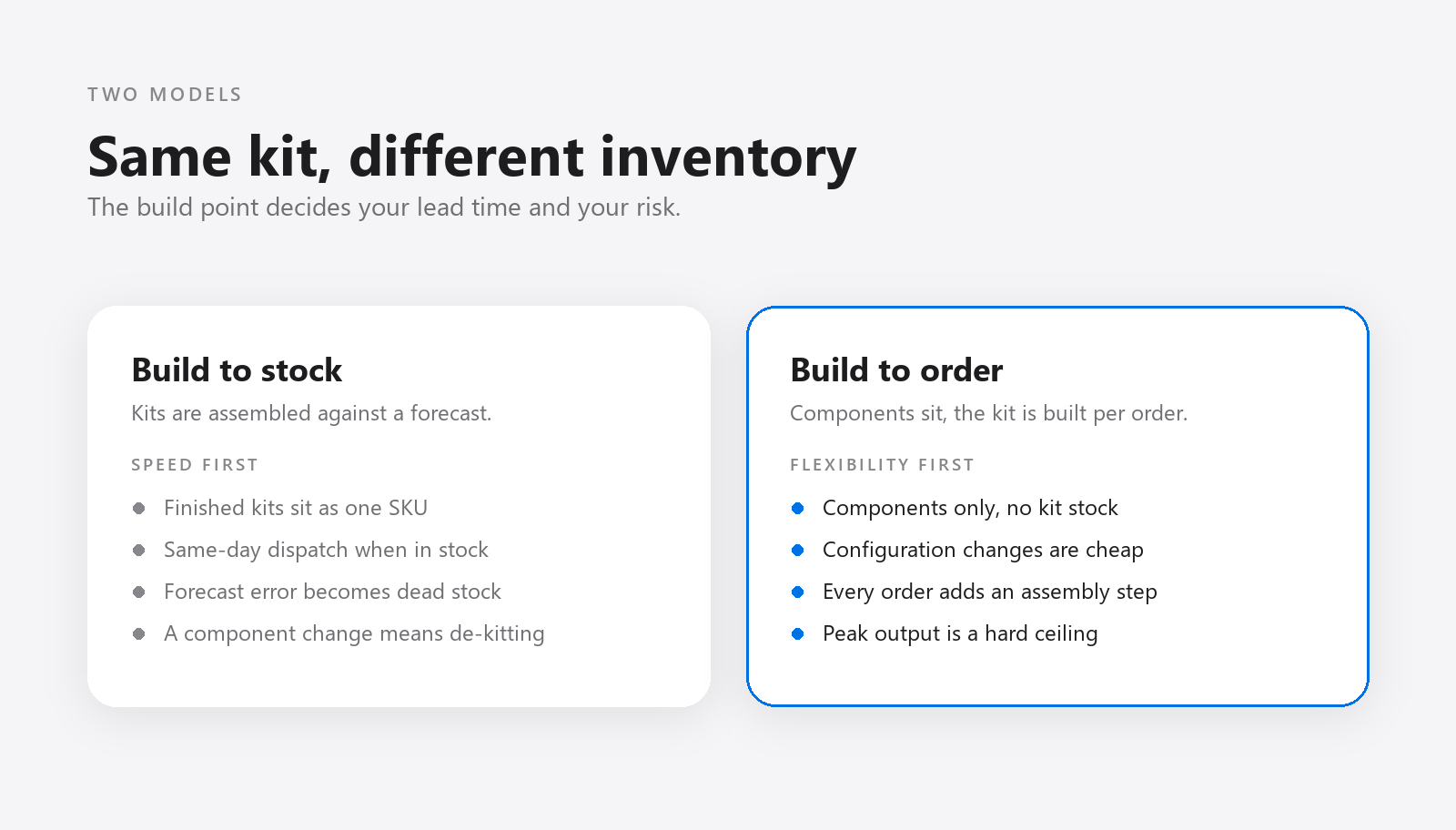
Build to stock. Kits are assembled against a forecast and stored as a single SKU. An order ships the moment it lands. The cost is forecast risk: a slow kit is finished inventory that has to be dismantled before it can be sold another way.
Build to order. Components sit in stock; the kit is assembled when the order arrives. Inventory is light and a configuration change is nearly free, but every order carries an extra operation, the cut-off moves earlier, and peak capacity becomes a hard limit.
Hybrid. Fast movers pre-built, long tail and personalised sets built on demand. Most brands that have run kits for a year end up here, at a ratio that moves with the category.
All three need the kit to exist in the warehouse system as something you can release work against. In a WMS, that means wave templates, work templates and location directives — the system decides which locations the picker is sent to and how the work splits. A warehouse that builds kits from a printed sheet and a supervisor's memory can look fine at 50 kits a day and fall apart at 500.
| Question | Build to stock | Build to order | Hybrid |
|---|---|---|---|
| Inventory held | Components plus finished kits | Components only | Both, in a set ratio |
| Ship speed | Same day, if the kit is in stock | Adds an assembly step | Fast movers same day |
| Cost per kit | Lowest at volume | Higher per unit, lower commitment | Between the two |
| Changing a component | De-kit the finished stock | Change the work order | Change the on-demand line only |
| Main risk | Forecast error | Peak capacity | Ratio drifts out of date |
The inventory question nobody asks
A four-component kit does not add one SKU. It adds five: four components, each needing its own safety stock, plus the finished kit.
That multiplication is where the money goes, and where the questions should go. Ask how components and finished kits are each charged — per pallet, per bin, per unit — and whether there is a minimum bin count. Ask how long a slow kit can sit before the warehouse asks you to move it. None of this appears in a headline rate, and all of it appears on the third invoice.
There is a second-order effect that catches brands mid-season. Component stockouts do not fail one order; they fail every order that contains the missing item. A kit with six components has six ways to go short, which is why substitution rules matter: if a component is out, may the warehouse swap it, and who signs off? Without a written answer, a short pick becomes a stopped line or a quiet substitution nobody mentioned.
Read the quote as four bills
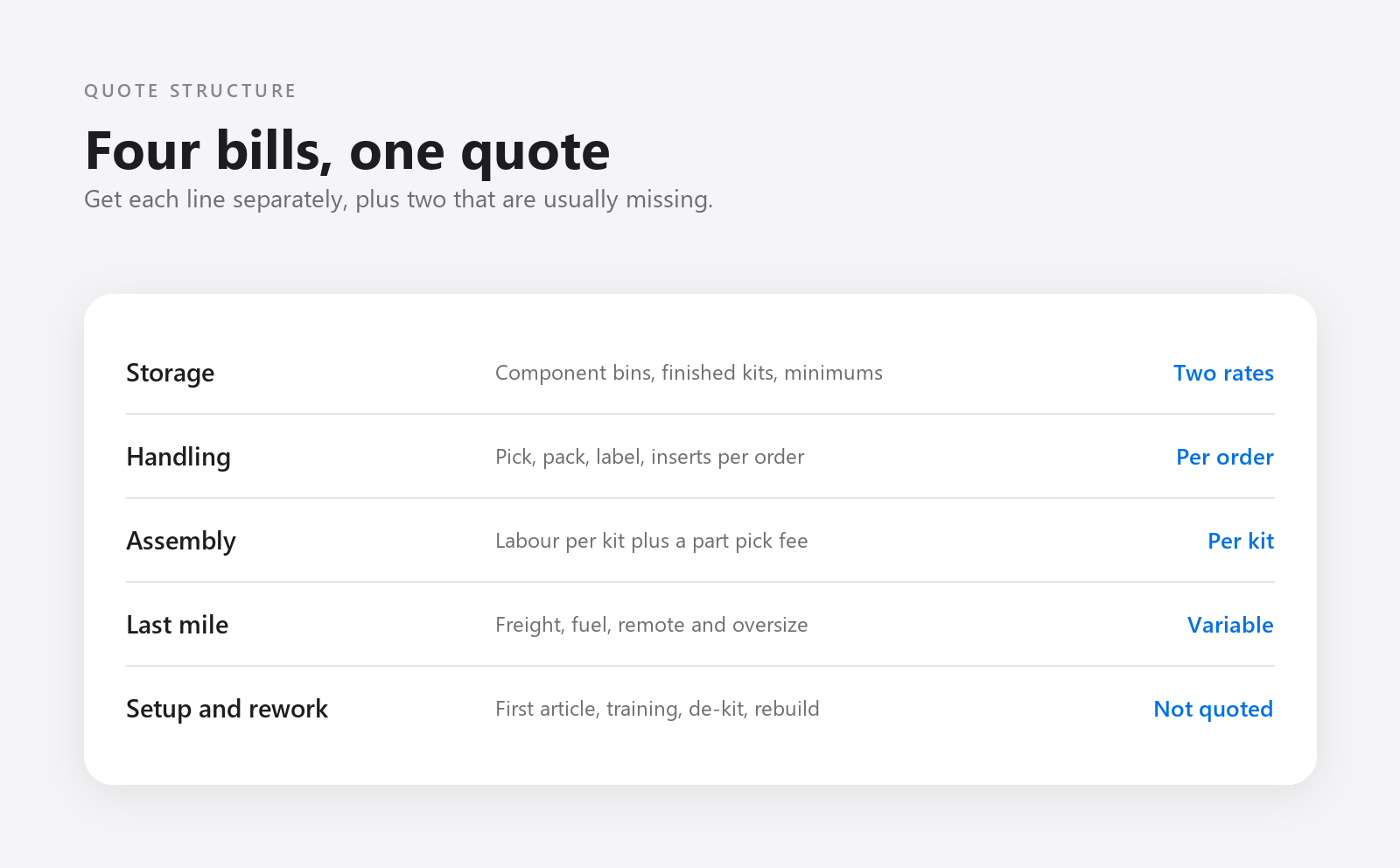
A kitting quote is four bills stacked: storage (often two rates, components and finished kits), handling (pick, pack, label per order), assembly (per kit, frequently plus a per-component pick fee), and last mile (freight plus surcharges).
Splitting them is the only way to compare two providers. The classic distortion is a low assembly rate with a high per-component fee; at four components the totals look alike, at eight the cheap quote is suddenly the expensive one. Last mile is billed on the greater of actual and volumetric weight, so a kit box that grows two centimetres can cross a band. Setup is the other hidden line — first article, station layout, training, commonly $50–$250 — and rework is the one nobody quotes until the first bad batch.
| Bill | What it covers | Where it usually hides |
|---|---|---|
| Storage | Component bins, pallets, finished kit space | Two rates quoted as one blended figure |
| Handling | Pick, pack, label, inserts per order | "Fulfillment fee" with no unit definition |
| Assembly | Labour per kit, plus component pick fee | Low kit rate, high per-component rate |
| Last mile | Carrier rate, fuel, remote and oversize surcharges | Surcharges excluded from the sample quote |
| Setup and rework | First article, training, de-kit, rebuild | Absent from the quote, billed later |
Five checks you can run in an afternoon
Visit, or ask for a video walk-through, and watch actions rather than listen to descriptions.
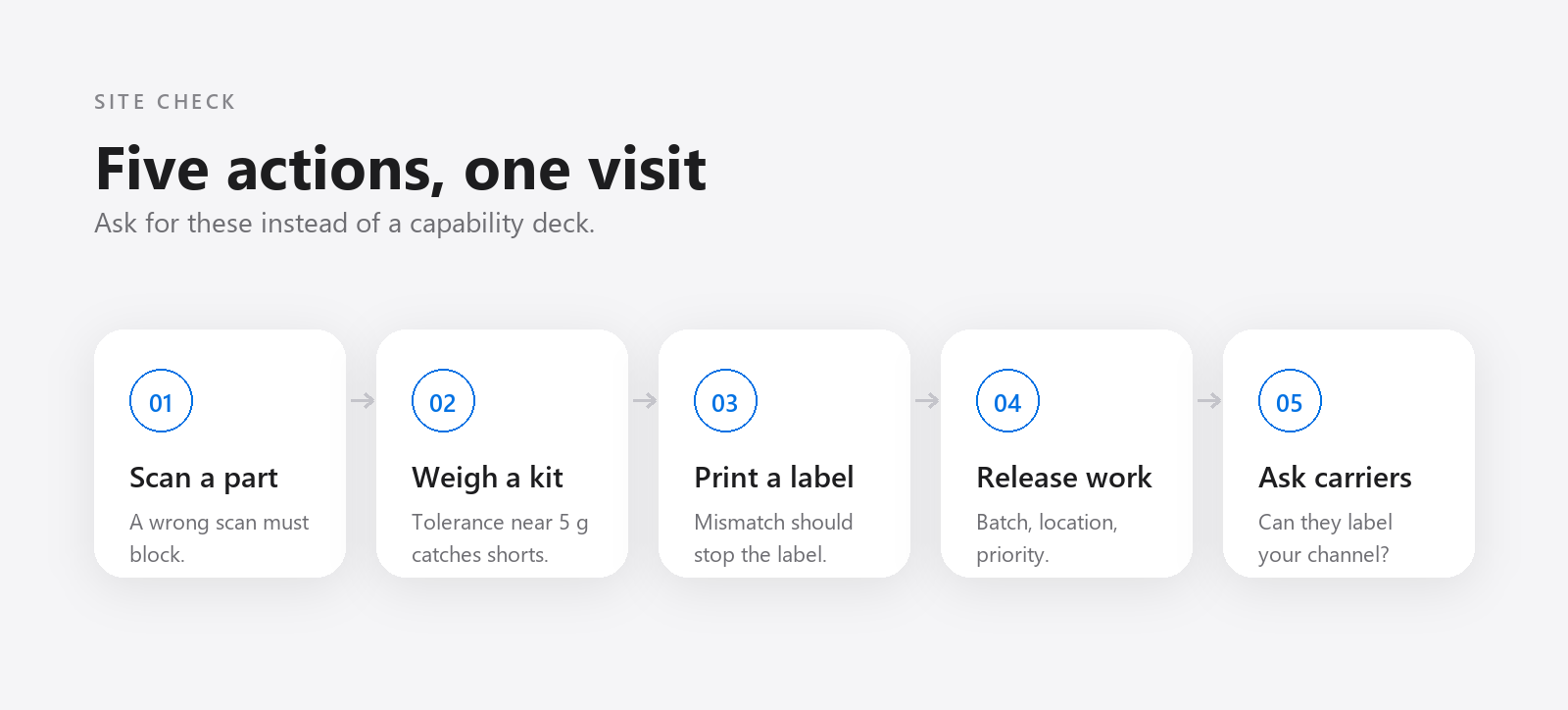
Scan a component. Hand the picker a PDA and a component. A wrong scan must block the next step, or the system is recording rather than preventing. Ask how the kit's own GTIN is held apart from the component codes.
Weigh a finished kit. Are kit and insert weights loaded into the system, and what is the tolerance? A serious operation sets it around five grams — enough to catch the missing sachet and the double-packed one with the same check.
Print a label against a wrong order. At dispatch, order barcode and label should be matched. If the label prints anyway, "A's goods with B's address" is a matter of time, not luck.
Release a work order. Ask them to split this week's build into work orders in the system: batch, location, priority. If the answer is a spreadsheet and a supervisor, scale will hurt.
Ask which carriers they can label. A warehouse that cannot produce the label your marketplace requires cannot ship the order, whatever the building size.
Ask for the error number, then the denominator
"99.7% accuracy" tells you nothing until you know what was counted.
One operator advertises pick error below 0.3%. A warehouse manager writing about the same problem sets a target of five per hundred thousand. Two orders of magnitude apart, and neither number is dishonest — pick errors, dispatch errors and customer complaints are three different metrics.
Ask three follow-ups: which error type is counted, over what period, sampled or full inspection. A provider who can answer precisely usually also knows which station is the weak one, which is more useful than the number itself.
What the contract has to say
Five clauses decide whether a bad month is recoverable.
Liability cap. What is paid for a wrong item, a short shipment, a damaged kit — per unit or per order value, capped at how many months of fees.
Shrinkage allowance. A clause absorbing inventory loss up to 2–4% of value is a line item you are paying for, whether or not it is invoiced. Push it under 1% or require actual-loss compensation.
Minimum volume. Whether a short month is billed as a shortfall or repriced at a higher unit rate.
Price review notice. Fuel, labour and peak surcharges: how many days' notice, and can a quarter be locked.
De-kitting. If a kit stops selling, what does it cost to break it back into components, and do those components return to sellable stock with their barcodes intact? Ask before you need it.
Peak is a schedule, not a capacity
Peak is not solved by hiring. It is solved by three numbers lining up: cut-off time, pre-build ratio, and first-scan timeliness.
Good operators publish all three. Cross-border warehouses commonly quote 48 hours to put away inbound stock, 24 hours from order to dispatch, same-day dispatch for orders placed before 10pm, 99% dispatch timeliness and 97%-plus first carrier scan.
Pre-build starts at 30–40% of the first week's forecast. A store shipping 100,000 orders in a day does not assemble them that morning; roughly 40,000 were built and staged the day before. Build too much and a slow seller turns into de-kitting work. Build too little and the first spike arrives as a backlog.
On labour, the pattern that holds is a fixed core on the accuracy-critical stations plus a flexible pool for packing, with temps booked a week ahead and a pressure test run before the event. Adding people on the day is the most expensive way to miss a cut-off.
When kitting shouldn't live at a 3PL
Bulky, fragile or equipment-heavy kits do not belong in an ecommerce warehouse optimised for small parcels. Assembly stations, cushioning and damage claims eat the storage saving.
Permanent high-volume fixed sets usually belong at the factory or a contract packer, where the unit cost is lower and nobody is paying ecommerce storage rates for finished goods. The value of a third-party warehouse is change, not stability.
The reverse is the real argument for outsourcing: it converts fixed cost into variable cost. Rent, equipment and base wages stop being yours, and if volume drops you can leave instead of holding a lease into next year. For kits that change every quarter and sell across several channels, that flexibility is usually worth more than the last few cents per unit.
The short version
Decide where inventory stops before you negotiate price. Read the quote as four bills, with setup and rework asked for separately. Verify with five actions instead of five adjectives. Ask what the error rate counts, not just what it is. Put liability, shrinkage, minimums, price notice and de-kitting in the contract. Then measure peak by cut-off, pre-build ratio and first scan.
Send us the SKU count, components per kit, monthly volume and sales channels — we will come back on which model fits before we talk about price. For the build side, see Kitting 038 Assembly; if your kits ship as single units today, the pick and pack service is the closer comparison.
References (Neutral Third-Party Sources)
Facts and concepts in this article were verified against standards bodies, U.S. federal regulations, carrier reference material and warehouse software documentation. No fulfillment provider pages are cited.
- DHL — Logistics of Things glossary: Kitting: the definition of kitting, and the distinction between logistics kitting and warehouse kitting. https://lot.dhl.com/glossary/kitting/
- CSCMP — Supply Chain Management Definitions and Glossary of Terms: where order fulfillment and third-party logistics sit in the industry's own vocabulary. https://cscmp.org/CSCMP/Educate/SCM_Definitions_and_Glossary_of_Terms.aspx
- Microsoft Learn — Warehouse management overview: how waves, work templates and location directives turn demand into directed warehouse work. https://learn.microsoft.com/en-us/dynamics365/supply-chain/warehousing/warehouse-management-overview
- GS1 — Predefined assortment: a fixed physical combination of trade items is a new trade item requiring its own GTIN. https://www.gs1.org/1/gtinrules/en/rule/271/predefined-assortment
- eCFR — 16 CFR Part 435, Mail, Internet, or Telephone Order Merchandise: the default 30-day shipment rule and the obligation to offer delay or refund. https://www.ecfr.gov/current/title-16/chapter-I/subchapter-D/part-435
- DHL — What is volumetric weight and how is it calculated?: why billable weight, not actual weight, drives parcel cost as kit boxes grow. https://www.dhl.com/discover/en-sg/ship-with-dhl/start-shipping/how-to-calculate-dhl-volumetric-weight