
Pick and Pack Logistics: A Step-by-Step Guide
Pick and pack is the stretch between a paid order and a carrier handoff: receive the order, pick the items, check them, pack them, label the box, and get it to the dock. It is not the same as storing inventory, and it is not the shipping itself — those sit on either side of it. The reason pick and pack gets its own name is that it's where most of a warehouse's labor cost lives, and where most of its errors get made.
This guide walks the six steps, explains the check step most small operations skip, breaks down what it costs, and gives you the real tipping point between doing it yourself and handing it off.
The six steps, in order
Pick and pack is a sequence, and skipping or reordering a step is how errors ship.
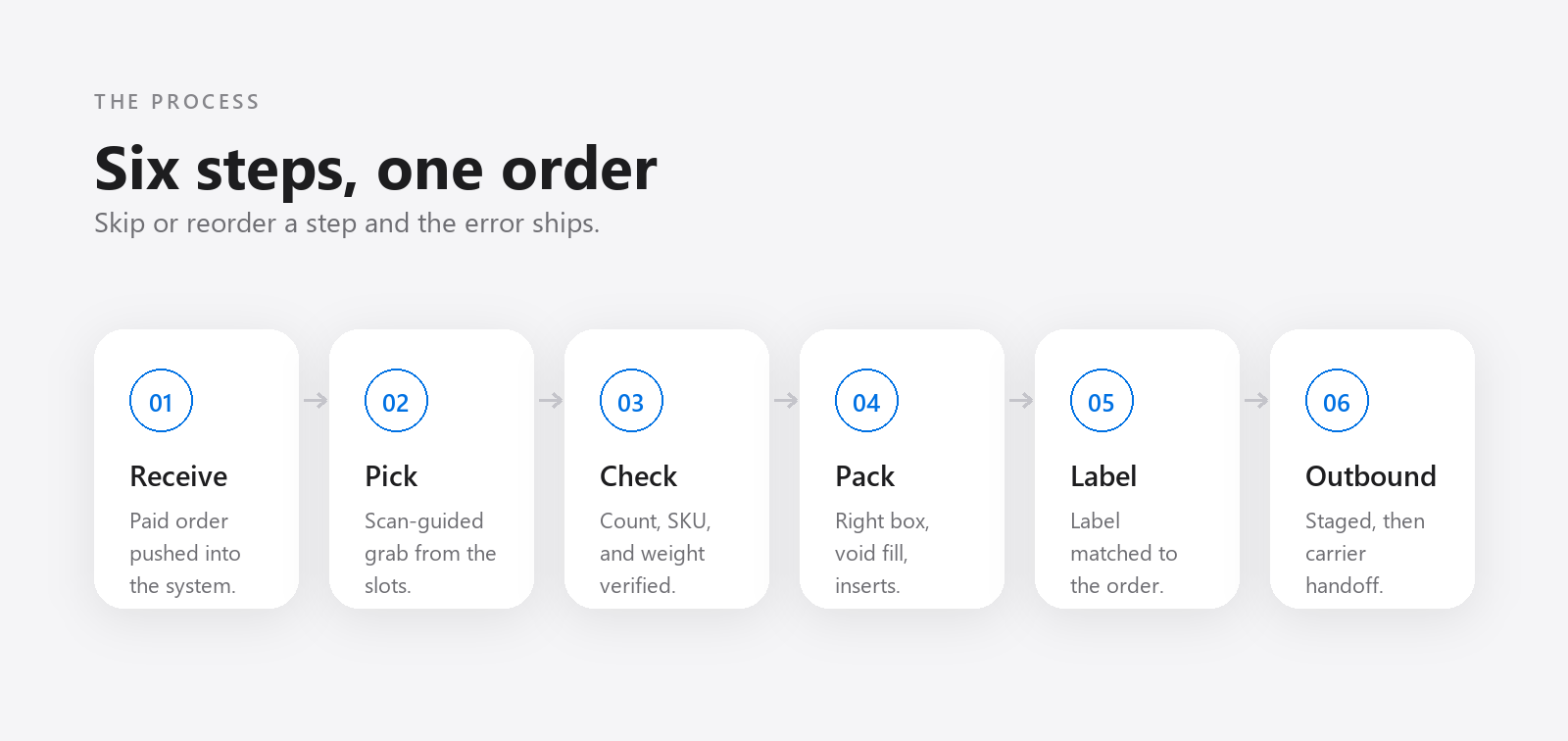
- Receive the order. The sales channel pushes a paid, validated order into the warehouse system. Nothing is printed yet; this is a data event.
- Pick. A picker collects the ordered SKUs from their slots, usually guided by a handheld scanner. Scanning the wrong SKU should stop the pick cold, because the barcode won't match the pick line.
- Check. The picked items are verified against the order — count, SKU, and often weight. This is the step most small operations skip, and it's the one that catches the wrong-item mistake before it becomes a return.
- Pack. Items go into the right-sized box or mailer with the right void fill. If a brand insert or packing slip is part of the spec, this is where it goes in.
- Label. The shipping label prints and is matched to the order one more time. A well-run dock requires the label barcode and the order barcode to agree before the label is allowed to print — otherwise "A's goods get B's address."
- Outbound. The parcel moves to staging, the area where packed, labeled boxes wait for the carrier's pickup, then hands off at the dock.
The check step small warehouses skip
Between pick and pack, good operations insert a verification gate that has nothing to do with eyeballing. They weigh the sealed box against an expected weight.
The way a Chinese warehouse guide describes it: every SKU, bundle, and free-gift combination has its weight pre-loaded in the system, and a finished parcel that's off by more than a few grams triggers an alarm. Five grams is enough to catch a missing insert or a wrong variant, because the system knows what the box should weigh down to the gram. A picker can read a barcode correctly a thousand times and still grab one unit too many; the scale doesn't care how careful anyone was.
This is the step that separates "fulfilled" from "we shipped you the wrong thing." If your operation has no check step, you are discovering errors through customer service instead of at the bench.
Four ways to pick, and when each wins
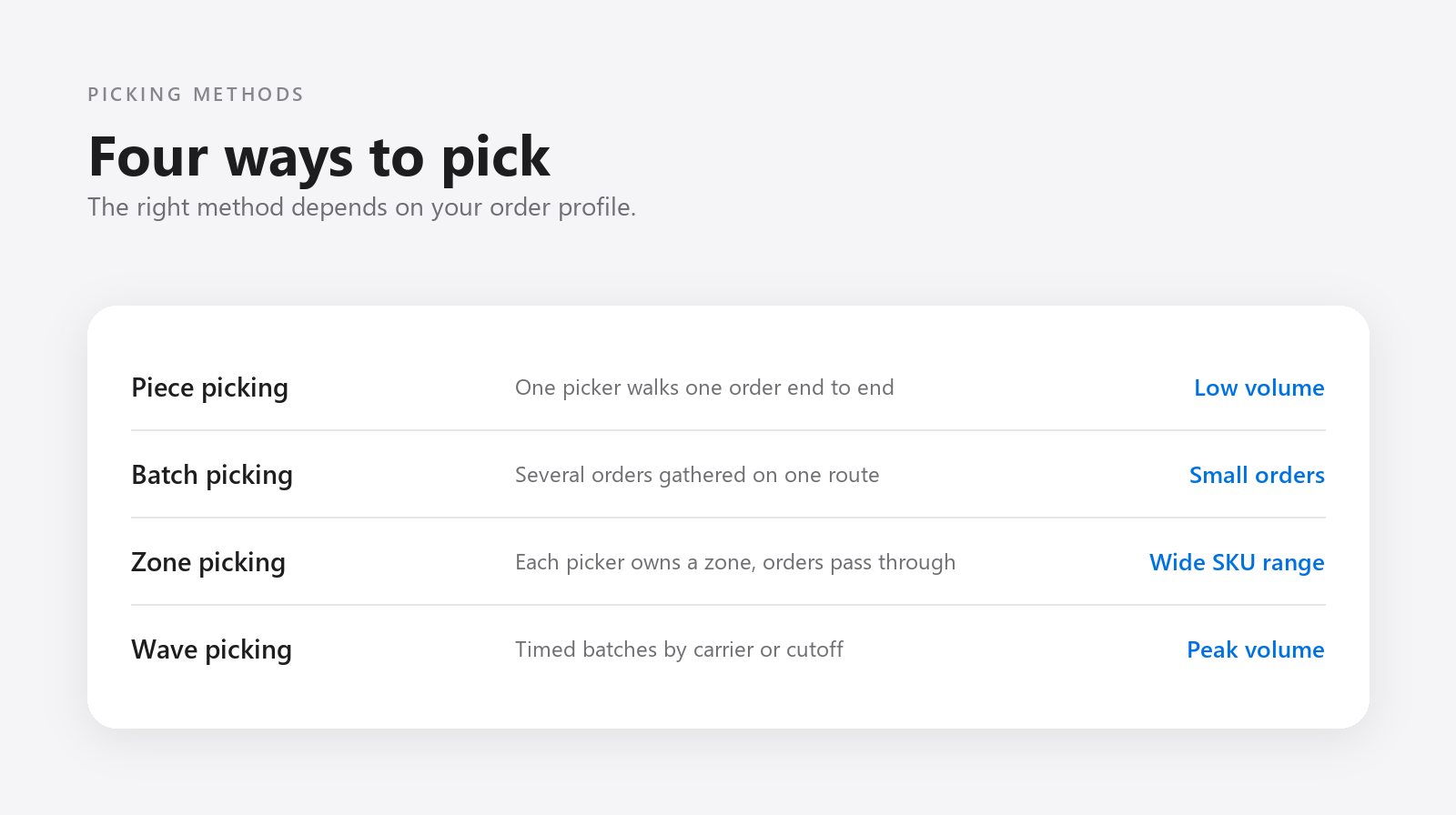
"Picking" hides four different methods, and the right one depends on your order profile. The distinctions come from the standard warehousing literature, not from any one vendor.
| Method | How it works | Best for |
|---|---|---|
| Piece picking | One picker walks one order end to end | Low SKU count, low volume |
| Batch picking | One picker gathers several orders on one route | Many small orders, similar SKUs |
| Zone picking | Each picker owns a zone, orders pass between them | Large footprint, wide SKU range |
| Wave picking | Batches released in timed groups by carrier or cutoff | Peak volume, carrier-aligned dispatch |
Piece picking is the intuitive default and the worst at scale. Batch and wave exist to cut travel distance, which is the real cost driver — a picker's time is mostly walking, so the method that shrinks walking wins. Zone picking trades travel for coordination: the order is assembled in pieces and must be consolidated before the check step, which is where mis-sorts show up.
What pick and pack actually costs
Pick and pack pricing looks like one number but is four buckets stacked, each with a different unit. If a quote gives you a single "X per order" figure, you can't compare it against anything.
| Fee line | What it covers | What moves it |
|---|---|---|
| Storage | Space your stock occupies | Pallet positions, shelf space, or cubic volume |
| Handling / operation | Receiving, put-away, pick, pack, label | Per item or per pallet, plus first-item vs extra-item |
| Last-mile shipping | The carrier leg to the customer | Weight band, zone, and surcharges |
| Value-added | Returns, relabeling, inspection, assembly | Per item, always itemized |
Three of those are negotiable; last mile is not, because it's the carrier's price plus a discount. The hidden cost driver inside "handling" is dimensional weight — or "计抛" in Chinese warehousing shorthand — where a light, bulky parcel is billed on its length-times-width-times-height divided by a divisor (often 8,000), not on its real weight. A 60×40×30 cm box bills as 9 kg of volume even if it weighs 6 kg. Bulky items get quietly expensive in the last mile, which is the largest single line on the invoice.
The tipping point: in-house vs outsourced
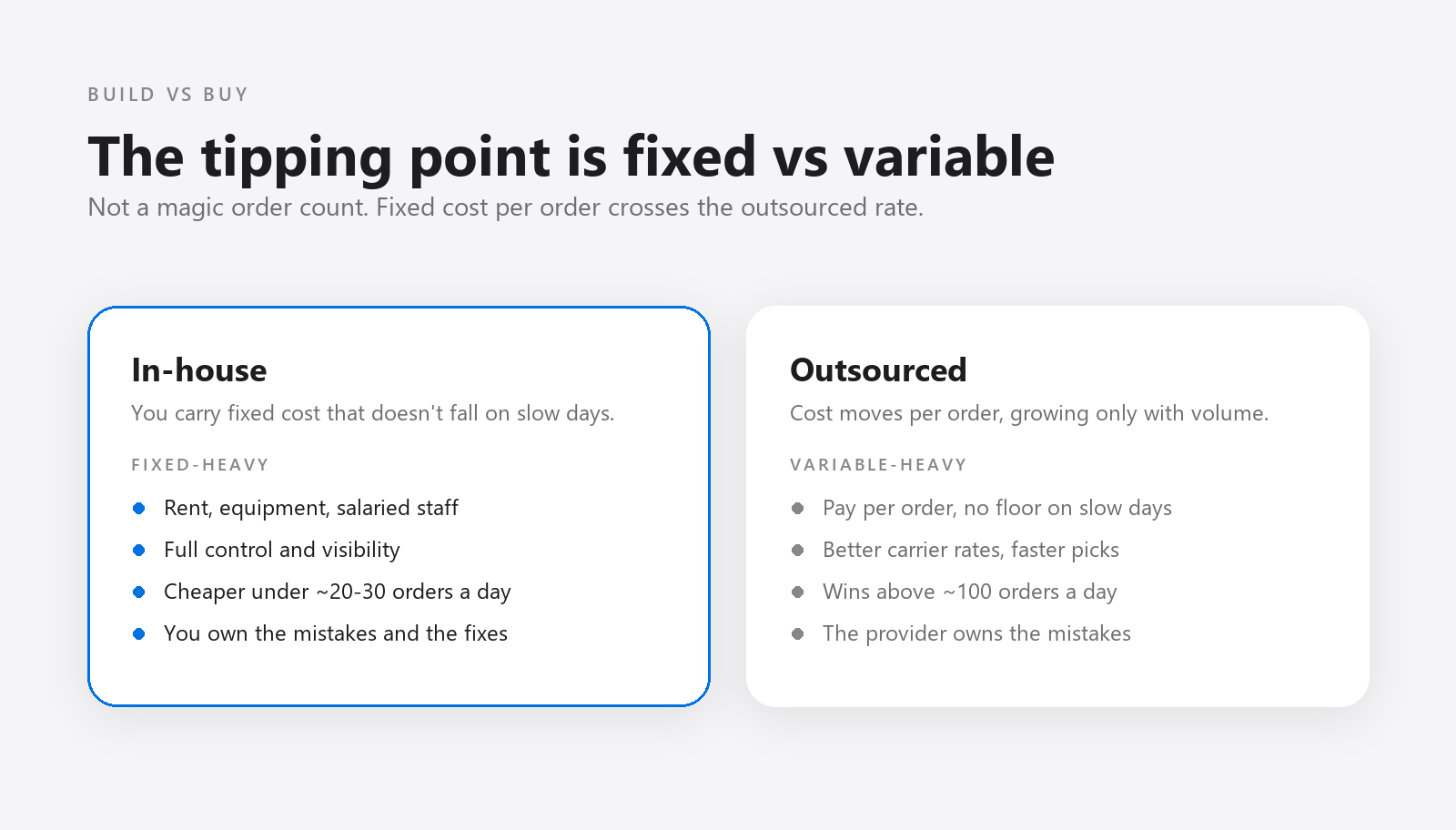
The honest answer to "when should I outsource pick and pack" is not a magic order count. It's a question of which cost is fixed and which is variable.
Doing it in-house means you carry fixed costs — rent, equipment, salaried staff — that don't fall when orders dip. Outsourcing fulfillment converts most of that into a per-order variable cost that only grows when orders do. The tipping point is where your fixed cost per order crosses the outsourced cost per order.
As a rough field guide from the trade literature: under roughly 20–30 orders a day with spare space, self-fulfillment is usually cheaper. Between 30 and 100 a day is the uncomfortable middle, where neither side clearly wins and the decision turns on your own time. Above 100 a day, a dedicated operation's faster picks and better carrier rates almost always outweigh the per-order fee. Those numbers are ranges, not laws — a business shipping 100 fragile, custom-packed items a day may never hit the crossover, while one shipping 300 identical mailers crosses it at 50.
Where the money leaks
Even a fair quote leaks money in the fine print. Ask these before signing, because each one is a line that shows up in the second month's invoice:
- Is packing material in the pick fee, or billed separately? Box, mailer, and void fill can swing a unit cost by cents to dollars.
- Is labeling included? Relabeling and barcode reprinting are often a separate per-item charge.
- Is broken-case splitting extra? If a case of mixed SKUs needs to be opened and split by hand, many warehouses add a fee.
- Is there a monthly minimum? Small sellers get hurt most here — you can negotiate a low unit rate and still pay a floor amount.
- What's the long-term storage trigger? Many operations add a fee once stock sits past 180 days, on purpose, to push you to clear dead inventory.
The single most useful question is the last one, because dead stock is the quietest cost in fulfillment: it keeps accruing storage fees until it eats the margin the order was supposed to make.
A pick-and-pack checklist
- [ ] Confirm every order passes a check step between pick and pack — count, SKU, and weight.
- [ ] Match the picking method to your order profile, and re-check it every time volume doubles.
- [ ] Split your quote into storage, handling, last mile, and value-added before comparing providers.
- [ ] Ask whether packing material, labeling, and broken-case splitting are inside or outside the handling fee.
- [ ] Confirm the dimensional-weight divisor and the monthly minimum in writing.
- [ ] Know your own fixed cost per order before you compare it against an outsourced rate.
The short version
Pick and pack is six steps, and the one that earns its keep is the check — the scale or scan that catches the wrong item while it's still fixable. The cost sits mostly in picking labor and last-mile dimensional weight, not in the box itself. And the build-vs-buy decision isn't a magic order count; it's your fixed cost per order crossing the outsourced rate. Get those three things right and the rest is just walking.
If you're deciding whether a provider makes sense at your volume, our pick and pack service overview explains what a managed service covers, and our fulfillment costs breakdown shows how the fixed and variable pieces fit together.
References (Neutral Third-Party Sources)
Facts and concepts in this article were verified against public references. No fulfillment-provider pages are cited.
- Wikipedia — Order processing: the pick, sort, pack, label, and consolidate sequence and the piece/zone/batch/wave picking strategies. https://en.wikipedia.org/wiki/Order_processing
- Wikipedia — Order picking: picking strategies and how travel distance drives pick productivity. https://en.wikipedia.org/wiki/Order_picking
- U.S. Bureau of Labor Statistics — Occupational Employment and Wage Statistics (OEWS) Tables: wage context for the picking and packing labor that dominates pick-and-pack cost. https://www.bls.gov/oes/current/oes_nat.htm